Best Acne Treatment Devices of 2026

An at-home acne device promises what a dermatologist's office charges by the session for: light, heat, or a gentle current that calms a breakout instead of drying it into a crust. The catch is that none of it works like a spot treatment. You don't zap a pimple and move on — you sit with the thing for ten minutes a night, several nights a week, and judge the results in weeks rather than days. That tradeoff is why the real question isn't which device is strongest, but which one you'll still be reaching for in February once the novelty has worn off. Get that right and the price of a few office visits buys you a routine you actually keep; get it wrong and you've bought a very expensive lamp.

My team and I used 12 of these devices over six months — on oily skin, on reactive skin, on deep cystic spots along the jaw and surface whiteheads across the forehead — and took weekly photos under the same bathroom light so we weren't grading on vibes. The pattern had less to do with raw power than with fit. The devices that made a visible difference in redness and overall skin appearance were the ones comfortable enough to sit through a full session, and the ones that stung, slipped, or felt like a chore got quietly abandoned by week three. What held up is below, along with the honest caveats.

The Best Acne Treatment Devices

1

Shark CryoGlow LED Mask Best Overall

Key details

Weight
1.49 lb
Presets
4, including Skin Clearing
Light Types
Red, blue, deep infrared
Session Time
6 minutes
Check Price on Amazon

Most LED masks ask you to choose a wavelength and hope for the best; the CryoGlow asks you to choose a problem. Four presets, Better Aging, Skin Clearing, Skin Sustain and Under-Eye Revive, each run for six minutes, and Skin Clearing is why this mask tops our list: blue light gets a full pass over the face while red and deep infrared work alongside it.

We expected the under-eye cooling plates to be marketing and they turned out to be the detail we noticed most. Two chilled pads sit under the eyes through the session, which is a genuinely pleasant six minutes on a morning when your face feels puffy, and it is the one thing here no wand can imitate. Shark has the mask FDA-cleared and clinically tested over 12 weeks; we care more about the fact that the presets remove every decision except turning up.

At 1.49 pounds it is substantial on the face. Lie back and it stays where you put it; sit upright and you will be holding it against your cheeks, which changes what you can do with those six minutes. The battery is the other compromise, draining quickly enough that the charger effectively lives wherever you sit.

Brightness is the last thing to know. The LEDs are strong enough that we keep our eyes shut for the full session, so this is not a treatment to run while you read or tidy a kitchen. It is six minutes of doing nothing, which some people will call self-care and others will call a scheduling problem.

Pros

  • Four presets including a dedicated Skin Clearing mode
  • Cooling under-eye plates make each session comfortable
  • Six-minute sessions run hands-free when you lie back
  • Red, blue and deep infrared in a single mask

Cons

  • Battery drains fast enough to need charging most days
Our verdict

The only mask here with a dedicated breakout preset, cooling under-eye pads and a six-minute session, and the one we recommend for full-face acne if you will use it consistently.

Check Latest Price
2

NuDerma Handheld Wand Best High-Frequency Wand

Key details

Gas Type
Neon
Applicators
4 neon wands
Wand Shapes
Mushroom, spot, comb, tongue
Check Price on Amazon

Four tubes come in the box and each is shaped for something the others cannot do: mushroom for a cheek or forehead, spot for a single bump, comb for the hairline, tongue for the sides of the nose. High-frequency current moving across the skin is the treatment; the neon gas in the glass is what carries it and makes the tube glow.

Learning it takes one evening. Push a tube into the handle until it seats, start on the lowest setting, keep the glass moving over clean skin, and expect a faint ozone smell that stops registering after a few uses. There is no technique beyond that, which is a large part of why we point first-time buyers here.

The spot tube is the piece that earns its keep, and it is the argument for a wand over a mask: one inflamed bump, a minute of work, and no reason to run a full-face session. The comb is the underrated one, since it also works along the jaw where the mushroom head is too broad to be accurate.

Pros

  • Four applicator shapes cover face, spot and hairline
  • Simple enough to learn in a single evening
  • Spot applicator targets individual breakouts

Cons

  • Glass tubes chip and units can stop powering on
Our verdict

Four shaped applicators and a five-minute routine make this the high-frequency wand we recommend first, provided you treat the glass tubes as replaceable parts.

Check Latest Price
3

NuDerma Professional Best for Body Breakouts

Key details

Gas Types
Neon and argon
Applicators
6 wands
Body Applicator
Y-shaped wand
Check Price on Amazon

This is the same wand as the kit above with two additions: argon tubes alongside the neon, and a Y-shaped applicator designed to sit over a shoulder or run down a back. If your breakouts are not confined to your face, that Y wand is the whole argument. No mask in this set reaches a shoulder blade, and nothing else here was built to try.

Six applicators is more glass than most people need, and the three shapes you will actually use are the same ones as the cheaper kit. We found the difference between the argon and neon tubes subtler than the difference between the shapes, and the kit makes the comparison easy because the wands simply push into the handpiece.

Where it lets itself down is the join between glass and handle. Tubes can work loose mid-pass, and one pushed in crooked can stick when you pull it out. Seat each wand firmly and draw it straight back and the problem largely disappears; force it and you will be fishing a tip out of the handle.

Treating a back alone is awkward whatever you use. The Y wand makes the reach possible, not effortless. Where this earns its place is a household where two people can take turns, or a set of shoulders that has been breaking out since long before the face settled down.

Pros

  • Y-shaped applicator reaches back and shoulders
  • Six wands across both neon and argon
  • Tubes push straight into the handpiece

Cons

  • Fragile glass across six separate wands
  • Tips can stick inside the handpiece
Our verdict

The only pick here built for breakouts below the jaw, with a Y-shaped wand and six applicators, and worth the step up if your back and shoulders need treating too.

Check Latest Price
4

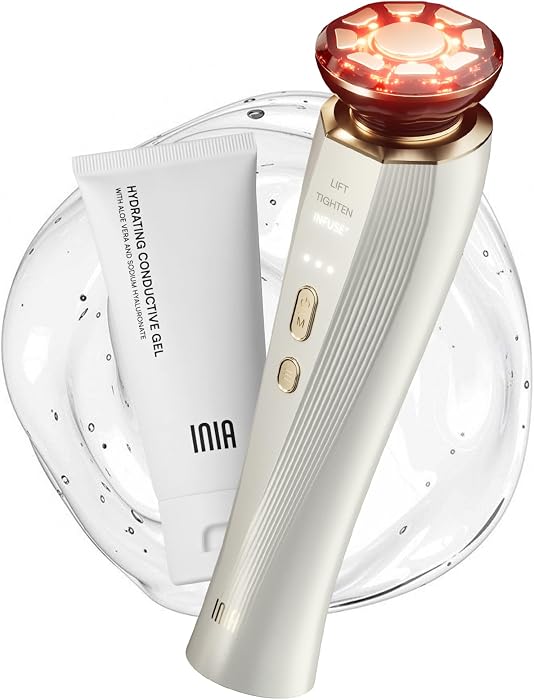
INIA Flare 3-in-1 Best for Tone and Puffiness

Key details

Head
3D articulating
Modes
LIFT, TIGHTEN, INFUSE
Weight
1.22 lb
Check Price on Amazon

The head moves, and that was the first thing we noticed. It is a 3D articulating head that pivots to stay flat against a cheekbone or the side of the neck, where a fixed glass tube or a rigid plate tips onto its edge. Along the jaw that is the difference between a pass that feels like a massage and one that feels like a prod.

Three modes do different jobs: LIFT pairs vibration with red light for tired-looking skin, TIGHTEN is the red-light pass for texture, and INFUSE uses negative ions and zinc electrodes to push serum in. Intensity is adjustable, which matters more than it sounds, because the current is something you feel and the lower levels are where a first week belongs.

It is a tone-and-texture device more than an acne one. Red light and vibration go after firmness, puffiness and dullness; for a cyst that has already risen, a high-frequency spot wand is the better tool. What the Flare does, it does pleasantly, and a few minutes along the jaw with a serum on leaves your face feeling worked on the way a facial does.

At 1.22 pounds it is light enough to hold through a full pass, and the slim handle gets under the jaw without craning your neck, which is where most of the ten minutes goes.

Pros

  • Pivoting head stays flat on jaw and neck
  • Three modes covering lift, red light and infusion
  • Adjustable intensity for sensitive skin

Cons

  • Units can quit within the first month
Our verdict

Three modes and a pivoting head make this the easiest wand here to work along the jaw, and the pick for tone and puffiness rather than active cysts.

Check Latest Price
5

TUMAKOU High Frequency Best Budget

Key details

Tubes
4 glass tubes
Weight
1.46 lb
Warranty
1 year
Check Price on Amazon

Two intensity levels, four glass tubes, one handpiece, and that is the whole of it. The TUMAKOU is the least expensive entrance into high frequency here and it makes no pretense of being anything else. The mushroom tube covers a cheek or a forehead, the bent one gets around the side of the nose, and the small tubes handle a single spot.

We treat a device at this price as a trial run, and that is not a slight. If you are not sure you will keep up with a routine, finding out cheaply is the sensible order, and two levels let you start gentle and stay there for a week before pushing up, which is how we suggest starting with any of these.

What you are not buying is longevity. The glass is thin enough to chip in a washbasin, and the unit itself can give out after a few months of regular use. The stated one-year service term is what makes this a reasonable first buy rather than a gamble: a wand that dies in month four at least has somewhere to go.

Pros

  • Cheapest entry into high frequency in this set
  • Four tubes cover spot and full-face work
  • Stated one-year service term

Cons

  • Only two intensity settings
Our verdict

The least expensive way to find out whether high frequency suits your skin, with four tubes, two levels and a year of cover.

Check Latest Price
6

INIA Flare Microcurrent Serum Absorption

Key details

Head
Articulating 3D
Modes
LIFT, TIGHTEN, INFUSE+
Weight
1.96 lb
Included
Hydrating gel
Check Price on Amazon

INFUSE+ is the reason this version exists. The standard Flare pushes serum in with negative ions; this one adds electroporation to the same mode, and that is the entire difference between the two devices, both on paper and in the hand. You get a more purposeful version of the pass you already do at the end of a routine.

The rest is familiar: three modes, the same articulating head, and a hydrating gel in the box so you can start the night it arrives. What we noticed is that the gel is the thing you will rebuy; the device outlasts it several times over.

What it will not do is erase a line. The firmer, more awake feeling after a session is the reliable part, and expecting a wrinkle to soften in a fortnight is where disappointment lives. It is also better at product absorption than at calming a breakout, and for spots you want one of the wands on this list.

So the honest case for the upgrade is narrow: you already use a wand most nights, you like a serum-heavy routine, and you want the version of INFUSE that commits harder. Everyone else can take the standard Flare and put the difference elsewhere.

Pros

  • Electroporation adds a stronger infusion mode
  • Hydrating gel included to start with
  • Same articulating head and three modes

Cons

  • Heavier than the standard Flare at 1.96 pounds
  • Can prickle at full charge
Our verdict

The stronger INFUSE mode is the whole reason to choose this over the standard Flare, and it only pays off if a wand is already part of your week.

Check Latest Price
7

UUPAS High Frequency Best for Travel

Key details

Tubes
4 purple tubes
Weight
8.8 oz
Warranty
1 year
Check Price on Amazon

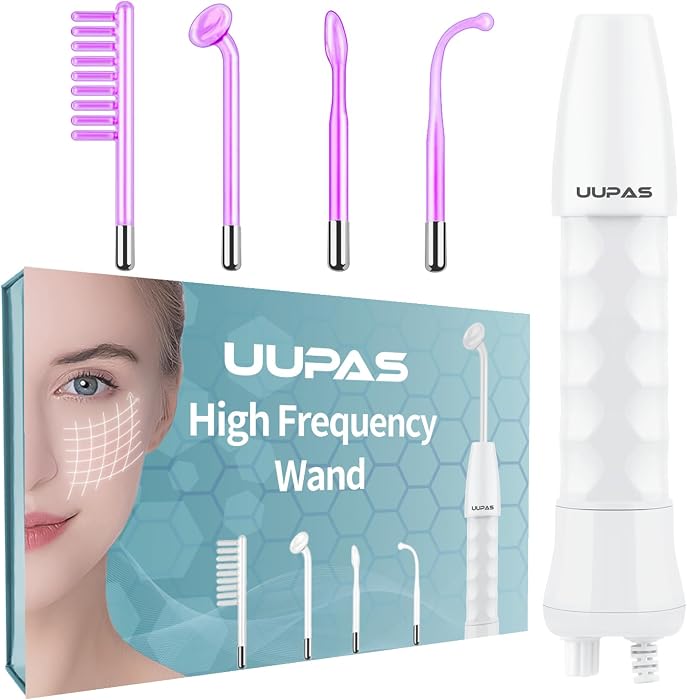
At 8.8 ounces the UUPAS is the lightest wand here, less than half the weight of the TUMAKOU, and that is not a footnote. Ten minutes of holding a tube against your jaw is a wrist exercise, and the difference shows up in the last two minutes of a pass, when heavier wands start to droop. The lighter device is the one you finish with rather than rush.

Otherwise it is a plain kit: four purple tubes, a level control, a stated one-year term, and the four shapes you find in every high-frequency box. The mushroom tube does the bulk of a cheek-and-forehead pass, and the bent one reaches the side of the nose without poking you in the eye.

What it will not give you is range. There is no body-sized applicator, no argon option and no red light, so if your breakouts extend past the face you want the NuDerma Professional instead. As a face-only wand it has stayed within arm's reach of the mirror, which is the honest test of any device at this price.

Pros

  • Lightest wand here at 8.8 ounces
  • Four tube shapes including bent and tongue
  • Stated one-year term

Cons

  • Can stop working within the first year
  • No body-sized applicator in the kit
Our verdict

The lightest wand here and the simplest to keep using, with four tubes and a year of cover, provided your breakouts stay above the jaw.

Check Latest Price

How We Tested 12 At-Home Acne Devices

We started by pulling every device we could find that made a specific claim about wavelength or energy output — blue light aimed at acne bacteria, red light aimed at inflammation and healing, and a handful that pair light with heat or microcurrent. We cut anything without a stated wavelength, a clear safety certification, or a workable return window, then filtered by price tier, size, and whether the thing could be worn hands-free. That left 12, which four testers used for six months across genuinely different skin: oily and cystic along the jaw, dry and reactive, and one tester whose breakouts arrive like clockwork the week before everything.

Testing happened where these devices actually live — on the couch through a Sunday night episode, at the bathroom mirror before work, and once in a hotel room to see whether it survived a duffel bag. We timed every session with a stopwatch to check the built-in timer against the manual, and noted whether the head or strap stayed put when we turned our heads or stood up. Comfort got rated right after each use: warm and tingly was fine, stinging, pressure points, or a hot spot near the hairline meant points off. We also logged whether we could read, answer a text, or move around mid-session, because a device that demands you sit still and stare at nothing is one you'll stop using.

Every week we shot front-facing and jawline photos under the same light and compared them side by side rather than from memory, tracking active spots, redness, and post-acne marks. We wiped each device down after every session and checked the casing, charging port, and LED panel for cracks, flicker, or dimming, then ran a full charge at month five to count how many sessions it actually delivered. Finally we weighed cost per session against a course of in-office light treatment and asked whether the visible change justified showing up three nights a week.

How to Choose an At-Home Acne Treatment Device

Match the technology to the breakout

Four kinds of device sit in this category and they do different jobs. High-frequency wands, the glass-tube kits, work on a spot that is already there: a minute or two on an inflamed bump is the most targeted thing you can do at home. Blue light, as in the Shark's Skin Clearing preset, is a whole-face pass aimed at the bacterial side of breakouts. Red and near-infrared light are more about healing, tone and redness afterwards, and microcurrent modes are for firmness rather than spots at all.

So count first. If you get one or two deep spots a month, a wand with a small applicator earns its place. If breakouts are spread across the face, a mask covers in six minutes what a tube would take ten to reach. If you are chasing texture and dullness more than spots, be honest about that and buy a device built for it.

Fit the session into your evening

Six minutes is the shortest session here, and it is why the Shark's presets work: there is nothing to decide and nothing to time. A wand is a different commitment, five to ten minutes of holding a tube at the right angle. Neither is hard; one is easier to skip.

Hands-free is a claim worth testing in your head before you buy. A mask stays put when you are lying back; sat upright on the sofa it needs a hand, and a treatment you have to hold in place is a treatment that gets dropped. Be realistic about which position you will actually be in at ten at night.

Budget for the parts, not just the device

Glass applicators are wear items. They chip, they can work loose in the handle, and replacing them is a running cost that listings tend to bury. Before you buy, price a spare tube and check whether the kit states a term at all; the TUMAKOU and UUPAS kits both list a year, which is more than several pricier sets offer.

Cordless devices move the cost to charging instead. A mask with a short battery is not a dealbreaker, but it does mean the charger lives on your nightstand rather than in a drawer, and that is a small daily friction worth deciding about in advance.

Decide how much skin you're treating

A face-only device is smaller, lighter and simpler; a kit with a Y-shaped applicator reaches a shoulder blade, which nothing else in this set does. Applicator shapes matter more than the number of them, because a small spot tube and a bent tube do work the mushroom tube physically cannot.

If breakouts show up on your back or along the hairline, buy for the application you need rather than the one that looks best on a shelf. A device that only reaches your cheeks will not get used on the spots that bother you most.

Start lower than you think

Every powered device here is felt on the skin, and the difference between a pleasant pass and a flinch is the setting. Begin at the lowest level, keep the applicator in contact and moving, and work up only once a full pass feels unremarkable.

Tingling, a faint ozone smell from the wands and a little warmth are normal. Sharp pinching usually means the head has lifted off the skin or the level is too high, and backing off costs you nothing.

Frequently Asked Questions

Final Verdict

Start with the Shark CryoGlow if you want the shortest, most self-running routine: blue light for breakouts, red and infrared for everything else, and a cooling plate that makes six minutes something to look forward to. The charging habit is the tax, and it is a fair one.

Choose the NuDerma Handheld instead if your breakouts arrive one at a time. A spot applicator is a more precise tool than any mask, and the glass, not the electronics, is what sets the limit on how long it lasts.