Best Clay Face Masks of 2026

A clay mask runs on a simple principle: as the paste dries, it lifts oil and whatever else is sitting in your pores up toward the surface. That same mechanism is why a bad one leaves your face tight and pink for a day afterward — what separates a mask that clarifies from one that strips you is the clay blend, what's added to cushion the finish, and how fast the whole thing sets. I've kept clay masks in my routine for years, and over the past four months my team and I have worked through 14 of them to see which ones actually deliver.

Formula percentages only go so far. Texture decides the experience, because a gritty paste that sets like plaster is hard to spread evenly, and the thin patches pull tighter than the rest. My colleagues with reactive skin cared more about what the clay was cut with than which clay it was, I started counting how many uses I got per jar after two similar-looking pots turned out weeks apart, and I noted which tinted formulas left a shadow on my washcloth that took a second rinse. The picks below cover everything from a ten-minute weekday reset to a proper Sunday treatment.

The Best Clay Face Masks

1

Aztec Secret Indian Healing Clay Best Overall

Key details

Clay
100% calcium bentonite
Size
2 lb (32 oz)
Format
Powder mixed with liquid
Wear Time
5 to 10 minutes for sensitive skin
Check Price on Amazon

A two-pound tub of dusty clay is the least convenient thing in this guide, and it is still the one we reach for first. Nothing else here produces the same deep clean, and nothing else comes close on cost per mask: one scoop mixed with liquid covers a face and neck, and the tub keeps going for months.

The ingredient list is one line: 100% calcium bentonite clay. Mixed to a thick paste it spreads like wet plaster, tightens hard as it sets, and rinses off with a grit that feels like it is doing something. We use it when our pores are visibly congested. The morning after, the nose and chin look less blocked and the skin feels smoother, if a little tight.

Mixing is the ritual. Powder goes into a small bowl, liquid goes in a spoonful at a time until it is the texture of thick yogurt, and then it goes on with fingers or a brush. Apple cider vinegar is the traditional liquid and water works too. The label is unusually direct, asking for a forearm patch test and stating external use only, and we would take it at its word.

One practical thing the tub does not tell you: it is bigger than most bathroom shelves want. We decant a few weeks' worth into a small jar and keep the rest in a cupboard.

Pros

  • Deep pore clean at a very low cost per mask
  • Single ingredient, nothing added to react to
  • Two-pound tub lasts months

Cons

  • Mixing and rinsing are messier than a tube
  • Redness and tightness if left past 5 to 10 minutes
Our verdict

The most effective deep-pore clean we tested, and by far the best value per mask — worth it if you will mix a scoop of powder before you use it.

Check Latest Price
2

New York Biology Dead Sea Mud Mask Best Ready-To-Use

Key details

Size
8.8 oz jar
Format
Ready-to-use mud
Key Ingredients
Dead Sea mud, aloe vera, calendula oil, vitamin E, jojoba oil
Check Price on Amazon

If the Aztec tub sounds like homework, this is the jar to keep on the shelf. It is a thick, silky Dead Sea mud that goes on straight from the jar with a finger or a brush and rinses clean without a bowl in sight.

We like it as the everyday mask of the two. The mud is cut with aloe, calendula, jojoba and vitamin E, and it spreads like a gel rather than a paste, so a thin layer covers evenly in about a minute. The drying, drawn-tight feeling never arrives, and skin is soft and comfortable afterward. There is a light scent that is pleasant enough to notice and not strong enough to mind.

What you give up is intensity. This is mud, not a bentonite paste, and it cleanses rather than pulls. For anyone whose skin flushes, stings or tightens at the first sign of clay, that is the right trade.

It is sold for face and body, which we have made use of on the back and shoulders, a spot a face-sized routine rarely reaches and where breakouts like to settle in.

Pros

  • Ready to use, no bowl or mixing
  • Gentle enough for sensitive skin
  • Doubles as a body mud

Cons

  • Dip-in jar rather than a squeeze tube
Our verdict

Our pick for anyone who wants a clay mask without a mixing bowl — a silky mud that cleanses gently and leaves skin comfortable rather than tight.

Check Latest Price
3

Queen Helene Mint Julep Masque Best Budget

Key details

Size
8 oz tube
Scent
Mint
Format
Rinse-off clay masque
Targets
Oil and clogged pores
Check Price on Amazon

The tube costs less than anything else in this guide and has sat on drugstore shelves long enough to have a following, so we came to it expecting a novelty and found a workhorse. The paste is thick and unmistakably green, and the mint smell fills the bathroom the moment the cap comes off.

On the T-zone it dries in a few minutes, cooling and tingling the whole time, then rinses off easily with warm water. An oily forehead looks matte afterward and the pores around the nose look smaller and cleaner. Two or three uses a week is plenty; there is nothing gradual about it.

For oily and acne-prone skin we think it is the best value in this guide, full stop. The mint makes the few minutes feel like a treatment rather than a chore, and the clay does the actual work. Reactive skin should keep it to the T-zone and rinse sooner rather than later.

It is also the mask most likely to survive a shared bathroom: the tube wipes clean, and nobody's fingers go into a jar.

Pros

  • Cuts oil and tightens the look of pores
  • The lowest-priced mask in this group
  • Squeeze tube is quick and clean to use

Cons

  • Strong mint scent will not suit everyone
Our verdict

The cheapest mask here and still one of the most effective on oily skin — reach for it when your T-zone is the problem and the budget is small.

Check Latest Price
4

Beauty of Joseon Red Bean Pore Mask Best for Dry Skin

Key details

Size
8.47 oz jar
Format
Wash-off cream clay
Texture
Soft, non-drying clay
Key Ingredients
Red bean extract, kaolin clay
Check Price on Amazon

Most clay masks announce themselves by tightening, and this one barely does, which is precisely why we keep reaching for it when our skin is already dry. The texture is closer to a thick moisturizer than a mud, and it rinses off leaving skin soft rather than stripped.

Red bean extract and kaolin do the work, and the 8.47-ounce jar is generous enough to use without rationing. It spreads smoothly, does not crack or flake as it sets, and the scent is mild and slightly sweet. Skin looks brighter and feels smoother after, and the exfoliation is gentle enough for twice a week.

It takes a few rinses to come off completely, so we keep a damp washcloth nearby and wipe most of it away before the final splash. That is a fair trade for a mask that never leaves the cheeks feeling papery.

It is the one we would hand to someone using clay for the first time, and the one most likely to get used on a whim rather than saved for a Sunday.

Pros

  • Leaves skin soft rather than tight and dry
  • Generous 8.47 oz jar
  • Gentle enough for twice-weekly use

Cons

  • Stubborn blackheads need a stronger mask
Our verdict

Our pick if clay masks usually leave your face parched — a soft, creamy formula that clears pores gently and leaves skin comfortable.

Check Latest Price
5

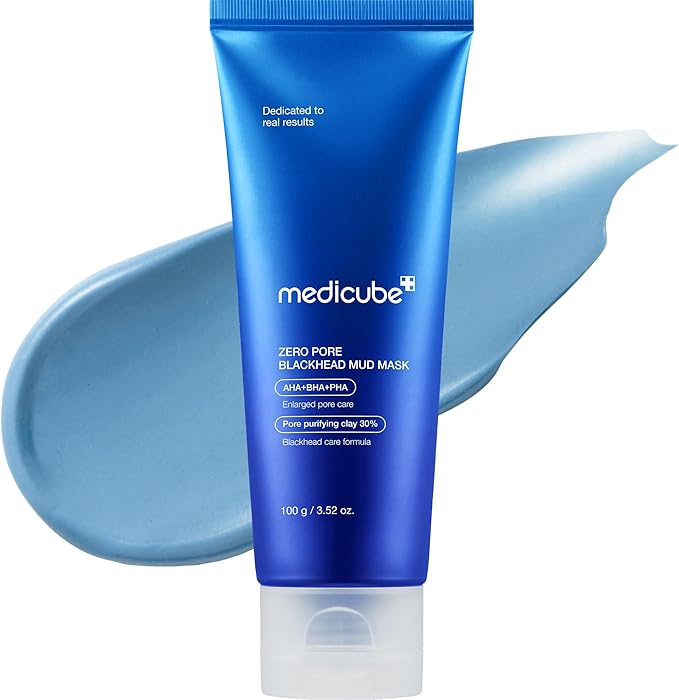
medicube Zero Pore Blackhead Mud Mask Best for Blackheads

Key details

Size
3.95 oz tube
Format
Quick-dry mud
Actives
AHA, BHA, PHA with bentonite and kaolin
Wear Time
3 minutes
Check Price on Amazon

Three minutes is shorter than most people spend brushing their teeth, and that is the entire argument for this one: a mud mask that sets almost as soon as it is on.

We put it up against the slower masks on a weekday morning and it is the one that actually gets used. Bentonite, Canadian colloidal clay and kaolin absorb the oil while AHA, BHA and PHA loosen what is blocking the pore, and the nose in particular looks cleaner afterward. Skin feels smooth rather than scraped.

The bright blue paste is the one thing to plan around, and it is not the mask for dry cheeks, so we keep it to the center of the face.

On an oily T-zone that narrow focus is the point. It is the fastest route to a cleaner-looking nose in this guide, and the one we would restock first for summer.

Pros

  • Ready in three minutes
  • Pores and blackheads look cleaner afterward
  • Skin feels smooth rather than tight

Cons

  • Blue color can stain pale towels
  • Sets firm and needs a washcloth to remove
Our verdict

The one for blackheads and busy mornings — three minutes, a quick rinse, and pores that look cleaner than they did.

Check Latest Price
6

The Ordinary Salicylic Acid 2% Masque Best for Oily, Congested Skin

Key details

Size
1.7 oz tube
Format
Charcoal-clay masque
Actives
2% salicylic acid, charcoal, kaolin
Check Price on Amazon

There is a tingle to this one that the plain clay masks here do not have, and it is the salicylic acid making itself known. Charcoal and kaolin absorb; the 2% acid exfoliates.

It goes on as a thin, dark paste and dries quickly, so you have to move when you apply it. Rinsed off, skin is brighter and noticeably smoother to the touch, and the effect on rough patches around the nose and chin is the most convincing of anything in this guide.

We use it on problem zones rather than the whole face: nose, chin, the space between the brows, two or three times a week. It is the mask we choose when the complaint is texture rather than shine, and a little goes a long way when you are only doing patches.

Set against the medicube mud, this is the more targeted and more exfoliating of the two; the medicube is faster and gentler.

Pros

  • 2% salicylic acid targets texture and congestion
  • Brightens and smooths rough patches
  • Works well as a spot-zone treatment

Cons

  • Built for oily skin; dry or reactive skin should skip it
Our verdict

The pick for congested, textured skin — 2% salicylic acid in a clay base, best used on problem zones two or three times a week.

Check Latest Price
7

Caudalie Instant Detox Mask Best Splurge

Key details

Size
1.76 oz tube
Format
Pink clay mask
Wear Time
10 minutes
Key Ingredients
Pink clay, caffeine, grape extract
Check Price on Amazon

Ten minutes with this on feels like a small holiday: a thin layer of pink clay, a light clean scent, and none of the cracking or itching that comes with a stiff bentonite paste.

Pink clay does the cleansing while caffeine and grape extract round it out, and the texture is closer to a rich cream than a mud. It dries down without pulling, and skin afterward looks brighter and more even, with the pores around the nose looking tighter.

A thin layer really is enough. Spread it with fingertips and it covers the whole face, which is more than you can say for the thicker pastes here.

This is the one we hand to someone who wants a mask to be a treat rather than a chore, and it is the most enjoyable ten minutes in this guide. If the goal is the deepest possible clean, though, a bentonite paste gets further.

Pros

  • Leaves skin brighter with pores looking tighter
  • Pleasant texture that dries without pulling
  • A thin layer covers the whole face

Cons

  • Premium price for a 1.76 oz tube
Our verdict

The most pleasant mask to use here, and it delivers a visible brightening lift — worth it if the ritual matters as much as the result.

Check Latest Price
8

SKIN1004 Poremizing Clay Stick Mask Best for Travel and Gym

Key details

Clay
18% kaolin plus four clays
Size
0.95 oz
Format
Twist-up clay stick
Wear Time
3 to 5 minutes
Check Price on Amazon

A clay mask you twist up and draw across your face sounds like a gimmick until you are doing it in a hotel bathroom with no bowl, no brush and no drips running down the sink.

The stick glides on like a firm balm, lays an even layer over the nose, chin and forehead, and sets in about three minutes, the shortest wear time here. It carries 18% kaolin with four clays, centella and red bean powder, and skin feels clean and soft afterward without the tightness of a paste.

The limitation is depth: a dry stick cannot pull the way wet clay does, and a blackhead that a bentonite paste lifts will sit there through a stick mask. On a Tuesday night, that is a trade we will take.

It is the least fuss of anything here, and that is the whole reason to own it. We ended up reaching for it more often than the jars simply because it takes seconds, and a mask you actually use beats a better one you do not.

Pros

  • No bowl, brush or mixing
  • Sets in about three minutes
  • Even layer across the nose and chin

Cons

  • 0.95 oz goes quickly with regular use
Our verdict

A clay mask you swipe on and rinse off in three minutes without mixing a thing — the one that actually gets used when you are traveling.

Check Latest Price

How We Tested the Clay Masks

We started with every clay mask that kept turning up on bestseller lists, in dermatologist interviews, and in the back of my own cabinet, then cut the list by reading ingredient panels. A jar that was mostly clay with nothing in it to cushion the finish didn't make it, and neither did one that listed clay so far down the panel it was basically a moisturizer. That left 14 masks across a range of prices, which I tested over four months — roughly one a week, with a few repeats when the first result surprised me.

Most testing happened on Sunday nights, when a mask is a reasonable thing to do before a work week, plus midweek evenings when my skin was genuinely misbehaving and I wanted to see whether a mask would calm the redness or make it louder. I applied each one with the same small spatula at roughly the same thickness, timed how long it took to go from wet to that stiff, don't-smile stage, and rinsed with a damp washcloth, counting the passes before the water ran clear. Then I checked the washcloth itself for leftover color.

Two colleagues with reactive skin patched each mask on their jawline first and reported back on stinging and lingering redness, which is where the gap between a well-buffered formula and a harsh one showed up fastest. We noted how skin felt right after — tight, soft, or actually soothed — then looked again the next morning, checking whether the congestion across my nose looked any different. For value, we counted full-face uses left in each jar after the fourth application and worked out cost per use rather than cost per ounce, since a thin mask and a thick one don't cover the same number of faces.

How to Choose a Clay Face Mask

Start With the Format, Not the Clay

Powder is the most work and the most flexible: you control the thickness, mix only what you need, and a big tub is the cheapest way to mask regularly. A ready-to-use mud or cream saves a step, which matters more than it sounds on a weeknight. A stick is the least fuss of all and reaches the least deeply.

Be honest about which one you will do twice a week. The Aztec tub rewards someone who doesn't mind a bowl and a spatula; the Beauty of Joseon jar suits someone who does.

Match the Clay to Your Skin

Bentonite is the strongest absorber in this guide. It tightens hard, pulls visibly, and is also the clay most likely to leave skin red or dry. Kaolin and pink clay are gentler and better suited to normal, dry or reactive skin, while Dead Sea mud sits in between: a real clean without the drawn-tight finish.

Oily, congested skin can take bentonite weekly; dry or sensitive skin should start with a cream-textured clay and keep bentonite to the T-zone. Any clay can still sting a reactive face, so patch test first.

Take It Off Before It Cracks

A clay mask works while it is wet and drying. Once it has set hard and started to crack, it is pulling moisture out of the skin along with the oil. That is why the wear times here run from three minutes to ten, and why the shortest ones are the ones you can use most often.

Set a timer rather than waiting for the mask to tell you. Skin that feels tight an hour later, or looks flushed the next day, either stayed on too long or used too strong a clay.

Look Past the Clay for Actives

A plain clay is a cleanser; clay with salicylic acid, AHA or BHA is a treatment. Acids do more for rough texture and clogged pores, but the contact time is short, since a mask is not a leave-on serum, and they raise the odds of tingling and redness.

If you already use an exfoliant a few nights a week, a plain kaolin or mud mask is the better pairing. If you want one product doing both jobs, The Ordinary's salicylic masque is the one to try.

Judge the Jar Against the Price

The sticker price is the least useful number on the page. Two pounds of bentonite powder makes dozens of masks; a 1.76-ounce tube of pink clay makes maybe a dozen thin ones. Work out roughly what a single use costs and the ranking flips: the biggest tub is usually the best value and the smallest tube the most expensive per mask.

Only you know whether the ritual is worth the difference.

Frequently Asked Questions

Final Verdict

The Aztec Secret Indian Healing Clay is the mask we would buy first: a two-pound tub of pure bentonite that gives the deepest clean here for the least money per mask, provided you will mix it.

If a bowl and a spatula are the reason a mask never gets used, buy the New York Biology Dead Sea mud instead. It opens, spreads and rinses, and it is gentle enough for skin that flinches at everything else.