Best Highlighters of 2026

A highlighter is supposed to make something stand out, not turn the back of the page into a crime scene. Anyone who has color-coded a reading assignment or underlined a verse knows the two ways it goes wrong: the ink bleeds through thin paper, or it smears the gel-pen line you just wrote. The job is simple — lay down color you can read through, dry fast enough to survive a turned page, and stay off the reverse side. Everything else, from how many shades you get to how smoothly the tip glides, is what separates a good one from a pen that lives at the bottom of the drawer.

I've kept 18 highlighters in rotation for the past four months — chisel tips, fine tips, pastel sets, the ones sold as Bible-safe — and used them on copy paper, sticky notes, and a tissue-thin Bible. Tip width matters more than I expected: a chisel a hair too broad turns a narrow column of text into one solid bar. These are the ones that held their color, didn't ghost through, and felt worth the money.

The Best Highlighters

1

BIC Brite Liner Highlighters Best Overall

Key details

Ink
Translucent water-based
Tip
Chisel
Barrel
Slim, pen-style
Pack Size
5 highlighters
Check Price on Amazon

Of everything here, this is the set we hand to someone who just wants a highlighter that works: the cheapest pack in the group, with a chisel tip as clean as any of them. The narrow barrel sits in the hand like a pen rather than a drumstick, which matters over a long chapter, and it disappears into a pencil case. BIC also rates each one for up to eight hours of writing with the cap left off — a claim that sounds like marketing until you're mid-paragraph and forget to cap anything.

The chisel does the work. Lay it flat and you get a broad, even band across a sentence; turn it on the edge and you can underline one word without catching the line above. The ink is translucent, so print and pencil underneath stay legible, which is the entire job and something the darkest pens here get wrong.

Five colors is the right amount to buy if you don't yet know how you'll use them: enough to code a course or a project, few enough that nothing sits drying out in a drawer. Nothing here is precious enough to save for best, and that is exactly the point of the pack.

Pros

  • Cheapest pack in this group
  • Chisel makes broad bands or fine underlines
  • Translucent ink keeps print readable
  • Slim barrel fits a pencil case

Cons

  • Bleeds through very thin paper
  • Five pens go fast with daily use
Our verdict

We recommend the Brite Liners to anyone who wants an ordinary highlighter that behaves: a clean chisel, readable ink, and the lowest price in this group.

Check Latest Price
2

Zebra Mildliner Double-Ended Highlighters Best for Thin Pages

Key details

Ink
Water-resistant pigment
Tip
Broad chisel and fine bullet
Line Size
1mm - 4mm
Pack Size
5 highlighters
Check Price on Amazon

Two tips, one pen: a broad chisel at one end and a fine bullet at the other. On dense text the fine end is what earns its keep — you can underline a single phrase in a margin instead of laying a band across three lines. The five colors are soft and slightly muted, closer to a wash than the neon fluorescents here.

Thin pages are where we trust these most. The pigment sits light on the surface rather than soaking straight down, so the reverse of a Bible page or a thin novel stays legible; a heavy hand can still shadow it, but of the dual-tip sets in this group it's the one we reach for when the paper is the problem. Water-resistant ink also lets you layer a second color once the first is dry, which is how journalers get two-tone headings out of five pens.

The cost of that precision is speed. The fine tip crawls across a page you're marking in bulk, and the ink doesn't last as long as the price implies — a set in daily use won't see out a heavy semester. For margin work in a book you care about, that's a fair trade; for three chapters the night before an exam, a cheap chisel pack serves you better.

Pros

  • Broad chisel and fine bullet in one pen
  • Best thin-page behavior among the dual-tip sets
  • Muted colors leave print readable
  • Layers cleanly once dry

Cons

  • Ink runs out sooner than the price implies
Our verdict

For thin pages and margin work, this is the set we buy: a fine tip for underlining and soft pigment that doesn't soak through.

Check Latest Price
3

Sharpie Pocket Highlighters Best Big Fluorescent Set

Key details

Ink
Alcohol-based, quick-drying
Tip
Chisel
Formula
Odorless, AP-certified
Pack Size
12 highlighters, six colors
Check Price on Amazon

Twelve pens, and the split is telling: three yellows, two each of pink, orange, green and blue, and a single purple. That's a pack assembled by someone who knows which color you burn through. The barrels are noticeably slimmer than a tank highlighter, so they steer along a line easily and store in a fraction of the drawer.

This is the set we leave out when a whole room is highlighting — a class, a study group, a shared office desk — because the shades are vivid enough to code with and the quick-dry ink resists lifting ballpoint and printer ink. It's odorless and AP-certified too, which we appreciated in a small room where a solvent smell would be miserable to work in.

Where we wouldn't use it: journaling and planning pages, where multiple fluorescent shades layered together get loud fast. This is a coursework pack, built to jump off a printed page.

Pros

  • Twelve pens with three yellows
  • Quick-dry ink resists smearing over print
  • Slim barrel is easy to steer
  • Odorless, AP-certified formula

Cons

  • Slim tips can snap under heavy pressure
  • Bright shades show through thin paper
Our verdict

Our pick when a whole class needs highlighters: twelve slim, quick-dry pens with three yellows, built for coursework rather than journaling.

Check Latest Price
4

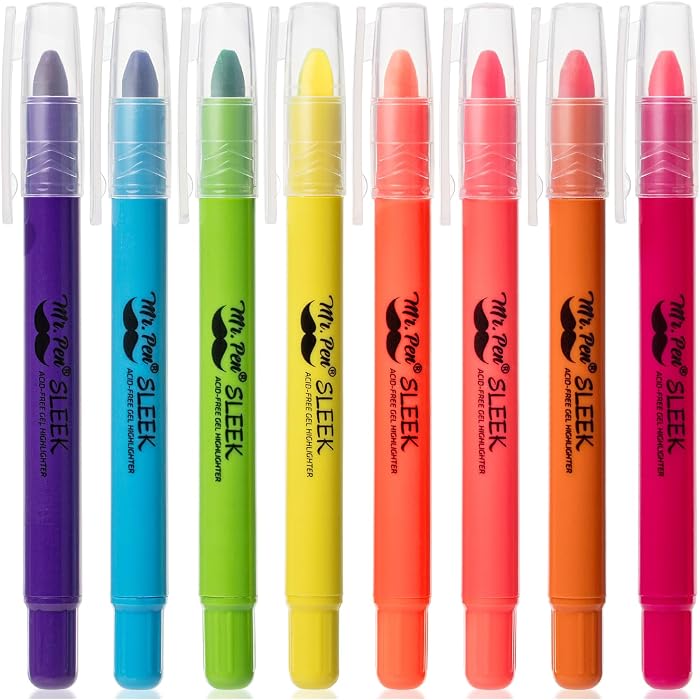
Mr. Pen No Bleed Gel Highlighters Best for Zero Bleed-Through

Key details

Ink
Waxy gel pigment
Tip
Twist-up gel stick
Point
Fine, sharpenable
Pack Size
8 highlighters
Check Price on Amazon

A gel highlighter isn't a marker with a different name. The tip is a twist-up stick of waxy color, closer to a crayon than a felt nib, and it lays color on the paper instead of soaking into it, which is why it doesn't show through. Anyone marking a Bible, a magazine, or a thin-paged novel should start here.

The laydown takes a minute to get used to. It's creamy and sits slightly raised on the page, more like drawing than highlighting, and it covers a line in one pass without darkening the print underneath. Twist the base to advance the stick, and when it flattens, a pencil sharpener gives you a finer point again.

The staying power is what we point to first: there's no reservoir to lose, so an uncapped night doesn't finish the pen the way it would a marker. The stick does wear down faster than ink does — sharpening it back to a point becomes part of the routine — and eight colors is enough to keep a study system running without a color you'll never touch.

Pros

  • No show-through on Bible-thin paper
  • Won't dry out if left uncapped
  • Twist-up stick can be sharpened to a finer point
  • Eight colors for color-coding

Cons

  • Waxy color can smear over wet pen ink
Our verdict

If the paper is thin enough to see through, stop looking — these waxy sticks are the only ones here that never soak in.

Check Latest Price
5

BIC Brite Liner Grip Pastel Highlighters Best Pastel Set

Key details

Tip
Chisel
Grip
Soft contoured grip
Colors
Six pastel shades
Pack Size
12 highlighters
Check Price on Amazon

Pastel ink doesn't shout. Where a fluorescent pen lays a neon band over a line, these lay a soft wash that you can look at for an hour without your eyes sliding off the page. If you've ever highlighted a whole paragraph and made it harder to read, that's the problem this set solves.

You get twelve pens in six soft shades, and the contoured grip is the detail that separates them from the plain Brite Liner — over a long planning session the shape stops the barrel digging into your finger. The chisel cuts the same broad band or narrow underline, so nothing about the format is different.

Be clear about what they're for. A pastel band is gentle by design, so it won't give you the instant contrast of a fluorescent yellow on a page you'll only look at once. We keep these for planners, journals and study guides read slowly, and reach for the bright sets when the goal is to find a line again in ten seconds.

Pros

  • Twelve pens in six pastel shades
  • Contoured grip for long sessions
  • Keeps dense planner pages readable
  • Twice the pens of the other pastel set here

Cons

  • Too soft for fast revision scanning
  • Ink can dry out before the pen feels used up
Our verdict

We like these for planners and journals: soft color that keeps dense pages readable, in a dozen pens with a grip that survives long sessions.

Check Latest Price
6

Sharpie Retractable Highlighters Best Retractable

Key details

Ink
Quick-drying
Tip
Chisel
Mechanism
Retractable, no cap
Pack Size
8 highlighters
Check Price on Amazon

There's no cap. You click the top like a ballpoint, the chisel slides out, you click it back, and nothing rolls under the desk. In a lecture hall or the bottom of a backpack that's a small convenience that stops being small once you've lost your third cap.

The rest is standard Sharpie: a chisel that bands a sentence or underlines a word, quick-dry ink that resists smearing over print, and eight assorted colors for coding. The body is pen-shaped, so it sits in a hand the way a pen does rather than asking you to grip a barrel.

A retractable depends on that seal doing its job. Left clicked open on a desk for days, the tip can dry out the way a capped pen wouldn't, so treat the click as the cap: close it every time and it behaves like any other highlighter.

Where it earns its place is the middle of a sentence — pull, click, mark, click, done, one-handed, with no cap to hunt for. And because the tip disappears into the barrel, it can ride loose in a bag without painting the inside of a pencil case.

Pros

  • No caps to lose
  • One-handed click operation
  • Chisel does wide bands and fine underlines
  • Eight colors for coding

Cons

  • Fewer pens than the twelve-packs at a similar price
Our verdict

Buy this one if you highlight in short bursts and keep losing caps: the click is genuinely handy, and the chisel and quick-dry ink hold up.

Check Latest Price
7

Amazon Basics Tank Style Highlighters Best for Shared Offices

Key details

Tip
Chisel
Barrel
Clear tank style
Extras
Built-in clips
Pack Size
12 highlighters
Check Price on Amazon

The barrel is clear, so the ink level is right there in front of you. That sounds trivial until you're packing for exam week and want to know which pens are close to done; with these you can sort the whole pack in ten seconds.

Twelve fluorescent pens, a chisel that cuts a fine line on the edge and a broad band flat, and built-in clips that keep one attached to a notebook. In our hands they wrote as cleanly as the name-brand tanks here, which is the entire argument for buying a pack this size.

Thin paper is where they give ground: the color shows on the reverse of anything lightweight, so these are notebook and copy-paper pens rather than Bible pens. On standard paper they behave, and the chisel cuts a clean edge without dragging.

What keeps them in the drawer is the combination of the clear barrel and the size of the pack — something you can hand round a study group without wincing, and pens you can check at a glance before a long week.

Pros

  • Clear barrel shows the ink level
  • Twelve pens with built-in clips
  • Writes as cleanly as the name-brand tanks
  • Cheapest twelve-pack here

Cons

  • Tips can break under firm pressure
  • Ink runs out sooner than the barrel size suggests
Our verdict

A twelve-pack we're happy to hand out and lose — clean chisel work, a clear barrel, and the lowest outlay for a full set.

Check Latest Price
8

TWOHANDS Pastel Highlighters Best for Detail Work

Key details

Tip
Chisel
Colors
Six pastel shades
Pack Size
6 highlighters
Line Widths
1mm + 5mm
Check Price on Amazon

Two line widths from one chisel: 1mm on the edge and 5mm flat. That's the detail we appreciated most — you can underline a heading narrowly and then band the text beneath it without swapping pens, which is more useful than it sounds in a planner full of small boxes.

The six shades are sheer enough to read through and tidy enough to look deliberate on a page, and the ink dries quickly enough that pencil underneath stayed put. They're compact too, small enough to keep one in a bag and one at the desk.

The pastels are deeper than the lids suggest — closer to soft neon than true pastel — so six shades don't separate as cleanly as a serious color-coder might want. The 1mm edge is the way around that: a narrow underline in six shades still reads as six colors, where a fat band does not.

Pros

  • Cuts both 1mm and 5mm lines
  • Quick-drying, sheer pastel ink
  • Compact enough for a pen loop
  • Six colors for light color-coding

Cons

  • Ink can run and puddle if you pause mid-line
Our verdict

These earn a spot for the 1mm edge: pastel color you can underline with, in a compact six-pack that suits planners more than textbooks.

Check Latest Price

How We Tested the Best Highlighters

We started by gathering the highlighters and highlighter sets people actually buy — chisel and fine tips, neon and pastel palettes, jumbo multi-packs and single pens — then narrowed by price per pen, tip width, and whether the maker made any claim about bleed or thin-paper-safe ink. That left 18 highlighters, which I used for four months.

They lived where highlighters actually live: on my desk for marking up printed drafts, in a tote for a weekly study group, and beside a thin-paper Bible I annotate. I highlighted the same page of dense text with each one, flipped it immediately, and checked the reverse side for ghosting and full bleed-through, then came back an hour later to see whether the line had crept further.

For smudge resistance, I highlighted directly over fresh gel-pen writing and dragged my thumb across the line at five, fifteen, and thirty seconds to find when it stopped transferring. I logged each color on white copy paper versus cream book stock — some pastels nearly vanished on the latter — and noted how smoothly the tip moved without dragging or skipping. Durability got its own test: caps off for ten minutes mid-session to see which tips recovered, and a check over the following months for pens that dried out sitting in the drawer. Value came down to how many pens in a set I'd genuinely reach for.

How to Choose a Highlighter

Match the ink to your paper

Most pens here are water-based markers: the color soaks into the sheet and dries there, which is why a thin page shows the mark on the reverse. Gel is the exception. The Mr. Pen sticks are waxy pigment that sits on the surface, and that is the design to choose if you mark scripture, magazine stock, or anything you can read the other side of.

For copy paper, textbook stock and printed handouts, a standard chisel marker is cheaper and faster. Whatever you buy, test it on the last page of a cheap paperback before you commit it to a book you care about.

Decide whether you need a second tip

A chisel is a two-in-one: laid flat it makes a broad band, turned on its edge it draws a line fine enough to underline a single word. That covers most highlighting, and it's why we treat a plain chisel as the default rather than a compromise.

A dual-tip pen such as the Mildliner adds a separate fine bullet end. That is genuinely better for margin notes and small type, but it is slower across a page you are marking in bulk, so buy it for precision rather than volume.

Choose fluorescent for finding, pastel for reading

Fluorescent ink exists for contrast: a bright band against black print that your eye finds again in a second, which is what revision wants. Pastel lays a soft wash that stays comfortable over a dense planner page, at the cost of being harder to spot from across a room.

Our advice is to buy fluorescent first and add pastel as a second set. If you only ever highlight things you'll reread slowly — journals, reading logs, study guides — start with pastel and skip the neon.

Count colors, not pens

Five pens is enough for most people, and a five-pack is the cheapest way to learn which colors you actually use. Twelve-packs suit a classroom, a shared office drawer, or anyone who highlights daily and empties a pen every few weeks.

Read the split rather than the number. The Sharpie Pocket pack weights its twelve toward three yellows, which tells you which color runs out first and whether the mix fits how you code.

Caps, clicks and storage

A retractable highlighter removes the lost-cap problem and lets you mark a line one-handed; the catch is that the tip depends on the seal closing properly, so click it shut rather than leaving it open on the desk. Capped pens are simpler and usually cheaper per pen.

Either way, store highlighters flat or tip-down so ink stays near the nib, and keep them out of a hot car — heat dries water-based ink and softens gel sticks.

Frequently Asked Questions

Final Verdict

Buy the BIC Brite Liners if you want a dependable, ordinary highlighter and don't want to think about it. The chisel is as clean as anything here, the ink keeps print readable, and a five-pack is the cheapest sensible place to start.

Change the recommendation if your pages are thin. For Bible paper, magazine stock, or anything you can see through, the Mr. Pen gel sticks are the safer buy, and the Mildliner is the better choice if you also want to underline in the margins.