Best Nail Repair Treatments of 2026

The day I peeled off a gel manicure I'd left on two weeks too long, my nails came away with it — thin, chalky, bending like wet paper. That's usually the moment people start looking for a nail repair treatment. A good one smooths the peeling edge, cuts down on splitting, and puts back some of the moisture that polish and acetone strip out, so the nail has a chance to grow out intact instead of breaking first.

My team and I spent four months with 15 treatments — brush-on proteins, keratin coats, oil pens, and strengtheners that promise to bond peeling layers back together. The tradeoff nobody warns you about: the formulas that cling hardest rarely feel the nicest, and a film that refuses to chip can leave nails drier underneath once it's off. Scent matters more than you'd expect, too; a strong one is a formula you'll skip on a busy morning, and skipping is the whole problem. Give any of them a month before you judge. Here's what held up.

The Best Nail Repair Treatments

1

Onyx Hard as Hoof Cream Best Overall

Key details

Size
1 oz
Scent
Island coconut
Format
Cream
Use On
Nails and cuticles
Check Price on Amazon

Every other treatment here asks you to paint on a film and then live with it. This one goes on like hand cream: you work it into bare nails, it sinks in, and nothing is left to chip, lift, or take off at the end of the week. That sounds like a small thing until you've spent a month maintaining a strengthener that peels away the moment your hands hit dishwater.

The formula is a vitamin-enriched cream in a 1 oz tub, and a small amount covers all ten nails, so a tub keeps going for ages. It goes onto the nail plate, the edge and the cuticle, which means the dry skin around a damaged nail gets treated at the same time — our cuticles look better in the stretches when we're using it. The Island Coconut version smells like coconut rather than like a salon, which is the version we keep.

Where it separates itself from the rest of this guide is peeling and breakage. Edges that split stop splitting, soft nails feel firmer, and it rewards frequency: several applications through the day is where the quickest changes came from, so keep one tub at the desk and another by the bed. A nail that has already split at the tip still needs filing down, because no cream reattaches it.

If you want a treatment that looks like polish, or one that survives a week of dishes, this is the wrong tub and Rejuvacote 1 is the swap. Everything else about it is what brings us back: it's cheap enough to use generously, and it's the only product here you can apply in the middle of a workday without thinking about it.

Pros

  • Conditions nails and cuticles in one step
  • No polish to apply or remove
  • A small amount covers all ten nails
  • Peeling edges improve as nails firm up

Cons

  • Hands feel greasy for a few minutes after
Our verdict

Our pick for most damaged nails: a cream that sinks in fast, conditions the cuticle as it goes, and never needs removing — no polish, no remover, no weekly reset.

Check Latest Price
2

Duri Rejuvacote 1 Best for Post-Acrylic Recovery

Key details

Size
0.45 fl oz
Wear
Alone, base, or top coat
Format
Brush-on polish
Routine
One coat daily; remove weekly
Check Price on Amazon

Thin, see-through nails that split at the sides after a gel or acrylic removal are exactly what Rejuvacote 1 was built for, and it's the product we put in front of anyone in that situation. The routine is one coat a day for seven days, then remove it and start again, repeating until the damaged part has grown out.

It earns the place on strength. Nails that used to bend now hold their shape, and the hardening results here are the most convincing of anything in this guide. It dries quickly, so a morning coat costs you a minute, and it works as a base coat, a top coat, or on its own when you want nothing else on the nail.

The 0.45 fl oz bottle is used a coat at a time on a weekly cycle, so the cost per week is modest for a treatment at the upper end of this range, and the formula has been made in small batches in the USA for two decades. Set an alarm for the first week: this one lives or dies on the daily application, and the nails that stay with it are the ones that get the coat before the coffee.

Pros

  • Hardens thin, bendy nails noticeably
  • Dries fast enough for a morning coat
  • Works as base coat, top coat, or alone
  • Weekly cycle uses the bottle slowly

Cons

  • Can flake within hours of application
  • Daily coat and weekly removal required
Our verdict

The strongest hardening we came across in this set, and the one to choose if gels or acrylics left your nails thin and bendy — as long as the daily coat fits your routine.

Check Latest Price
3

CND RescueRXX Keratin Treatment Best for Splitting and Peeling

Key details

Size
0.35 oz
Format
Brush-on oil
Routine
Twice daily, up to 4 weeks
Key Ingredients
Keratin, jojoba, sweet almond oil
Check Price on Amazon

Four weeks of twice-daily use produced a 73 percent drop in splitting and 80 percent in peeling in CND's own clinical testing, which is the only figure of its kind on any label here. That's the brand's study rather than our tape measure, but it lines up with what we saw, and it's why this is our pick when the damage is peeling layers and vertical splits rather than plain softness.

It's an oil rather than a lacquer: keratin carried in jojoba and sweet almond oil, brushed over the nail, the edge and the cuticle, then massaged in until it disappears. Nothing sits on top of the nail, nothing lifts, nothing has to be removed, which makes it the easiest treatment here to keep up with during a working day. The 0.35 oz bottle is small, but a couple of drops per hand covers everything.

Expect it to be genuinely oily — the brush slides across the nail instead of painting it, so rub it in rather than trying to lay down a coat, and give it a minute before you touch a keyboard. What changes first is the peeling at the tip; the white spots at the base are the slowest to fade, which is worth knowing before you decide it isn't working.

Pros

  • Targets splitting and peeling specifically
  • Stated clinical results behind it
  • No film, so nothing to chip or remove
  • Conditions cuticles at the same time

Cons

  • Twice-daily application for at least four weeks
  • Priciest treatment in this guide
Our verdict

Our pick for peeling, splitting nails: a keratin oil you massage in twice a day, with the brand's four-week clinical figures behind it and no film to maintain.

Check Latest Price
4

Sally Hansen Maximum Growth Best Budget

Key details

Size
0.32 oz
Coats
One
Format
Brush-on polish
Formula
Triple protein and silk
Check Price on Amazon

One coat. That's the whole pitch, and for a bottle this inexpensive it's a convincing one: a quick-drying clear strengthener with a triple protein and silk formula that goes on like polish and stiffens thin, weak nails while it's on them.

We wore it as a base coat under color and on its own. It dries fast enough to keep a morning routine moving, adds a clear gloss that reads as a fresh manicure, and holds color on top for longer than bare nails manage. One thin coat is enough, and it's also the point at which the formula behaves best.

For mildly weak nails, this is the sensible buy: it protects the nail and primes it for polish in one step, which is more than most budget treatments attempt. Build a second coat and you'll find the whole thing can lift in one piece, so keep it thin and redo it weekly. If your nails are badly damaged rather than just soft, the money is better spent on Rejuvacote 1 or RescueRXX.

Pros

  • Dries within about a minute
  • One coat hardens and primes
  • Clear gloss wears alone or under color
  • Easy, even application

Cons

No notable drawbacks to flag.

Our verdict

The least you can spend and still get harder, glossier nails: one thin coat, dry within a minute, and a brush that behaves — our budget pick.

Check Latest Price
5

ella+mila First Aid Kiss Best Free-From Formula

Key details

Format
Brush-on polish
Formula
17-free, vegan, cruelty-free
Removal
Non-acetone remover
Routine
One coat for 7 days
Check Price on Amazon

The label is the reason to start here: 17-free, PETA-certified cruelty-free and vegan, in a category where plenty of bottles stay vague about what's in them. If you've been avoiding conventional hardeners and still want a film that genuinely hardens, this narrows the shortlist to one.

It's a real hardener, not a compromise. One coat on bare nails, left for seven days, then taken off with non-acetone remover. Thin nails held up better as the weeks went on, and it dries to a bright, even shine that looks deliberate rather than medicinal.

The cycle is the part to plan for: a fresh coat on a clean, dry nail, seven days of wear, and a removal that doesn't drag. Where it fits best is a nail that's soft and peeling at the edge rather than one that has already split, which is a job for the keratin oil instead. It's also the one we hand to anyone who wants the treatment to double as a clear manicure.

Pros

  • 17-free, vegan, cruelty-free formula
  • Visible strengthening over a seven-day cycle
  • Dries to a bright, even shine

Cons

  • Coat can peel after a day or two
  • Hardening can leave nails feeling brittle
Our verdict

The one we point clean-formula shoppers to: 17-free and vegan, and still a hardener that leaves weak nails noticeably stronger and glossier.

Check Latest Price
6

Nail-Aid Keratin 3 Day Growth Quick Gloss Coat

Key details

Coats
Two
Format
Brush-on polish
Key Ingredient
Keratin amino acids
Stated Timeline
3 days
Check Price on Amazon

Three days is the promise on the label — visible strengthening in as little as that — and what you get in three days is mostly the coating: a hard, shiny shell over a soft nail. That's not nothing. It's what stops a splitting tip catching on a sweater while the nail underneath grows out.

The formula leans on keratin amino acids, and two thin coats wear alone or as a base and top coat. We found it the least fussy of the brush-ons: it levels quickly, the shine is good enough to skip a clear polish, and it doesn't drag when you layer it.

Where it lands for us is the entry point — the cheapest way to find out whether a hardening coat suits you at all, and the bottle is small enough to keep in a bag. Keep it dry: it lifts after prolonged water, so wear gloves for the washing up, and put a fresh coat on every few days rather than waiting for the shine to dull.

Pros

  • Hard shell over a soft nail within days
  • Wears alone or as base and top coat
  • Cheapest treatment in this guide

Cons

  • Can leave nails dry and brittle underneath
Our verdict

Cheap, glossy, and quick to try: a keratin coat that can firm up soft nails within days, provided you reapply after every sinkful of dishes.

Check Latest Price
7

Probelle Nail Strengthener High-Gloss Finish

Key details

Use
Daily or as base coat
Finish
High gloss
Format
Brush-on polish
Key Ingredients
AHAs, vitamin B5, vitamin C, hexanal
Check Price on Amazon

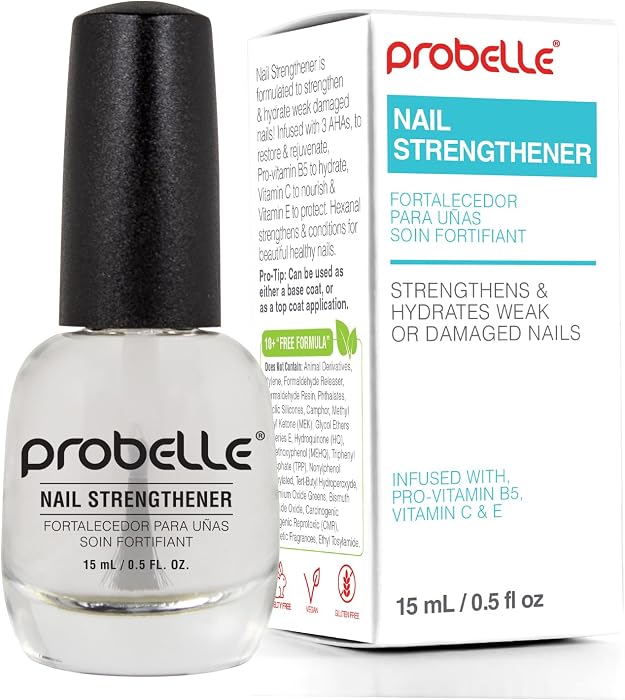
Probelle is the only treatment here that looks like a manicure on its own. The milky clear formula dries to a high gloss, and on a bare nail it reads as a deliberate polish rather than a treatment you're putting up with.

The formula is built around AHAs, vitamin B5, vitamin C and hexanal, aimed at texture — the chipping, peeling and cracking at the surface rather than a nail that bends. One coat under color as a base coat, or daily on bare nails, building the product up over the week. What you notice first when you open it is the smell: a sharp solvent odor that hangs around while it dries.

It removes with ordinary polish remover, which makes the weekly restart painless, and it layers without the goopy drag you get from thicker hardeners. Thin coats, a minute between each, and the finish stays level.

For us it's the pick for someone who wants both: a strengthener that improves a peeling nail and a finish worth leaving the house in. It won't out-harden Rejuvacote 1 on genuinely bendy nails, but nothing else here looks this good doing the job.

Pros

  • High gloss that reads as polish
  • Targets chipping and peeling texture
  • Doubles as a base coat
  • Removes with ordinary polish remover

Cons

  • Gloss can lift within a day
Our verdict

A high-gloss strengthener that firmed up chipping, peeling nails for us — the pick when you want a treatment that reads as a fresh manicure.

Check Latest Price
8

ONSEN Nail & Cuticle Cream Best for Dry Cuticles

Key details

Feel
Non-greasy
Size
15 ml
Format
Cream
Key Ingredients
Tsubaki, jojoba, shea butter
Check Price on Amazon

Most cuticle products are oils, and oils sit on the skin until you wipe them off on a towel. This one is a thin cream that sinks in on contact, no greasy fingerprints on the phone screen, and that's the reason it stayed in the rotation rather than getting used twice.

The blend is Japanese tsubaki, jojoba and rice bran oils with shea and cocoa butter, in a 15 ml tube that smells softly of lavender. We worked it into the cuticle and the nail edge morning and night, and cracked sides and hangnails were the first thing to settle.

It's a conditioner, though, and worth being clear about: it softens and hydrates, but it won't firm a bendy nail or hold a splitting tip together. Read it as the support act rather than the treatment, and keep a hardening product alongside it.

That's how we use it — at night, once whatever coat you're wearing has done its work for the day. For anyone whose nails are broadly fine but whose cuticles crack and bleed in winter, this is the pick here, and it earns its place in a bag rather than on a shelf.

Pros

  • Absorbs without a greasy film
  • Softens cracked cuticles and hangnails
  • Light lavender scent
  • A small dab covers both hands

Cons

  • Small tube for twice-daily use
Our verdict

A cream rather than an oil, and the one we reach for when the damage is dry, cracked cuticles and a rough nail edge — not a nail that needs hardening.

Check Latest Price

How We Tested 15 Nail Repair Treatments

We built the shortlist by reading full ingredient lists rather than front-of-bottle claims, narrowing a field of about 40 down to 15. Anything that leaned on acetone or required a harsh remover to take off was cut, as were treatments that only made sense if you also wore polish. We weighed cost per application, not just per bottle, and favored formulas people with genuinely damaged nails kept repurchasing.

Each tester claimed one bad nail — usually post-gel, post-acrylic, or a thumbnail that had been peeling for weeks — and applied the treatment on its own schedule: twice a day for oils and pens, once or twice a week for film-forming coats. We washed dishes, typed, scrubbed the bathroom, and did the constant hand washing that winter asks for. Every evening we checked whether a coat had lifted at the corners, flaked at the tip, or come away in a single sheet, and we noted whether the texture sank in or sat greasy on top and how it behaved under regular polish.

Fragrance got its own running note: whether the scent faded within ten minutes or followed us to lunch, and whether it made twice-daily use feel like a chore. On Fridays we marked the cuticle line with a fine-tip liner and measured new growth, and at four weeks we paused each treatment for a week to see whether the nail felt stronger or more brittle without it. We also tracked how far one bottle stretched, since a formula you reach for twice a day is only a value if the bottle lasts.

How to Choose a Nail Repair Treatment

Start With a Format You'll Keep Up With

Three formats cover this category, and they ask for very different things. A cream like Hard as Hoof goes onto bare nails several times a day and never needs removing. A brush-on like Rejuvacote 1 or First Aid Kiss leaves a film that stays for days and comes off in a weekly reset. An oil like RescueRXX is massaged in twice a day and leaves nothing behind at all.

Choose by your hands rather than by the marketing. If they're in water for hours — dishes, cleaning, small children — a film will lift before it has done anything, and a cream or oil earns its keep. If a nail is splitting and catching on everything it touches, the shield a brush-on provides is worth the maintenance. The combination that never works is a polish-style hardener used sporadically: you get a chipped coat and no change.

Match the Formula to the Damage

Peeling layers, white spots and vertical splits are surface damage, and keratin is the ingredient aimed at them — it's the core of RescueRXX and of the Nail-Aid coat. Soft nails that bend rather than break need something that firms the plate, which is where a brush-on hardener or a vitamin cream does more. Rough, chipping texture is where AHAs and hexanal come in, as in Probelle.

One label check is worth making before you buy. Plenty of conventional hardeners rely on formaldehyde to get that grip, so if you're avoiding it, look for a formula marked 17-free, like First Aid Kiss, or 20-free, like the Nail-Aid coat. The free-from options here still harden; you aren't choosing between a clean label and a working one.

Decide Whether You Want a Gloss

Some treatments are invisible and some are a finish in their own right. Probelle and Maximum Growth dry to a clear gloss you can wear alone; the creams and the keratin oil leave nothing visible. If you already wear color, a strengthener that doubles as a base coat saves a step, and First Aid Kiss, Maximum Growth and Probelle all work under lacquer.

Then think about how the film behaves. A coat that lifts within a day is protecting nothing, and the treatments here that hold longest are the ones applied thin, to a dry, clean nail, with no oil underneath. If you use a cuticle cream, put it on at night rather than underneath your treatment — oil under a coat is the fastest way to make it peel.

Plan on Six Weeks, Not Three Days

A damaged nail can't be repaired in place. The damaged part has to grow out, and a fingernail takes months to replace itself, so what a treatment really does is protect the nail while that happens. Four weeks is the shortest honest trial — it's the frame behind CND's clinical results — and six weeks tells you more.

Two habits keep the process from backfiring. File the split or peeling edge down so it stops catching, because no treatment reattaches it. And put a conditioning cream on a few nights a week while you use any hardening coat: hard, dry nails snap where flexible ones bend, and that brittleness is the most common reason a strengthener gets blamed for making things worse.

Frequently Asked Questions

Final Verdict

For most people with weak, peeling nails, Hard as Hoof is the one to buy. It strengthens and conditions in the same step, it never needs removing, and it's the treatment here you can use three times a day without rearranging your life — which is why it wins over formulas that are stronger on paper and sit unused in a drawer.

Change the requirement and the pick changes. Nails thinned by gels or acrylics do better with Rejuvacote 1 and its daily coat. Surface peeling and white spots call for RescueRXX and its four-week oil routine. And if you want a treatment that reads as a fresh manicure, Probelle is the one that does both.