AHA vs BHA: Which Exfoliating Acid Your Skin Actually Needs
One dissolves in water and works on the surface. The other dissolves in oil and gets inside the pore. Everything else — including the percentage on the front of the bottle — is downstream of that.
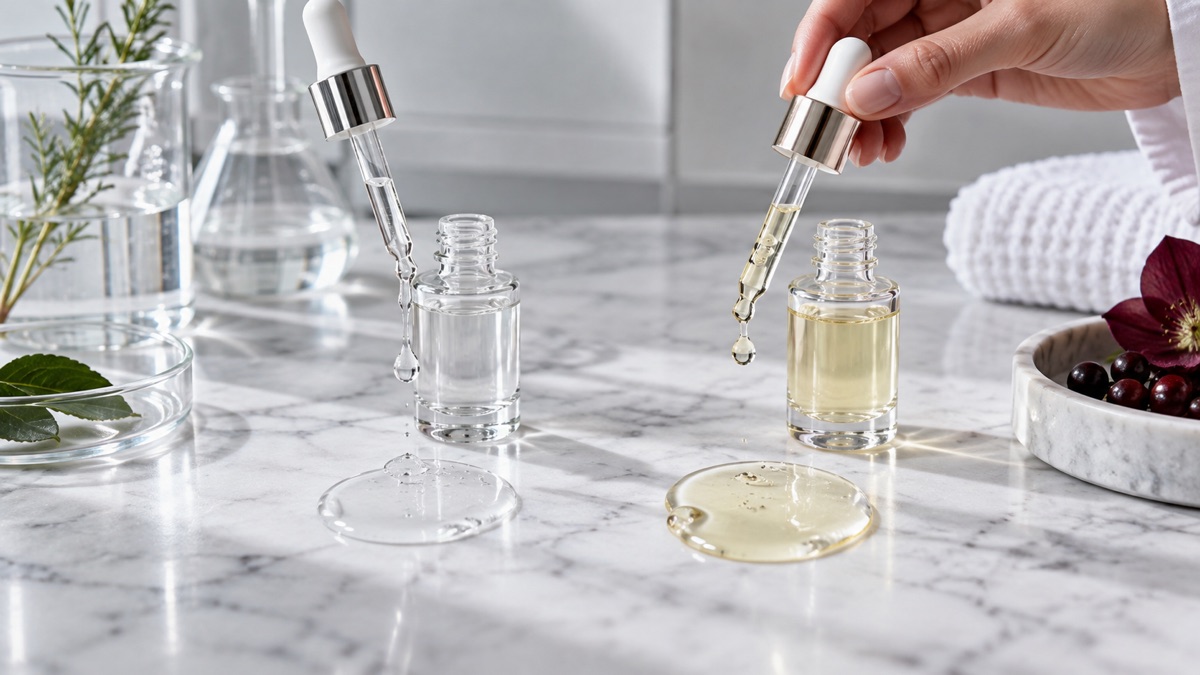
Walk down any exfoliant aisle and the labels shout percentages at you: 10% glycolic, 2% salicylic, 30% AHA peel. Almost none of that tells you what you actually need to know, which is a much simpler question — where does your problem live?
If it sits on the surface (rough texture, dullness, flaky patches, faded-looking tone), you want an AHA. If it lives inside the pore (blackheads, congestion, oily skin that keeps re-clogging), you want a BHA. That single distinction is not marketing. It is chemistry, and it is the reason a 10% glycolic serum can polish your face beautifully for six months without ever clearing one blackhead.
The short answer, side by side
Alpha hydroxy acid
AHA
- Dissolves in
- Water
- Works on
- The surface layer of dead cells
- Common forms
- Glycolic, lactic, mandelic, malic, tartaric
- Best for
- Rough texture, dullness, dry flaking, uneven tone, fine lines
- Side effect to expect
- Tingling; higher sun sensitivity
- Typical leave-on strength
- 5–10%
Beta hydroxy acid
BHA
- Dissolves in
- Oil
- Works on
- Inside the pore, in the sebum
- Common forms
- Salicylic acid (essentially the only one)
- Best for
- Blackheads, clogged pores, oily skin, bumpy congestion, body acne
- Side effect to expect
- Dryness, tightness, flaking at first
- Typical leave-on strength
- 0.5–2%
Salicylic acid is capped at 0.5% to 2% in leave-on products sold as acne treatments in the US, and that is not a formulator's preference — it is the range written into the FDA's over-the-counter monograph for topical acne drugs. So when a brand advertises "extra-strength 5% BHA," it is either a rinse-off, a professional peel, or a product that is not making an acne drug claim.
The percentage on the front is not the dose
Here is the part almost no product page explains, and it is the single most useful thing on this page.
Acids only exfoliate in their free acid form — the un-neutralized molecule. Formulators routinely buffer a product to raise its pH and make it gentler, and every step up in pH converts more of the acid into a salt that mostly sits there. How much stays active is fixed by chemistry: each acid has a pKa, the pH at which exactly half of it is free, and the fraction falls off fast on either side.
Free acid % = 1 ÷ (1 + 10(pH − pKa)). Glycolic acid's pKa is 3.83; salicylic acid's is 2.98.
Run the numbers on a single 8% glycolic serum, changing nothing but the pH:
The same 8% bottle ranges from 6.9% to 0.5% of working acid depending on a number that most brands never print. It gets more dramatic with salicylic acid, whose lower pKa makes it far more pH-sensitive:
Read those three tiles again. A 2% salicylic acid buffered to pH 4 delivers less working acid than a 0.5% salicylic acid at pH 3. The "four times stronger" product is the weaker one. This is why two 2% BHA liquids can feel completely different, and why "percentage shopping" leads people to buy something harsh when they wanted gentle, or something inert when they wanted results.
Brands that take exfoliation seriously publish the pH, and some publish a free acid value outright. If a product lists neither, treat the percentage as a marketing number and judge it by how your skin responds over two weeks, not by the figure on the front.
Why molecule size decides how much it stings
Within the AHA family the acids are not interchangeable, and the ranking that matters is weight. Smaller molecules move through the surface faster, which means more result and more sting per percent. Larger ones move slowly, which is exactly what irritation-prone skin wants.
That ladder is the practical answer to "which acid should I start with." Glycolic is the strongest-feeling and the one most likely to burn a beginner. Mandelic, at twice the size, is the usual pick when skin is reactive or prone to dark marks. And the polyhydroxy acids at the bottom — gluconolactone, lactobionic acid — are the ones dermatologists reach for on skin that cannot tolerate anything else, including rosacea-prone and post-procedure skin.
Pick by your actual complaint
- Blackheads on the nose and chin that come back weeklyBHA (salicylic 1–2%)The only one of these that gets into the pore at all
- Oily skin, closed bumps, makeup that separates by noonBHAAlso mildly anti-inflammatory, which helps inflamed spots
- Rough, dull, "my serum just sits there" textureAHA — glycolic or lacticLoosens the dead-cell layer that is blocking absorption
- Dry, tight skin with flakingLactic acidExfoliates and holds water, unlike glycolic
- Dark marks left behind after spots, on deeper skin tonesMandelic acidSlow penetration means less inflammation, and inflammation is what makes new pigment
- Sensitive, flushing, or rosacea-prone skinPHA (gluconolactone)Or nothing — see the cautions below
- Bumpy upper arms (keratosis pilaris)Body lactic acid or ureaFace strengths are too mild for arm and leg skin
- Chest and back breakoutsBHA body wash or sprayReaches skin your hands cannot
How often — and how to tell you have gone too far
There is no universal number, and any article that gives you one is guessing. The American Academy of Dermatology's rule is the honest version: "the more aggressive the exfoliation, the less often it needs to be done," and how often depends on both your skin and the method. Start here and adjust based on the skin in the mirror, not the calendar:
| Product | Oily / resilient | Normal | Dry or sensitive |
|---|---|---|---|
| Leave-on BHA 1–2% | Daily | 3–4× a week | 2× a week |
| Leave-on AHA 5–10% | 3–4× a week | 2–3× a week | 1× a week, or PHA instead |
| Rinse-off acid cleanser | Daily | Daily | Every other day |
| At-home peel pads 10%+ | 1–2× a week | 1× a week | Skip |
| Physical scrub | 1× a week | 1× a week | Skip — use a washcloth |
The AAD is blunt about scrubs for anyone dry, sensitive or acne-prone: a washcloth and a mild chemical exfoliant is the better call, because mechanical scrubbing "may be too irritating."
Red, irritated skin is the AAD's headline sign. In practice it arrives as a set: a tight, shiny, almost waxy look; stinging from products that never stung before; small flakes that appear after moisturizer; new breakouts along the jaw and cheeks; and skin that looks better on the days you skip everything. The fix is not a gentler acid. It is two to three weeks of no acids at all, plus a plain moisturizer.
Can you use both?
Yes, but "both" almost never means both at once. Layering two acids in one session mostly multiplies irritation without multiplying results — and if the second product raises the pH of the first, it can even blunt it. Three approaches that do work:
- EasiestAlternate nights. BHA Monday and Thursday, AHA Saturday, nothing on the other nights. Your skin gets both jobs done with three days of recovery built in.
- TargetedSplit by zone. BHA only on the nose, chin and anywhere that congests; AHA on the cheeks and forehead where the issue is texture. Different problems, different acids, same evening.
- GentlestSplit by format. A salicylic cleanser in the morning — short contact time, low risk — and a leave-on AHA two nights a week. This is the version that suits combination skin that is oily in the middle and dry at the edges.
Do
- Introduce one acid at a time, and give it two full weeks before judging it
- Apply to dry skin, not damp — water increases penetration and sting
- Follow with a plain moisturizer, always
- Keep acids away from the eyelids and the corners of the nose
- Wear sunscreen every morning you use one
Don't
- Stack an acid with a retinoid or benzoyl peroxide in the same session — the AAD advises against exfoliating while using them at all
- Use one on skin that is already broken, sunburned or actively flaring
- Chase a stronger percentage after one calm week
- Exfoliate before waxing, threading or a professional treatment
- Assume a tingle means it is working — a burn means stop
The sun rule is not optional, and there are numbers behind it
This is the one place where the caution is measured rather than assumed. In FDA-sponsored studies, four weeks of applying an AHA increased skin's sensitivity to UV reddening by 18 percent, and sensitivity to UV-induced cell damage doubled, on average.
"Sunburn Alert: This product contains an alpha hydroxy acid (AHA) that may increase your skin's sensitivity to the sun and particularly the possibility of sunburn. Use a sunscreen, wear protective clothing, and limit sun exposure while using this product and for a week afterwards."
Two details in that sentence get missed. First, and for a week afterwards — the effect outlives the product. Second, it is reversible: FDA researchers found no significant difference in UV sensitivity one week after people stopped. The FDA recommends similar precautions for BHA products.
The Cosmetic Ingredient Review panel's safety conditions for consumer AHA products are equally concrete: concentration of 10 percent or less, finished pH of 3.5 or greater, and either sun protection in the product or directions telling you to use it daily. If a leave-on AHA on your shelf exceeds 10% or sits below pH 3.5, it is outside those conditions — which does not automatically make it unsafe, but it does mean you are in peel territory and should treat it that way.
Who should be careful, or skip acids entirely
- On a prescription retinoid, retinol or benzoyl peroxide. The AAD advises against exfoliating while using them — they already increase sensitivity, and stacking tends to produce dryness or breakouts rather than faster results.
- Darker skin tones, or skin that marks after spots and bug bites. The AAD specifically advises avoiding strong chemical or mechanical exfoliation here, because aggressive exfoliation can drive more pigment, not less. Gentle and slow — mandelic or a PHA — is not a compromise; it is the strategy.
- Active eczema, rosacea flare, broken or sunburned skin. Wait until it is calm.
- Pregnant or breastfeeding. Low-strength topical salicylic acid is commonly considered acceptable, but high-concentration peels and oral salicylates are not. This is a question for your doctor about your specific product, not one to settle from a blog.
- Infants and children. The FDA's consumer guidance on BHA advises avoiding use on them.
Reading a label in ten seconds
- Find the acid and its number. "Glycolic acid 7%" is a claim you can evaluate. "AHA blend" is not.
- Look for a stated pH. Anywhere on the box, the site or the FAQ. Its absence is not damning, but its presence tells you the brand knows the number matters.
- Check leave-on versus rinse-off. A cleanser has thirty seconds of contact; a serum has all night. They are not comparable at the same percentage.
- Scan for a second acid. Multi-acid formulas are not automatically stronger, but they are harder to troubleshoot when your skin reacts.
- Check where the acid sits in the ingredient list. An acid listed after the fragrance and preservatives is present in a fraction of a percent, whatever the front of the box implies.
The honest summary
AHA and BHA are not competitors and not tiers. They are two tools that reach two different depths, and the one you need is decided by where your problem sits, not by which is stronger. Once you have picked the right family, the variables that actually change your result — in order — are pH, molecule size, contact time and how often you use it. Percentage comes fifth, which is roughly the opposite of how it is sold.
Frequently Asked Questions
-
They are not on the same scale, so the question does not really resolve. Glycolic acid is used at 5–10% in leave-on products and salicylic acid at 0.5–2%, but salicylic is doing a different job at a different depth. The more useful comparison is free acid: an 8% glycolic at pH 3.8 delivers about 4.1% working acid, while a 2% salicylic at pH 3.0 delivers about 0.98%. The glycolic is doing more work on the surface; the salicylic is the only one doing any work inside the pore.
-
You can, but most skin does not need to and many will regret it. Layering two acids tends to multiply irritation rather than results, and a second product can raise the pH of the first enough to blunt it. Alternating nights, splitting by facial zone, or pairing a BHA cleanser with a leave-on AHA on separate evenings all deliver both benefits with far less risk.
-
Texture and glow usually shift within one to two weeks, because you are removing a layer that is already loose. Blackheads and congestion take four to eight weeks with a BHA, since you are changing what happens inside a pore over repeated cycles. Post-spot dark marks are the slowest — several months, and only if you are wearing sunscreen, which does more for pigment than the acid does.
-
Polyhydroxy acids — mainly gluconolactone (178 Da) and lactobionic acid (358 Da) — are chemically related to AHAs but much larger, so they penetrate more slowly and irritate less. They are the sensible starting point if you have rosacea-prone or reactive skin, if every acid you have tried has stung, or if you are exfoliating after a cosmetic procedure. If your skin tolerates glycolic or lactic acid comfortably, you do not need one.
-
They do less than a leave-on at the same percentage, which is exactly why they are useful. Thirty to sixty seconds of contact makes a salicylic cleanser a good daily option for oily and congested skin, and a reasonable way to introduce acids to skin that reacts to leave-on products. Do not expect a cleanser to clear stubborn blackheads on its own.
-
Light flaking in the first week is common. Redness, stinging from products that never stung, a tight waxy feeling, or flakes that appear after moisturizer are not a break-in period — they are over-exfoliation, and the AAD names red irritated skin as the sign you are doing it too often. Stop all acids for two to three weeks and use a plain moisturizer. Restart at half the frequency, not at a lower percentage.