Best Pumice Stones of 2026

The tradeoff with pumice stones is baked into the material itself: the coarse ones flatten a callus in four strokes and can leave your heel stinging and raw, while the fine ones are so gentle you saw away for ten minutes and get nowhere. What you actually want is a stone that takes off what's dead and then stops. That's the whole job — two minutes after a shower, a heel you're not embarrassed by in sandals, and no pedicure appointment on the calendar.

I've spent the past three months with 14 stones in my shower and on my bathroom counter, passing a few to my team and keeping the rest for dry-heel nights in front of the TV. The ones we kept reaching for all held their grit after weeks of wet use instead of dissolving into paste. Price told us almost nothing — a couple of the cheapest kept their shape better than stones that cost three times as much. The picks below are the ones still sitting in the shower.

The Best Pumice Stones

1

Tweezerman Sole Smoother Best Overall

Key details

Grit
Coarse and smooth sides
Length
10.8 inches
Weight
4.32 oz
Stone Material
Ceramic with plastic handle
Check Price on Amazon

The handle is where this one starts. It runs about ten inches end to end, which sounds like a small thing until you're perched on the edge of the tub trying to reach the outer rim of a heel with a palm-sized rock. With the Sole Smoother you keep your foot flat, hold it like a hairbrush, and work the stone where the callus actually is.

One end of the head is a coarse ceramic face for the hard, thickened skin around a heel; the other is smooth enough to finish the ball of the foot and the sides of the toes. Ceramic is denser than the lava stones most of us picture, so it doesn't shed grit into the tub every time you use it, and the whole tool is fully waterproof, which is why it has stayed on the shower shelf through our testing rather than in a drawer.

What the money buys is the handle and the ceramic head, and it's the priciest pick in this group by a wide margin. The length that makes it comfortable is also what keeps it out of a carry-on, so treat it as the stone that lives at home rather than one that commutes.

Set against the natural stones, this is the pick that asks the least of you: less bending, no grit coming off under your fingers, and a fine side for the weeks when you're only tidying up. We reach for it first, and it's the one tool here that handles both the repair job and the upkeep without a second purchase.

Pros

  • Handle lets you work sitting down
  • Coarse and smooth faces in one tool
  • Ceramic head doesn't shed grit
  • Sturdy enough to live in the shower

Cons

  • Priciest stone in this set
  • Long handle takes up bag space
Our verdict

The one we recommend first: a ten-inch handle that spares your back, coarse and smooth faces on a waterproof ceramic head, and no grit in the tub.

Check Latest Price
2

Asqraqo Natural Pumice 2-Pack Best Value

Key details

Pieces
2 stones
Material
Natural lava pumice
Hanging Loop
Rope loop on each
Check Price on Amazon

Two full-size lava stones for less than most of the single stones in this guide is the offer, and we think it's the best value here — not because it's cheap, but because the second stone is genuinely useful. One hangs from its rope loop in the shower; the other goes in a gym bag or to whoever else in the house is complaining about their heels.

The stones themselves are natural lava, porous and mildly abrasive, and they behave the way the old instructions promise: soak your feet until the skin softens, wet the stone with soapy water, and rub in circles. The honeycombed surface lifts softened skin and rinses clean, and the rope loop means it dries instead of sitting damp in a caddy.

Lava is a consumable, though. These wear down as they abrade, the surface flattens where you press hardest, and eventually you're rubbing a smooth rock over your heel. Hanging it to dry after each use buys you more time, but buy the pair expecting to replace it rather than to pass it down.

Pros

  • Two stones for the price of one
  • Natural lava with a mild abrasive surface
  • Rope loops for hanging dry

Cons

  • Wears down with use
Our verdict

We think this pair is the best value here: two natural lava stones, rope loops for drying, and a spare that lives in your gym bag.

Check Latest Price
3

Mr. Pumice Pumi Bar 4-Pack Best Synthetic Bar

Key details

Grit
Medium-coarse, ridged and flat sides
Pieces
4 bars
Material
Frothed polyurethane
Check Price on Amazon

There's no rock in this box. The Pumi Bar is a bar of frothed polyurethane with the texture of a fine whetstone — medium-coarse on both a ridged face and a flat one — and it's the bar format you'll see on a salon tray. Four of them come in the pack, and each is light enough to work one-handed.

In the shower it does what a good stone does, only more predictably: warm water softens the skin, the ridged face gets into the cracked edge of a heel, the flat face covers more ground, and because the material chips away as it abrades there's no grit trapped inside it and nothing to scrub out afterwards. That last part matters in a wet room, where a porous stone stays damp for hours.

It does wear out, and that self-chipping design is exactly why a bar doesn't hold up like ceramic or terracotta, so the four-pack is a supply rather than a set to hand around the house. If you want one tool you buy once, the handled stone above is the better call; if you want a bar beside each shower that never gets grungy, four is the right number.

Pros

  • Medium-coarse grit with a ridged and flat face
  • Self-chipping material resists buildup
  • Four bars per pack

Cons

  • Erodes with use
Our verdict

We point shower scrubbing to this bar: uniform medium-coarse grit, nothing to clean out of it, and four in the pack so each bathroom gets one.

Check Latest Price
4

Gilden Tree Terracotta Stone Best for Thick Heels

Key details

Weight
7.04 oz
Material
Natural terracotta
Surfaces
Rough scrub and smooth polish sides
Dimensions
5.5 x 2.25 x 1.25 inches
Check Price on Amazon

Next to the porous lava stones here, the Gilden Tree reads as a serious tool: a solid slab of terracotta with a wide flat scrubbing face, a smoother polishing side, and enough weight — about seven ounces — that you can lean into it without your hand sliding around on wet skin.

The scrub face is coarse without being punishing, and flat means coverage: one pass across a heel covers more ground than a rounded rock does. Flip it over and the smooth side buffs the edges so you don't leave the bathroom with a fresh rough patch catching on your sock.

For heels that have gone hard over a summer of sandals, this is the one we hand people. It's more tool than someone with slightly dry skin needs — the fine side of the handled stone above handles maintenance with less effort — but when the callus is thick and stubborn, the wide terracotta face earns its place on the shelf. Keep it somewhere it won't slide onto tile, and it will outlast the lava stones by a wide margin.

Pros

  • Wide flat face covers a heel fast
  • Second smooth side polishes
  • Weight steadies it in the hand

Cons

  • Brittle if dropped on tile
  • Heaviest stone in this set
Our verdict

Our pick for genuinely thick heel skin: a wide terracotta scrub face followed by a polishing side, in a stone heavy enough to lean into.

Check Latest Price
5

Maryton Double-Sided 4-Pack Best Multi-Pack

Key details

Grit
Two levels of coarseness, double-sided
Pieces
4 stones
Product Dimensions
5 x 2 x 4 inches
Check Price on Amazon

If one bathroom serves three people who all want softer heels, this is the pack to buy. Maryton gives you four stones, each double-sided with a coarser face and a finer one, and each sized to sit in the palm — so everyone gets their own without a shared stone going back into the caddy.

Two grits on one stone is the detail we appreciate most: you can take the rough edge off a heel and then go back over it with the finer face without putting anything down. Four stones that cost less than a couple of the singles here also make it the cheapest way to put a spare in a guest room or a suitcase. Four is more than one person needs, though — on your own, the lava two-pack does the same job with less sitting in a drawer.

Pros

  • Four stones in one pack
  • Coarse and fine faces on each stone
  • Lowest cost per stone here

Cons

  • More stones than one person needs
Our verdict

We recommend the four-pack for a shared bathroom: double-sided stones with two grits each, and enough of them that nobody shares.

Check Latest Price
6

Pumice Valley Natural Stone Simple Single Stone

Key details

Weight
4.8 oz
Material
Natural volcanic lava rock
Dimensions
3.54 x 2.36 x 1.57 inches
Hanging Loop
Rope loop
Check Price on Amazon

This is the chunk of the natural stones: about three and a half inches long and an inch and a half thick, so it fills the palm the way a bar of soap does and gives you something to hold onto with wet hands. The surface is volcanic rock, there's a rope loop at one end, and there's nothing else in the box.

One line in the instructions is worth repeating: rinse the stone before the first use. New lava carries dust from shipping, and half a minute under the tap saves you a basin of grey water. After that it works like any good stone — softened skin, soapy water, light circles — and the rope holds its shape when wet, so it hangs to dry without kinking.

What we like is the simplicity of it: one good stone, no grits to choose between, nothing to assemble. What you give up is the spare, since the lava two-pack costs less and leaves you a backup, and a fine side for the weeks when your heels are already in decent shape. If neither of those matters, this is the least fussy pick here.

Pros

  • Chunky enough to grip with wet hands
  • Natural volcanic rock
  • Rope loop that holds shape when wet

Cons

  • Single stone, no spare
  • Only one grit, no fine side
Our verdict

A single chunky natural stone that fills the hand and hangs to dry — our choice if you want one simple tool and no extras.

Check Latest Price
7

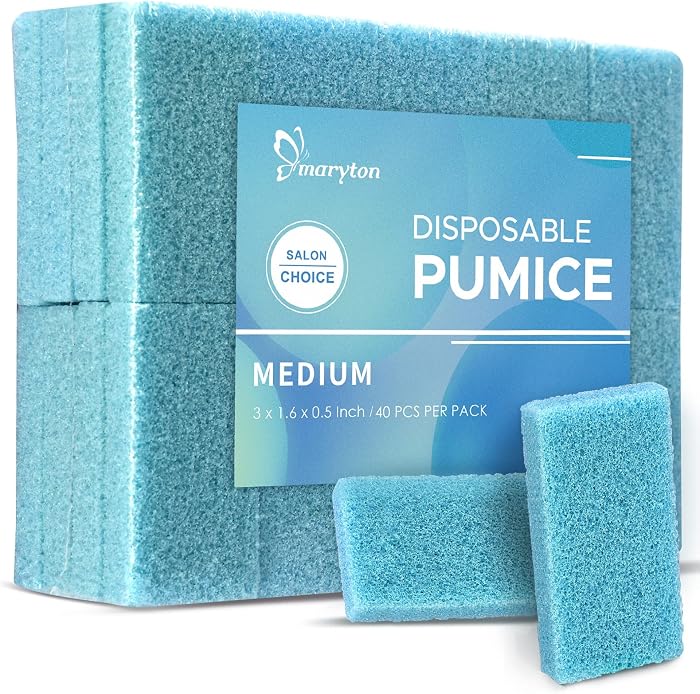
Maryton Disposable Scrubbers Best for Salon and Travel

Key details

Pieces
40 pads
Material
Synthetic foam pumice
Dimensions
3 x 1.6 x 0.5 inches
Intended Use
Single use
Check Price on Amazon

Forty single-use scrubbers in one box is a strange recommendation for a household and an obvious one for a salon, a guest bathroom, or a carry-on. Each is a small foam pumice pad, about three inches across and half an inch thick, made to be soaked with the feet and then thrown away.

The appeal is hygiene without upkeep: nothing sits damp in a caddy between uses, and you can hand one to a friend or a client without a second thought. The trade is longevity — Maryton designs these for one pedicure and doesn't pretend otherwise, and they behave that way, thinning and losing their bite as you work. Used with a callus gel on softened skin, a pad does a decent job; just buy it as a supply rather than as a stone you keep.

Pros

  • 40 pads per box
  • Uniform grit on every pad
  • Nothing stored damp between users

Cons

  • Single-use by design
Our verdict

We keep these in mind for salons, guest baths, and travel: forty single-use pads that skip the damp-stone problem entirely.

Check Latest Price

How We Tested 14 Pumice Stones Over Three Months

To build the shortlist, I read through customer reviews of pumice stones in every format I could find — plain volcanic rock, handled stones, pumice pads, and two-sided synthetic blocks — and filtered out anything with a run of complaints about arriving cracked, handles snapping, or grit going smooth within a week. That left 14 stones, nearly all under $15, which my team and I used for three months.

Every stone got the same workout. I used each on wet skin right after a shower, two or three times a week, working the heel and the ball of the foot and counting strokes until the callus visibly flattened — some took twenty seconds, others took five minutes of nothing happening. After each session I ran a thumb over the spot to judge smoothness, then checked an hour later whether the skin felt tight, raw, or stinging, which is where the coarse stones separated themselves from the merely effective ones.

For durability, I weighed each stone at the start, at six weeks, and at twelve, and stored half of them in a wet shower caddy the way most people actually do — those told us whether a stone holds its grit or turns to mush sitting in water. Handles and grips were tested with wet, soapy hands, including whether the handle reached my heel without cramping my wrist. For value, I tallied cost per use across the three months and noted what came in the box: a cord, a brush, a travel case, or nothing at all.

How to Choose a Pumice Stone

Material sets the grit

Natural lava is porous and mildly abrasive: it cuts softened skin quickly, sheds grit while it works, and wears flat over time. Synthetic bars are uniform, so the texture you feel on day one is the texture you get in month three, and the material chips away instead of clogging. Ceramic and terracotta are denser still, with no shedding, a scrub face that stays flat, and the most cutting power per pass.

Match that to your skin rather than to the label. Thick, hard calluses want the coarse face of a dense stone; weekly upkeep between pedicures is a medium grit and a light hand. If your heels are only slightly rough, the gentlest tool here will do the job.

Handle or hand stone

A palm-sized stone is inexpensive, packable, and easy to replace, but reaching the outside edge of a heel with one means bending and balancing, which is awkward on a wet shower floor. A long handle, like the ten inches on the Tweezerman above, lets you sit down and keep your foot flat. If bending is uncomfortable or balance worries you, that handle is worth both the money and the shelf space.

The call flips for travel. A small stone drops into a toiletry bag; a handled tool does not, so the two formats genuinely serve different buyers rather than one being better.

Wet skin, dry storage

Every stone here works on softened skin: soak for a few minutes, wet the stone with soapy water, and use light circular pressure, checking as you go. Storage is where most stones quietly fail. Left sitting in water, lava goes soft and sheds, and a damp stone never quite dries.

A rope loop lets a stone hang in the shower; a bar or a handled tool should stand on end or sit somewhere it can air out. Rinse it after each use, shake it off, and let it dry before it goes back in the caddy.

How many stones you need

Multi-packs are about households, not hoarding. One stone per person is the hygienic answer, and a spare in a gym bag or a guest bathroom earns its place. Beyond that, extra stones are money sitting in a drawer.

If it's just you and the stone never leaves the bathroom, buy one good tool instead — the money is better spent on a handle or on a denser material that holds its grit.

Frequently Asked Questions

Final Verdict

The Tweezerman Sole Smoother is the stone we point most people to. Ten inches of handle mean you can work sitting down with your foot flat, the coarse and smooth faces cover both a repair job and a quick tidy-up, and the waterproof ceramic head doesn't shed grit into the tub. It costs more than anything else here, and it earns that if the stone lives in your shower.

If it needs to travel, or the budget is tighter, the Asqraqo two-pack is the better buy: two natural stones, a rope loop on each, and a spare for a gym bag. For heels that have gone genuinely hard, the wide terracotta face of the Gilden Tree does more per pass.