Best Anti-Aging Devices of 2026

An in-office radiofrequency session costs about as much as a good pair of boots, and you have to keep going back. That's the pitch behind at-home anti-aging devices: buy once, use it a few minutes a night, and get firmer-looking skin on your own schedule. The catch is that every box promises the same thing, whether it holds a tiny wand or a full face mask.

I once bought a buzzy little wand, used it four times, and let it die in a drawer, so I know the real question isn't how many settings a device has — it's whether you'll still reach for it in March. Over eight months, my team and I ran nine devices through real evenings, after cleansing, before bed, on nights we were tired. Consistency does more for skin than power, and the ones that stuck were comfortable enough to finish a full session and sturdy enough to live on a bathroom shelf. Here's what earned the counter space.

The Best Anti-Aging Devices

1

iRestore Red Light Mask Best Overall

Key details

LEDs
360
Type
LED face mask
Wavelengths
635 nm red, 830 nm infrared, 415 nm blue
Session Time
10 minutes, 3–5 times a week
Check Price on Amazon

Ten minutes, three to five times a week, is the entire commitment — and that is the reason this mask is our top pick. The iRestore hovers over your face on a dual strap rather than pressing its lights into your nose, and the shell is built to block direct light from your eyes, so you can put it on, start a timer, and get on with your evening.

Inside, 360 LEDs run three wavelengths: 635 nm red and 830 nm infrared for tone and fine lines, plus 415 nm blue for the breakout-prone weeks. That blue option is what makes this a mask for the whole month rather than the run-up to an event. In our sessions the red and infrared settings were the ones we kept coming back to; blue is a mode for patches, not every night.

Comfort is what decides whether a mask gets worn, and this one stays put without being clamped on. At just under two pounds it isn't weightless, but the dual strap spreads it, and the eye shielding means no stray light creeping in at the edges. Use it over your usual serum — the instructions allow it — and keep sessions at the ten minutes the brand specifies rather than stretching them.

Two things to know before you order. It sits at the premium end of this set, and the results you're paying for depend on that three-to-five-times-a-week cadence, so a mask that lives in a drawer is money gone. The other is smaller: with the lights running and your eyes shielded, you won't be reading through it. Of everything here, though, this is the device we are most confident handing to someone who wants one good mask and no fuss.

Pros

  • Three wavelengths: red, infrared, blue
  • Ten-minute sessions, three to five times weekly
  • Hovers off the face with built-in eye shielding
  • Light enough to wear without holding it

Cons

  • Premium price tier
  • Needs three to five sessions a week to deliver
Our verdict

Our default pick: three wavelengths, ten minutes, and a fit comfortable enough to wear five nights a week — which is what this category actually demands.

Check Latest Price
2

Shark CryoGlow LED Mask Best for Under-Eye Puffiness

Key details

Type
LED mask with under-eye cooling
Treatments
4 (Better Aging, Skin Clearing, Skin Sustain, Under-Eye Revive)
Wavelengths
Red, blue, deep infrared
Session Time
6 minutes on Better Aging
Check Price on Amazon

Chilled plates sit under each eye, and that is the difference. Where most masks treat the whole face and let the under-eye area fend for itself, the CryoGlow runs red, blue, and deep-infrared LEDs alongside cooling pads — and it does it in six minutes on the Better Aging setting, the shortest session in this roundup.

The four presets are the other reason we rate it. Better Aging, Skin Clearing, Skin Sustain, and Under-Eye Revive each pair a light recipe with a duration, so there is nothing to configure at ten at night when you're tired. Shark's clinical testing on 119 participants is the brand's own claim and not something we can check, but the treatment design is coherent: red and infrared for lines and firmness, blue for breakouts, cooling for the morning after a late night.

Battery life is the trade-off. The charge doesn't stretch far, and once it's part of your day, charging becomes part of your day too — leave the cable where you store the mask, not in a drawer across the room. It also sits heavily enough that you may find yourself holding it up rather than trusting the strap. Neither stops us recommending it; both mean it earns its place beside a full-face mask rather than replacing one.

Pros

  • Cooling plates target the under-eye area
  • Six-minute sessions, the shortest here
  • Four named presets, no guesswork

Cons

  • Premium price tier
  • Sits heavily on the face
Our verdict

If your complaint is under-eye puffiness, we point you here: six minutes, four presets, and chilled plates no other pick in this set has.

Check Latest Price
3

INTEO Face & Neck Mask Best for Face and Neck

Key details

LEDs
680
Type
Wireless LED mask with neck piece
Power
Rechargeable, 120 minutes per charge
Wavelengths
630 nm red, 460 nm blue, 605 nm amber, 850 nm near-infrared
Check Price on Amazon

Most LED masks stop at the jaw, which leaves the neck to whatever your serum can manage. This one keeps going: a separate neck panel is part of the set, and the two pieces together carry 680 light beads across face, neck, and chest — the area a face-only mask quietly skips.

Four modes cover 630 nm red, 460 nm blue, 605 nm amber, and 850 nm near-infrared, and a remote handles the timer, so you're not tapping a button against your own face. The shell is soft silicone rather than rigid plastic, which makes a full session easier to sit through than the hard-shell masks here. It's cordless, and a week of sessions comes out of a single charge.

It runs large, though. On a narrow face the chin edge sits forward rather than flush, and the strap ends up doing the holding. Set that strap before your first session instead of fidgeting with it mid-treatment and the fit stops being a topic. For face-and-neck coverage at this price tier, we haven't found a better-balanced mask in this set.

Pros

  • Face, neck, and chest coverage in one set
  • 680 beads across four wavelengths
  • Wireless with a remote timer
  • Soft silicone wears comfortably

Cons

  • About 120 minutes of runtime per charge
Our verdict

The pick we make when the neck matters: face, neck, and chest coverage in soft silicone, for a good deal less than our top pick.

Check Latest Price
4

medicube Mini Booster Pro Plus Best for Travel

Key details

Type
Handheld facial device
Modes
Red, blue, purple
Weight
4.6 oz
Intensity
5 levels
Check Price on Amazon

At 4.6 ounces and about six inches long, this is the one that goes in the toiletry bag. Three modes — red, blue, and purple — with five intensity levels and a metal head that works your serum across the skin rather than just shining on it. We think of it as the device for people who won't sit still for a mask: a pass along the jaw and around the mouth while the kettle boils, done.

What it isn't is a whole-face treatment. The head is small, so cheeks, forehead, and jaw take more passes than a mask would, and the top intensity is a real sensation rather than a gentle hum — start at level one and work up over a week. It earns its keep on targeted work: the lines around the mouth, the jawline, the hollow under the eye. medicube's 625% absorption figure comes from a brand-commissioned study we can't verify, so treat it as marketing rather than a promise.

Pros

  • Pocketable at 4.6 ounces
  • Three modes with five intensity levels
  • Metal head works product into the skin

Cons

  • Small head means more passes for full-face coverage
Our verdict

We keep this one in the travel bag: a pocket-sized wand for jaw, mouth lines, and under-eyes in the minutes before you head out.

Check Latest Price
5

GLO24K LED Face & Neck Wand Best Heated Wand

Key details

Type
LED wand for face and neck
Power
Cordless, USB-C charging
Weight
9.6 oz
Check Price on Amazon

The neck and jawline are what this wand was designed around: a rounded massage head that follows the contour under the chin and down the throat, with LED light modes and vibration, and a head that warms against the skin as you work. It's a sit-down tool you hold rather than a hands-free mask — you're massaging, not waiting.

The shape is why we keep it in the roundup. Plenty of devices here treat the neck as an afterthought, where you tilt your head back and hope; this head actually wraps the jaw and runs down the throat in one stroke. Add the warmth and the vibration and it becomes the most pleasant ten minutes in this set, which matters more than it sounds. A device that feels good is a device you use on a Tuesday.

Two practical notes. It's a manual routine, so what you get out depends on doing the passes rather than on a timer running out, and 9.6 ounces of metal and plastic is fine in the hand for five minutes and noticeable at ten. It also works best glided over a serum or night cream rather than on dry skin, so it slots in at the end of your routine rather than replacing anything in it.

Pros

  • Shaped for the neck and jawline
  • LED light, vibration, and warmth together
  • Cordless with USB-C charging

Cons

  • Needs a hand for the entire session
Our verdict

We reach for this one on the neck and jaw — a warmed wand that turns a manual ten-minute pass into the part of the routine we look forward to.

Check Latest Price
6

Viconor Red Light Panel Best Budget Pick

Key details

LEDs
120
Type
Red light panel with stand
Stand
Adjustable
Wavelengths
660 nm red, 850 nm infrared
Check Price on Amazon

This is the least expensive way into light therapy here, and the only pick that treats a shoulder as easily as a cheek. A curved 120-LED panel on an adjustable stand, 660 nm red and 850 nm infrared, aimed wherever you point it — face at one height, knee at another.

Assembly takes a few minutes and is straightforward; the stand is the part to be careful with. It's stable once every knob is tight, but it can come apart if it gets knocked while those knobs are loose, so find a corner for it and leave it there instead of folding it away between sessions. Aim it, tighten, then step back and check before you settle in.

We rate it the value pick, and not only on cost. Face and body from one device means you aren't buying a second thing for your neck or your shoulder, and the curved face concentrates the light so you're not chasing it around. What you give up is hands-free convenience: you sit still in one position rather than wearing the treatment.

Two things to plan for. There's no session timer on the controller, so set one on your phone or you'll lose track of how long you've been sitting there. And because the light reaches you at a distance rather than against your skin, treat the first week as calibration — find the height and angle you'll actually keep, mark it, and stop adjusting. Once it's set, it's the most versatile device in this set.

Pros

  • Face and body from a single panel
  • Adjustable stand aims the light
  • Quick to assemble
  • Lowest price tier here

Cons

  • No session timer on the controller
Our verdict

Our budget pick does more than faces: a stand-mounted panel for skin and sore shoulders, provided you set it up once and leave it.

Check Latest Price
7

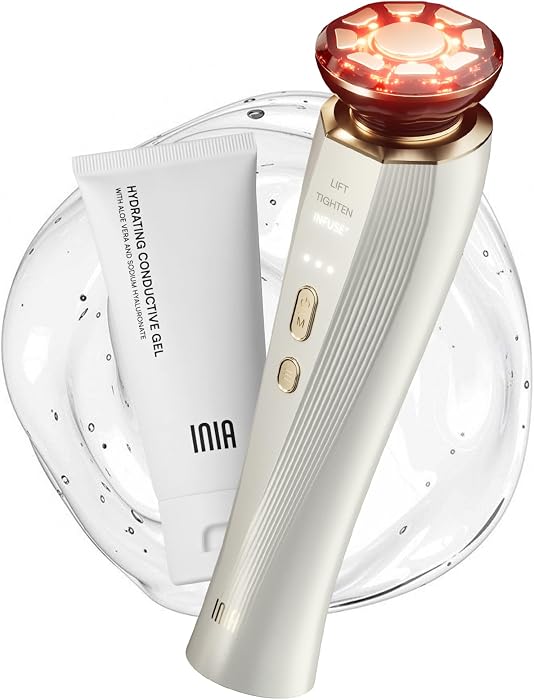
INIA Flare 3-in-1 Best for Lifting and Firming

Key details

Head
3D articulating
Type
3-in-1 facial device
Modes
Lift, Tighten, Infuse
Weight
1.22 lb
Check Price on Amazon

This one is for a specific buyer: someone who wants to do something to their face rather than sit under a light. Three modes, a 3D articulating head that follows the cheek and jaw, and a mix of vibration, red light, and low-level current that makes it feel like a treatment rather than a wait.

The modes are Lift for contouring massage, Tighten for red light plus vibration around the eyes, and Infuse, which uses negative-ion contact through zinc-alloy electrodes to help products sink in. Run in sequence, they make a routine that's more active than a mask and more targeted than a plain wand.

The sensation is what we noticed first. The current modes range from a faint pulse to a genuine sting depending on the setting and how damp your skin is, and metal on dry skin is where the unpleasant version happens — keep a serum under the head, start at the lowest level, and don't chase the strongest setting because it feels like it must be doing more.

Longevity is the open question: units have quit within the first month, so buy it somewhere with a straightforward return and register it the day it arrives. That caveat keeps it in also-consider rather than higher up. The three-mode format is genuinely useful for lifting-focused routines, and it makes a sensible second device for someone who already owns a mask.

Pros

  • Three modes: lift, tighten, infuse
  • 3D head follows the jaw and cheek
  • Combines light, vibration, and current

Cons

  • Stinging sensation at higher settings
  • Units have quit within the first month
Our verdict

We rate it as a second device: three modes for lifting and infusing, best once you know how much current your face will take.

Check Latest Price
8

INIA Glow 4D Mask Mid-Price Mask

Key details

LEDs
320
Type
Wireless silicone LED mask
Cooling
Magnetic gel eye pad
Light Modes
Red, blue, amber, combo
Check Price on Amazon

A flexible silicone mask bends to your face instead of hovering over it, and that single difference decides who this is for. If a rigid shell feels claustrophobic or leaves gaps at the temples, the Glow 4D conforms. It also means the fit is down to the strap, so set it before the lights go on rather than shuffling it around mid-session.

Inside there are 320 LEDs across four modes — red, blue, amber, and a combo setting — plus dual near-infrared channels, and a magnetic cooling gel pad that lives in the fridge and sits over the eyes on puffy mornings. It's cordless, so you can walk around while it runs.

Where it falls short of our top pick is the chin. The array thins toward the bottom edge, so the jaw and the underside of the chin don't get the same treatment as the cheeks and forehead. We don't think that's disqualifying at this price tier; the flexibility and the cooling pad are what you're buying, and both are real.

What we tell a friend: it's a real mask, not a gadget, and the flexibility is the reason to pick it over a rigid one. Wear it for a full session before you commit, because the strap and the weight are what decide it and both are personal. If you want maximum coverage right down to the jaw, spend more elsewhere in this set.

Pros

  • 320 LEDs in flexible medical-grade silicone
  • Four modes including dual near-infrared
  • Magnetic cooling pad for puffiness
  • Cordless and easy to move around in

Cons

  • Noticeable weight across a full session
Our verdict

We hand this to anyone who finds rigid masks claustrophobic — 320 LEDs, four modes, and a cooling pad for puffy mornings.

Check Latest Price

How We Tested the Best Anti-Aging Devices

We started by pulling every at-home device we could find from major retailers — LED masks, microcurrent wands, radiofrequency tools — and cut the list by specs: whether the device was cleared for home use, how long a session took, whether replacement parts were sold separately, and cost per treatment next to a single med-spa visit. That left nine worth ordering.

Nine devices went home with nine testers for eight months. Everyone used theirs on clean skin at night, four to five times a week, following the maker's own instructions rather than a schedule we invented.

At weeks zero, four, eight, and twelve, and again at the end, we photographed bare skin under the same bathroom light and compared. We noted whether cheeks looked plumper, whether the line between the brows softened, whether a jawline looked any different — and just as importantly, whether anything looked worse. Pain got logged every session: whether a microcurrent pulse made a tester flinch, whether radiofrequency got hot enough to pull the device away, whether a mask's light bothered anyone's eyes.

Alongside results we kept a plain running log. How many sessions per charge, how long a full charge took, whether a strap held its tension after weeks of stretching, whether a device survived a damp bathroom cabinet and one tumble off the sink. Setup got timed on the first night and again at month six, because the device you can run half-asleep is the one that outlasts the novelty. Value came down to cost per use across those eight months, not sticker price.

How to Choose an At-Home Anti-Aging Device

Pick the format around your actual evenings

Three formats do the work here, and they ask for very different things. A mask is hands-free: strap it on, start a timer, fold the laundry — which is why the shortest-session masks in this set are the easiest to keep up. A wand is manual and targeted: you hold it, so five to ten minutes on the jaw and neck is the realistic ceiling. A panel treats face or body from a short distance, but you have to sit still in front of it.

If you already abandon routines halfway through, buy the mask with the shortest session rather than the one with the most LEDs. The Viconor panel is the most versatile thing here, and it is also the one most likely to end up in a cupboard if you don't have a corner to leave it in.

Know what each technology can and cannot do

Red and near-infrared light are the workhorses for tone, texture, and fine lines; blue is there for breakout-prone skin, which is why three-wavelength masks like the iRestore cover more of the year than a red-only device. Current-based modes such as the Flare's lift and infuse settings work differently — they stimulate and massage, and the firming they produce is temporary, building only with regular sessions.

Vibration and warmth are comfort features rather than correction. They make ten minutes pleasant, and pleasant is what gets repeated. Match the technology to your actual complaint: dullness and puffiness on one side, lines and firmness on the other.

Fit and coverage decide the dose

Light only works where it lands, so coverage matters more than the LED count on the box. A mask that stops at the jaw leaves the neck untreated; the INTEO's separate neck panel is the fix if that's your concern. Fit matters just as much, because the light needs to reach skin evenly — which is why masks are built to sit slightly off the face, and why one that presses into your nose bridge is a mask you'll stop wearing.

Check the strap, the nose cutout, and the weight before you buy. Two pounds on your face for ten minutes is a very different thing from two pounds in your hand.

Budget for the battery and the warranty

Cordless is the feature you'll notice most, and the one with a running cost. Runtime per charge varies widely — the INTEO manages about a week of sessions on one charge, others want plugging in far more often — so think about where the charger will live and whether you'll remember it.

Then treat the device like any powered tool: register it, keep the receipt, and buy somewhere with a return window you can genuinely use. These things can fail quietly, months in, and a warranty claim is much easier with the receipt in your inbox.

Frequently Asked Questions

Final Verdict

After living with all of these, the iRestore is the one we hand to someone who wants a single recommendation. Not because it does the most — the Flare does more — but because ten minutes, three wavelengths, and a mask that doesn't need holding up is a routine that survives a real week, and this category rewards nothing else.

If your neck is what bothers you, the INTEO covers face, neck, and chest in soft silicone for a good deal less. If you want to treat a shoulder or a knee as easily as a cheek, the Viconor panel on its stand is the one to mount in a corner and leave there. The mask with the most LEDs isn't automatically the right one; the one you'll wear is.