Best NuFACE Dupes of 2026

Microcurrent devices promise a jawline that looks more awake and cheekbones with a little lift. The catch is that the best-known one costs as much as a weekend away, which is why so many of us go looking for a dupe. The worry underneath that search is real — that the cheaper version is just a buzzing noisemaker with a dying battery and a tingle. A good one does something unglamorous: it makes you want to use it five minutes a night, so the current actually gets a chance to work.

I've kept a microcurrent device in my bathroom drawer since 2021, and the gap between a great one and a dud has little to do with the name on the box. My team and I spent five months with 12 dupes, using them where they actually live: early mornings before work, Sunday nights on the couch, the evening before a wedding. The ones that stuck were comfortable enough to reach for when I was tired, simple enough that I never needed the manual twice, and quiet enough that the whole thing felt relaxing instead of clinical. The picks below earned a permanent spot next to my toothbrush.

The Best NuFACE Dupes

1

Hunvva EP-300 Microcurrent Device Best Overall

Key details

Modes
Microcurrent and red light
Weight
4.8 oz
Dimensions
1.57 x 2.76 x 4.33 in
Current Levels
5
Check Price on Amazon

At 4.8 ounces and 4.33 inches tall, the Hunvva EP-300 is the lightest wand here after the FOREO, and that matters around minute six of a jaw-and-cheek pass, when a heavier tool starts to feel like a dumbbell. The narrow head steers around the nose and into the hollow beside the mouth without clanking into your cheekbone.

What earns it the top spot is the current control. Five levels on one of the cheapest devices here is more adjustment than the FOREO or the AVORLA offers, and the range is wide enough to be genuinely useful: you can start low enough to feel only a faint tingle and work up over a couple of weeks until the muscle beside your mouth twitches under the head. That twitch is the point — microcurrent works on muscle, and muscle answers a current you can feel. The catch is the glide: load up with a conductive gel or a slippery water-based serum and top it up the moment the head starts to drag, because dry skin is what turns a tingle into a pinch.

The red light is real and pleasant, but the current is doing the visible work, so treat the light as a bonus rather than a second treatment. What we can't tell you yet is how long one of these lasts; there's no track record behind it the way there is behind a brand-name device. Buy it somewhere with easy returns, pair it with a large tube of gel, and give it three weeks of near-daily use before you make up your mind.

Pros

  • Five current levels to build up gradually
  • Under five ounces, easy to hold through a session
  • Narrow head reaches around the nose and jaw
  • Microcurrent and red light in one pass

Cons

  • Small head makes a full-face pass slow
Our verdict

The best first microcurrent device we tried: five levels of adjustable current, red light, and a narrow head that gets into the awkward spots, for the least money here.

Check Latest Price
2

FOREO BEAR mini Best for Eyes and Travel

Key details

Weight
2.08 oz
Warranty
2 years
Dimensions
1.25 x 2.2 x 2.24 in
Microcurrent Intensities
3
Check Price on Amazon

Just over two ounces is the whole idea. The BEAR mini is small enough to sit under the eye and beside the lip without the body of the device bumping your nose, and it disappears into a makeup bag. Around the brow bone it reaches places a wide plate simply can't, and after a few weeks it's the one that leaves the bathroom with us. It's also the slowest way to cover a whole face — this is a spot-treatment tool, not a ten-minute sweep.

What surprised us is the auto-adjust. The two spheres read how much resistance your skin is giving and set the current to match, so a patch you missed with gel doesn't spike the way it can on a device that holds one output. Three manual intensities sit on top of that, and the T-sonic pulsations add a fast, light buzz that makes a pass feel less clinical.

The premium covers size, that auto-adjust, and a two-year warranty — the longest cover here, and the reason the price doesn't sting as much as it looks. It doesn't buy more current; the Hunvva goes at least as strong. What it buys is precision and a safety net, and for something you hold against your eyelid, that's worth paying for.

Pros

  • Precise around the eye area and lip line
  • Adjusts current to your skin's resistance
  • Two-year warranty, the longest here

Cons

  • No wall adapter in the box, just a USB cord
  • Motor buzz is audible at the top intensity
Our verdict

The one we reach for around the eyes and throw in a bag: tiny, self-adjusting, and backed by the longest warranty here, though you'll pay for the polish.

Check Latest Price
3

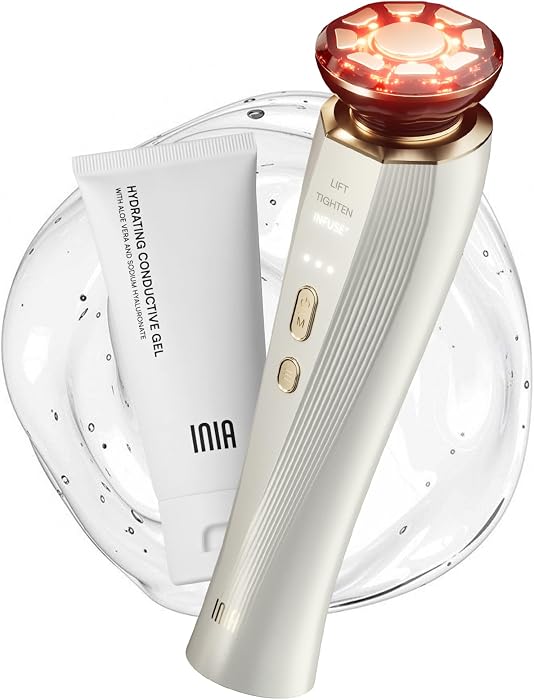
INIA Flare 3-in-1 Best for Full-Face Sessions

Key details

Head
3D articulating
Modes
Lift, tighten, infuse
Weight
1.22 lb
Dimensions
2.05 x 1.89 x 7.4 in
Check Price on Amazon

The Flare's head pivots — a 3D articulating plate on the end of a 7.4-inch handle — so it stays flat on your cheek as you sweep instead of rocking up onto an edge. On a jawline that curves in three directions, that's the difference between a smooth pass and a stuttering one.

Three modes do different jobs. Lift is vibration-led, Tighten pairs that with red light, and Infuse runs negative-ion current through zinc alloy electrodes to help a serum sink in. In practice the modes blur into one another during a session, and the red light is the part we noticed least; the vibration and the current are what you feel, and the long handle makes the side of the neck easy to reach without contorting your wrist.

This is the most full-face device in the group, and the one to choose if your routine is a proper ten-minute pass over jaw, cheek, and neck rather than a spot treatment. The caveat is longevity: units that quit within the first couple of months are the failure to plan for here, so buy somewhere with a return window you trust, and keep the box until you're past the first month.

Pros

  • Articulating head keeps contact on curved cheeks
  • Three modes including a red-light setting
  • Long handle reaches the neck easily

Cons

  • 1.22 pounds tires your arm before the pass ends
  • Current can feel sharp as you raise the level
Our verdict

A three-mode device with a pivoting head that stays flat on a curved jawline — the most full-face option here, if you'll accept the weight and a sharper current.

Check Latest Price
4

AVORLA LED Gua Sha Best for a Warm Gua Sha Routine

Key details

Weight
6.74 oz
Functions
Heat, microcurrent, red and blue LED
Dimensions
3.7 x 3.2 x 1.1 in
Intensity Levels
3
Check Price on Amazon

The AVORLA isn't a wand at all. It's a flat, stone-shaped plate roughly the size of a small bar of soap, curved along one edge, and the first thing it does is warm up. Within a minute or two it's noticeably hot against the skin, which turns a facial treatment into something closer to a hot-stone massage.

That warmth is why it earns a place. Warm skin and a bit of slip are what make a five-minute routine something you'll actually repeat on a Tuesday night, and repetition is the whole mechanism with microcurrent — one heroic session a month does nothing. The three intensity levels run from a light prickle to something quite strong, and the red and blue LEDs are a pleasant extra rather than a reason to buy.

Where it earns its keep is evening: after cleansing, with more gel than you think you need, it's five minutes of warmth that doesn't feel like a chore. It's also the best-covered device here on paper, with a one-year manufacturer warranty and a 90-day satisfaction window, which counts for something on a tool with a heating element in it.

Pros

  • Heat plus red and blue LED light
  • Curved edge hugs the jaw and cheek
  • Rechargeable and easy to pack
  • One-year warranty plus a 90-day satisfaction window

Cons

  • Too broad to work the eye area or lip line
  • Current can travel into the teeth along the jaw
Our verdict

A warm, flat gua sha plate with current and LEDs inside it — the easiest one here to use every night, as long as you want a broad, buzzy treatment rather than a precise one.

Check Latest Price
5

MiSMON 5-in-1 Facial Machine Multi-Mode Massage

Key details

Weight
4.41 oz
Vibration
Up to 8,600 rpm
Dimensions
1.96 x 1.96 x 7.08 in
Energy Levels
5
Check Price on Amazon

Two buttons, five modes, and a handle you grip like a thick pen: the MiSMON is a different animal from the wands above. It runs 7.08 inches long and 4.41 ounces, recharges by USB, and covers LED light therapy, high-frequency vibration, and microcurrent settings across five energy levels.

The vibration is what you notice. Eight thousand six hundred rpm is fast enough to feel like a proper massage rather than a tickle, and the LED modes give you something to work through in the ten-minute session the listing recommends two or three times a week. What you don't get is the precise, targeted current that makes a NuFACE-style device feel like it's working on muscle — here the buzz dominates and the current sits underneath it.

So it's a massager first and a toning device second, which is no bad thing if a daily five minutes is what you'll actually keep up. What it won't do is stand in for a real current-based device: if the muscle flicker is what you're chasing, the Hunvva costs less and is unambiguous about delivering it.

Pros

  • Five modes for one low-key daily routine
  • Fast 8,600 rpm vibration feels like real massage
  • Small and light enough to travel

Cons

  • Side button sits under your fingers and resets the mode
  • Power failures and units that won't turn on
Our verdict

A five-mode wand that's better at massage and light than at current — buy it for a daily five-minute ritual, not as a NuFACE substitute.

Check Latest Price

How We Tested 12 Microcurrent Dupes

The shortlist started with research rather than vibes. We read spec sheets for output, number of intensity levels, head shape, and how each device charges, then crossed off anything that was really a vibrating roller or a red-light wand with the word microcurrent in the marketing copy. Twelve devices made the cut, all of them priced like dupes rather than investments and all promising the same lifted, de-puffed look.

Each one moved into my bathroom drawer for five months and got used at least four nights a week, plus weekend sessions on the couch with a podcast on. We timed how long a charge actually lasted, noted whether the cable was standard USB-C or something proprietary that would be lost by week two, and cycled through every attachment head to see which extras earned their place. Comfort got the closest look: whether the current pricked, whether it pinched around the nose and jaw, and whether dialing down a level fixed it or killed the effect. We also tracked glide, since a device that drags and needs gel reapplied every 30 seconds doesn't get used twice, and took photos in the same light at the start, week four, week eight, and the finish.

By the end there was a clear split between devices that felt like a ritual and ones that felt like a chore, and it rarely came down to intensity. The keepers had heads that followed the curve of a cheekbone, intensity steps small enough to find a comfortable setting, and batteries that held through a week of short sessions. Two units quit charging inside six weeks — useful information about reliability — and came out of the running.

How to Choose an Affordable Microcurrent Device

Adjustable current beats a big number

Look for levels, not a maximum. A device that starts below your comfort threshold lets you build up over a few weeks; one with only an on switch leaves you either underwhelmed or wincing. The Hunvva's five levels give a real spread between the bottom and the top, while the FOREO and the AVORLA give you three.

The sensation to aim for is a light, even tingle that follows the head. A sharp pinch, a zap, or a pull means the current is too high or the skin has gone dry — turn it down rather than pushing through, because more current is not more lifting.

Budget for the gel, not just the device

Microcurrent needs a wet, conductive layer between metal and skin, and oil-based facial oils won't carry it. A thick water-based gel is easier to work with than a watery serum because it stays slippery for a whole pass, and you'll get through it faster than you expect if you use the device most days.

It's the cheapest part of the routine, so buy it in a size that makes reapplying feel normal. Keep the skin visibly wet and top up mid-pass instead of dragging through a dry patch.

Match the head to the zone you'll treat

Shape decides where a device is useful, and it matters more than any claim about power. Two small spheres, as on the FOREO BEAR mini, get under the eye and beside the lip. A flat plate, like the AVORLA, covers a jaw in two strokes and can't work a small area at all. An articulating head, as on the INIA, keeps full contact as your cheek curves away.

The trap here is assuming a bigger plate is stronger. It spreads the same current across more skin, which many people feel as a broader, harsher buzz rather than a more effective treatment.

Check the cord, the battery, and the box

Nearly everything here charges over USB, and some ship without a wall adapter — the FOREO expects you to supply one. If the device lives in a bathroom with no spare outlet, sort that before it arrives rather than after.

Weight is the other spec worth reading before you commit: the FOREO is just over two ounces, the INIA more than a pound, and that gap decides whether a device goes in a carry-on or stays in a drawer.

What these devices can and can't do

Microcurrent gives a temporary lift and some puffiness relief that lasts hours, plus a slower change in firmness with regular use. None of it replicates an in-office treatment, and no device here replaces one.

The variable you actually control is consistency, so buy according to whether you'll keep it up: five minutes most days is worth more than one long weekly session, and if you know your enthusiasm fades, the cheaper device that does the job is the better buy than the most impressive one.

Frequently Asked Questions

Final Verdict

Buy the Hunvva EP-300. It does the two things a NuFACE stand-in actually has to do — current you can dial down to comfortable, and a head that reaches the jaw, nose, and brow — and it costs as little as anything in this group. Everything above it buys precision, less weight, or a warranty, not a stronger treatment.

The one upgrade worth paying for: if the device will mostly travel, or if the eye area is your main concern, the FOREO BEAR mini's two ounces and two-year warranty justify the jump.