How to Reapply Sunscreen Over Makeup Without Starting Again
Every method of topping up over makeup delivers less than your morning application did. Knowing which ones deliver most — and that a partial top-up still beats none — is the whole skill.
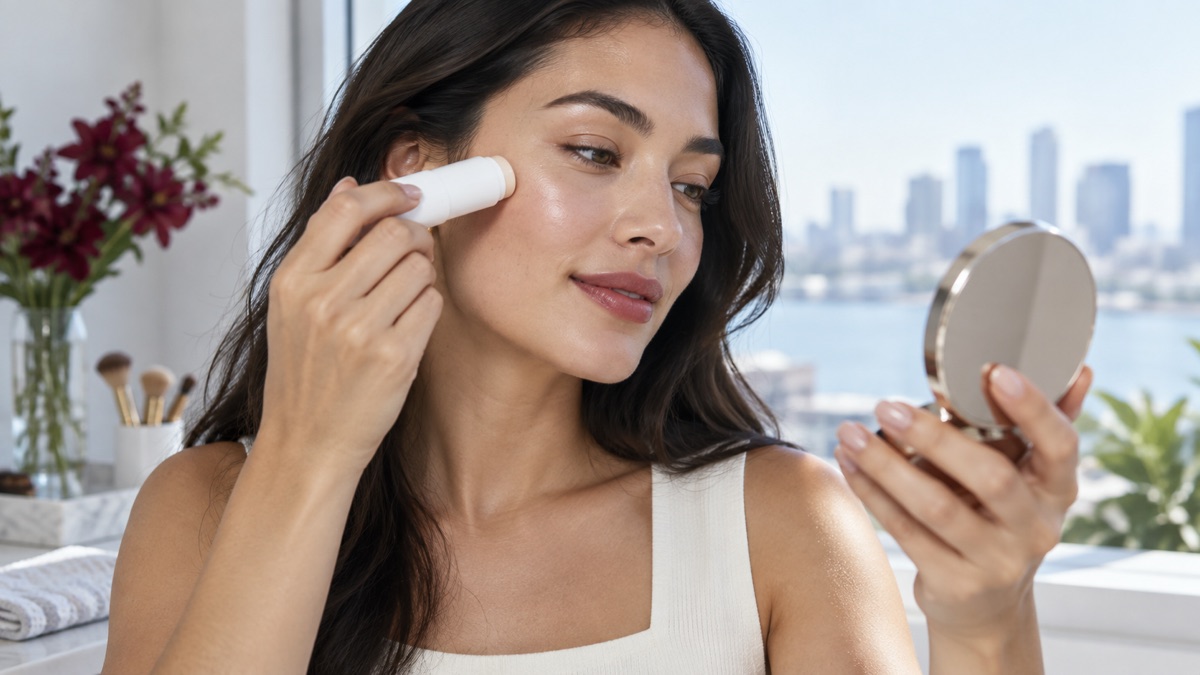
The morning application is a solved problem: at least a teaspoon of broad-spectrum SPF 30 or higher, on dry skin, 15 minutes before you go out. The unsolved problem is 2pm, when the AAD says to reapply and you are wearing foundation you would like to keep.
Start from an honest premise, because every guide that skips it gives bad advice afterward: no method of reapplying over makeup puts back as much sunscreen as the morning application did. The realistic goal is the best available top-up, not an equivalent one.
The methods, ranked by how much they actually deliver
| Method | Delivers | Makeup survival | Use it when |
|---|---|---|---|
| Remove and reapply properly | Full | None — you redo it | You are going to be outdoors for hours. Nothing else comes close. |
| Liquid SPF pressed on with a damp sponge | High | Good, if you press rather than sweep | The best realistic option on a workday |
| Cushion compact with SPF | Moderate–high | Excellent | You want coverage and protection in one step |
| SPF stick | Moderate–high | Good on targeted areas | Nose, cheekbones, hairline, ears — the places that burn first |
| Powder SPF | Low | Excellent | Genuinely better than nothing; never your only sunscreen |
| SPF setting spray | Low | Excellent | Same caveat as powder — a top-up, not a base layer |
| Foundation with SPF, alone | Very low | N/A | Not a sunscreen strategy. Nobody applies foundation at 2 mg/cm². |
Powders and sprays carry a real SPF number, tested at the standard density — and the amount you can physically get onto your face from a brush is a fraction of that. A light dusting delivers close to nothing; the people who use them well apply generously, in multiple passes, working around the face rather than once over. Treat powder as a useful midday top-up on top of a real morning application, never as the application itself.
The sponge method, in detail
This is the one worth learning, because it delivers the most while keeping most of your makeup.
- Step 1Dispense a normal amount of liquid sunscreen onto the back of your hand. Not a reduced amount because you are "only topping up" — the whole problem is under-application.
- Step 2Dampen a makeup sponge and squeeze it out. Damp, not wet. A dry sponge absorbs the product instead of depositing it.
- Step 3Press and roll, never sweep. Sweeping drags foundation around and lifts it; pressing deposits sunscreen on top of it. Work in sections.
- Step 4Do the edges people forget: ears, hairline, the sides of the neck, the back of the neck if your hair is up, and the tops of your hands.
- Step 5Let it set for a minute, then press powder if you need to mattify. If that powder has SPF in it, you have stacked two partial layers — which is the best outcome available short of starting over.
When you actually need to reapply — and when you do not
- Outdoors, or in and out all dayEvery two hoursThe AAD's figure, and also after swimming or sweating
- Commute, then indoors away from windows all dayUsually not neededGlass blocks most UVB; UVA is the reason the window matters
- Desk beside a large windowOnce around middayUVA passes through ordinary window glass
- Lunch outside, back to a deskReapply before you go out, not afterSunscreen is a pre-emptive step; applying it on return protects nothing
- Cloudy daySame as a clear oneUp to 80% of UV rays penetrate clouds
- Sweating or swimmingImmediately after, regardless of the clockWater resistance is a rating, not immunity
If your morning application is short — and for most people it is — fixing that beats optimizing your 2pm top-up. The AAD's figure is at least a teaspoon for the face, described as the amount that covers the length of your index and middle fingers. Doubling a too-small morning dose gains you more protection than any reapplication technique will.
Building a routine that makes this easy
Do
- Keep the top-up product in your bag, not on your bathroom shelf
- Press with a damp sponge instead of rubbing with fingers
- Prioritize the nose, cheekbones, ears and hairline — they burn first
- Reapply before going outside, not after
- Fix the morning dose first; it is the highest-leverage change
Don't
- Rely on SPF in foundation as your only protection
- Mix sunscreen into your foundation — you dilute the filter film
- Assume a light dusting of SPF powder counts as reapplication
- Skip it indoors if you sit beside a window
- Add SPF 30 powder over SPF 30 cream and assume you now have SPF 60 — SPF values do not add
The short version
Press a liquid sunscreen on with a damp sponge if you can; use a cushion compact or a generous powder if you cannot; and understand that all of them are partial. Reapply every two hours outdoors, before exposure rather than after, and put the effort you were going to spend optimizing your 2pm method into applying a full teaspoon at 8am instead.
Frequently Asked Questions
-
It carries a genuine SPF rating, tested at the standard density — the problem is that almost nobody applies that much powder to their face. Used generously with multiple passes it is a legitimate midday top-up. Used as a light dusting, or as the only sunscreen of the day, it is close to decorative. The useful framing: powder is how you extend a real morning application, not how you replace it.
-
No. SPF values do not add, and layering two products does not multiply protection. What the second layer does is restore some of the film that has degraded since morning, which is valuable in itself. Think of reapplication as maintaining a level, not stacking one.
-
Almost never, for one reason: SPF is measured at an application density of 2 mg/cm², and nobody applies foundation that thickly — you would look like you were wearing a mask. A foundation with SPF is a useful bonus layer on top of real sunscreen. On its own it delivers a small fraction of its stated number.
-
Usually not, with one exception: windows. Ordinary glass blocks most UVB but lets UVA through, so a desk beside a large window is a genuine exposure and worth one midday top-up. If you are away from windows and not stepping outside, your morning application is doing its job and you can leave it alone.
-
Shift the protection off your skin. A wide-brimmed hat and sunglasses do more for the face than any reapplication method, cost nothing in makeup, and do not degrade over the day. Add an SPF stick on the ears and hairline, which are rarely made up and burn first. Sun protection is not only a product problem.
-
No — you dilute the filter film that the SPF number was measured on, and with mineral formulas you can also clump the particles and create uneven coverage. Apply sunscreen as its own layer, let it set, then apply makeup. The step you save is not worth the protection you lose.