How to Make Perfume Last Longer — And Why Most Advice Aims at the Wrong Thing
Longevity is decided by concentration and base notes before you ever spray anything. Technique is worth an hour or two on top — real, but a rounding error next to what is in the bottle.
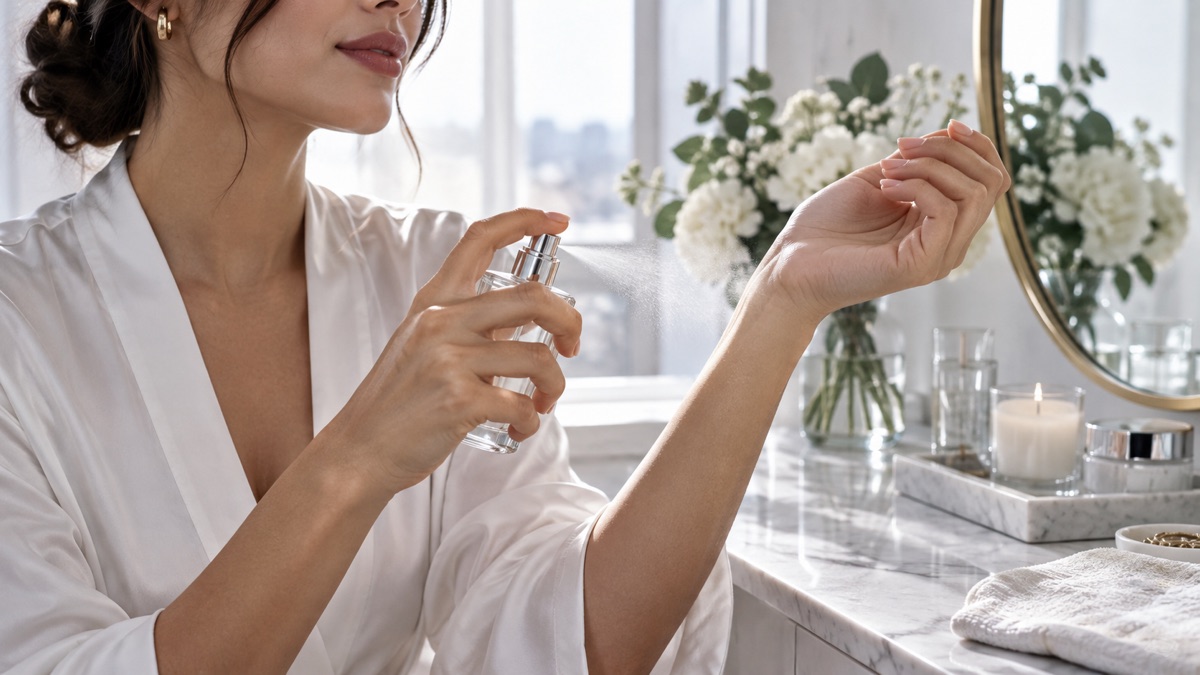
"It smells incredible for an hour and then it's gone." This is the most common complaint in fragrance, and the usual advice — spray more, spray your pulse points, rub your wrists — mostly does not address it, because the problem is almost never application. It is what is in the bottle, and how much of it there was to begin with.
First: it may not have disappeared at all
Two different things get described with the same sentence, and the fix is different for each.
Scenario 1
You stopped smelling it
- What happened
- Olfactory adaptation — your receptors stop reporting a constant, unchanging smell within minutes
- The tell
- Other people still comment on it; you catch it again after stepping outside and coming back
- Fix
- None needed, and spraying more is how people end up over-applying badly
Scenario 2
It genuinely evaporated
- What happened
- A top-heavy composition, a low concentration, or dry skin with nothing to hold it
- The tell
- Nobody notices it after lunch, and fabric you sprayed still smells of it
- Fix
- Everything below — but mostly, buy differently
Concentration is the biggest lever, and it is printed on the box
The category name on a bottle is a statement about how much aromatic compound is dissolved in the alcohol. Every other trick on this page is a rounding error next to it.
| Name on the bottle | Aromatic compounds | Rough expectation on skin |
|---|---|---|
| Parfum / Extrait | 15–30% (IFRA: typically ~20%) | All day, close to the skin |
| Eau de parfum (EdP) | 15–20% (typically ~15%) | Most of a working day |
| Eau de toilette (EdT) | 5–15% (typically ~10%) | An afternoon, with a bright opening |
| Eau de cologne (EdC) | 2–3% | An hour or two — by design |
| Eau fraîche | 3% or less | A splash; treat it as a refresher, not a fragrance |
The EdT of a fragrance is often not a diluted version of the EdP — it is a different composition. To make an EdT brighter and fresher, the oil is frequently tweaked to carry more top notes and fewer base notes. Chanel No. 5 is the textbook case: the parfum, EdP and EdT are genuinely different formulas, created decades apart. So "I'll buy the cheaper EdT of the one I like" can get you a fragrance that smells related and behaves completely differently.
Buy for the base, not the opening
Fragrant materials are classified by volatility, and Poucher's evaporation coefficients put top notes at 1–14, heart notes at 15–60 and base notes at 61–100. Longevity is entirely a question of what sits at the high end of that scale.
This is the single most useful shopping habit: read the base notes before the top notes. The opening sells the bottle; the base decides whether you still smell like anything at 4pm.
What application can actually change
Technique is worth perhaps an extra hour or two — real, but a fraction of what concentration does. In rough order of effect:
- BiggestApply to moisturized skin. Fragrance oil clings to lipids and evaporates fast off dry skin. An unscented moisturizer — or a thin film of something occlusive on the spot — gives the oil something to hold onto. This is why fragrance "disappears" on dry skin and lingers on oily skin.
- BigSpray onto skin, close, without rubbing. Rubbing your wrists together generates heat and accelerates the evaporation of the lightest molecules — the exact ones you most want to keep. Spray and let it dry.
- ModerateUse warm areas, but understand the trade. Pulse points project more because heat drives evaporation; that is the same reason they burn through faster. Warm spots for presence, cooler spots — behind the neck, the chest under clothing — for duration.
- ModerateLayer the same scent in a different format. A matching body lotion or oil holds fragrance far longer than alcohol on skin does, because there is no alcohol flashing off and a lipid base to sit in.
- FreePut some on fabric. Scarves, coat collars and hair hold scent for days rather than hours. Test on an inconspicuous corner first — oils can stain silk and pale fabrics.
Spraying an alcohol-based fragrance directly onto hair is drying, particularly on color-treated or curly hair. Spray a brush and run it through instead, or use a proper hair mist, which is formulated at a lower alcohol content for exactly this reason.
Storage is where most bottles quietly die
Fragrance is degraded by three things — heat, light and oxygen — and the standard place people keep it, a bathroom shelf, supplies all three. A bottle stored badly loses its top notes first and turns sour or flat at the opening, which people then misread as the fragrance "not lasting."
Do
- Keep bottles in a drawer, a cupboard, or the original box
- Store somewhere cool and stable — a bedroom, not a bathroom
- Keep the cap on; the sprayer is not an airtight seal
- Decant into a small atomizer for travel rather than carrying the full bottle around
- Finish what you own — fragrance is not a collectible that improves with age
Don't
- Keep it on a sunny windowsill or a bathroom shelf above a hot shower
- Rub your wrists together after spraying
- Spray into the air and walk through it — most of it lands on the floor
- Expect a citrus cologne to last eight hours; it was not built to
- Judge longevity from the first ten minutes of a sample on a paper strip
Match the fragrance to the occasion
- You want it to last all day at workEdP or parfum, woody or amber baseAnd apply to moisturized skin under clothing rather than on the wrists
- You want a bright, fresh opening in summerEdT, and accept the timelineCarry a 5ml decant and reapply at lunch — that is how citrus fragrances are meant to be worn
- You work somewhere fragrance-sensitiveSkin-close base notes, one sprayMusks and soft woods sit near the skin instead of filling a room
- People say they can't smell it but you canYou are fineThat is the intended distance for most modern musks
- It smells sour or sharp in the first minutesThe bottle has oxidizedStorage problem, not a longevity problem — and it is not reversible
The summary
Longevity is bought, not applied. Concentration sets the ceiling, the base notes decide whether anything is left at hour four, and storage decides whether the bottle still smells like it did in the shop. Application technique — moisturized skin, no rubbing, fabric, matching lotion — is worth an hour or two on top of that. Anyone promising more than that from a spraying trick is selling you something.
Frequently Asked Questions
-
Skin lipids, mostly. Fragrance oil clings to a lipid-rich surface and evaporates quickly off a dry one, which is why the same scent can run for eight hours on oily skin and three on dry. Skin pH, body temperature and even what you eat shift the drydown slightly, but dryness is the dominant variable — and it is the one you can fix with an unscented moisturizer before you spray.
-
It increases intensity and projection, not duration by much. More top notes evaporating faster is still top notes evaporating. If the composition has a thin base, a fourth spray mostly buys you a louder first hour and an identical fourth hour — and risks being the person others can smell from across the room. Layering with a matching lotion adds more duration than an extra spray does.
-
The usual explanation — that rubbing "crushes the molecules" — is nonsense, but the advice is still sound for a different reason: friction generates heat, and heat accelerates evaporation of exactly the lightest, most fragile top notes. Spray and let it dry on its own. The effect is modest, but it costs nothing to do it right.
-
Warm areas project more and fade faster; cooler, covered areas last longer and stay closer. A practical split: one spray at the base of the throat or chest under clothing for duration, one on a pulse point if you want people to notice it. Adding fabric — a scarf, a coat collar — gives you a reservoir that outlasts skin by days.
-
It degrades rather than spoils, and heat, light and oxygen drive it. The top notes go first, so an old bottle often opens sharp or sour while the base still smells more or less correct. Citrus-heavy fragrances turn fastest; heavy amber and woody compositions are the most forgiving. Storing bottles boxed, in a cool dark drawer rather than a bathroom, is the whole preservation strategy.
-
No — they are independent. Sillage is the trail of scent you leave behind you; longevity is how long any of it is detectable at all. A big-sillage fragrance can vanish in two hours, and a skin-close musk can quietly persist all day. If you want presence, look at projection; if you want duration, look at the base notes and the concentration.