How to Patch Test Skincare — And Why 24 Hours Isn't a Test
There are two kinds of reaction and they run on different clocks. The one that stings shows up in minutes. The one that leaves you with a rash for a fortnight takes days — which is exactly what an overnight test cannot see.
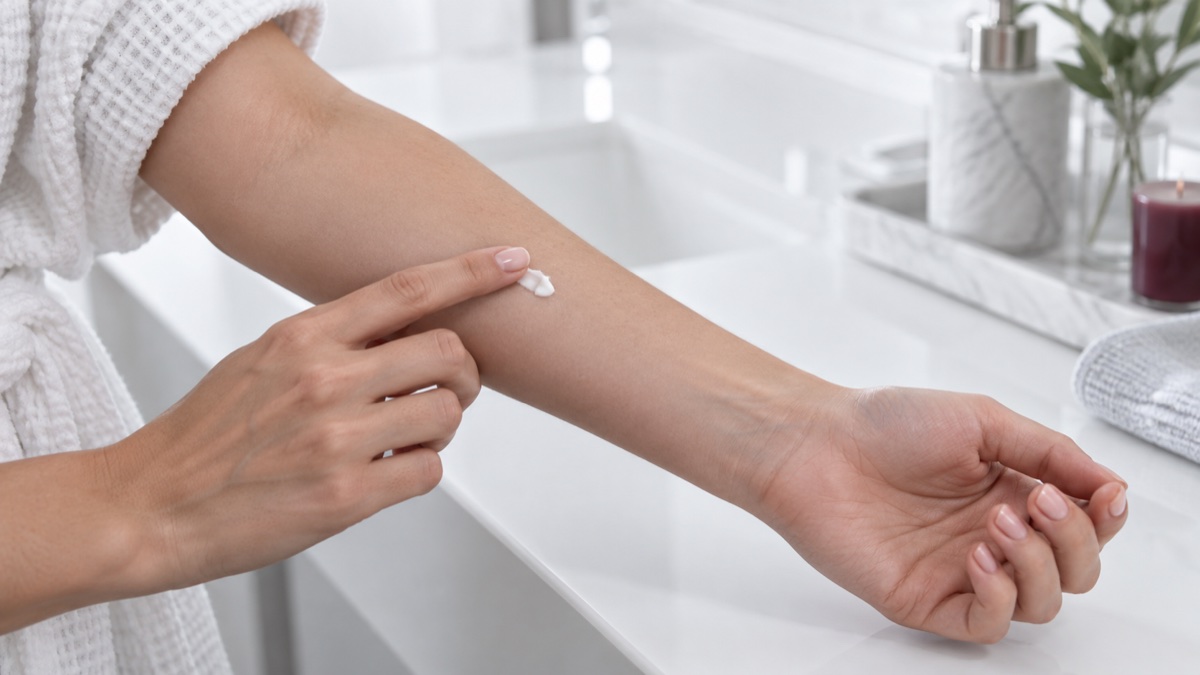
"Patch test first" is the most repeated and least explained instruction in skincare. Most people interpret it as dabbing something on their wrist, waiting until bedtime, and declaring it fine. That version of the test catches almost nothing worth catching.
The reason is that there are two completely different reactions, and they run on different clocks.
Irritant vs allergic — the distinction that makes the test work
Reaction 1
Irritant contact reaction
- Feels like
- Stinging, burning, tightness, immediate redness
- Timing
- Minutes to hours, on the very first contact
- Cause
- The ingredient is harsh for your skin right now — low pH, high active, damaged barrier
- Anyone can get it
- Yes, given a strong enough product
- What it means
- Often "not yet" rather than "never" — barrier repair can change the answer
Reaction 2
Allergic contact dermatitis
- Feels like
- Itch more than sting; swelling; a rash that spreads beyond where you applied it
- Timing
- Typically one to four days, sometimes longer on first exposure
- Cause
- An immune response — frequently to a preservative or a fragrance component
- Anyone can get it
- Only if you are sensitized to that specific ingredient
- What it means
- Usually permanent. That ingredient is off your list for good.
Allergy is the reaction you are testing for, because it is the one that lasts, spreads, and can take weeks to settle. It is also the one a 24-hour test cannot see. That is the entire argument for testing properly.
The protocol dermatologists actually recommend
The American Academy of Dermatology's version is specific, and the duration is the part people cut.
- Choose the spotA quarter-sized area somewhere it will not be rubbed off or washed away — the underside of the arm or the bend of the elbow.
- ApplyTwice a day, for seven to 10 days. The same amount you would actually use, not a smear. Repeated exposure is what reveals a sensitization that a single application hides.
- WatchCheck daily, and look for itch as much as redness. Redness that fades in an hour is irritation. Itching, swelling, small bumps, or a patch spreading past the edges of where you applied it is the allergic pattern.
- If it is clearIntroduce it to your face alone — one new product at a time, two more weeks before adding anything else.
- If it reactsStop, wash it off, and write down the product name. Keep the packaging. If you ever go for professional patch testing, that ingredient list is the most useful thing you can bring.
Two products, two well-separated spots, labelled in a note on your phone. What you must not do is test two things in the same place, or start three at once on your face and try to work backwards.
Where to test — and when the arm is the wrong place
| Site | Best for | Trade-off |
|---|---|---|
| Inner forearm / elbow crease | The AAD's recommendation — allergy screening for anything | Arm skin is tougher than facial skin, so it under-reports stinging |
| Behind the ear / along the jaw | Products going on the face, when you want a realistic tolerance read | Harder to keep undisturbed; more visible if it reacts |
| Side of the neck | A reasonable middle ground for facial products | Thin skin — a reaction here can look dramatic |
| The eyelid area | Nowhere. Never test here. | The thinnest skin on the body and the slowest to recover |
A practical compromise: run the full seven-to-10-day test on the arm to screen for allergy, then do a two-night trial on a small area of the jaw before committing the product to your whole face. The first test answers "will this give me a rash." The second answers "will this sting."
What patch testing cannot tell you
- Whether it will break you out. Comedogenic reactions take two to six weeks to appear and do not show on an arm at all. Only time on your actual face answers this.
- Whether it works. Obviously — but worth saying, because people conflate "did not react" with "good product."
- How it behaves stacked. A product can be fine alone and intolerable over a retinoid. Test alone, then introduce into the routine slowly.
- Photo-reactions. A few ingredients only react in combination with sunlight, and a covered arm patch will not reveal that.
- Cumulative irritation. Ten days of use tells you about ten days. Some products only become a problem in month two, which is why a new product deserves attention well past the test.
If everything you apply reacts, home testing has hit its limit — that pattern usually means a damaged barrier or an allergy to something common across many products, like a preservative. A dermatologist can run medical patch testing, which screens dozens of specific allergens at once and tells you the ingredient name rather than the product name. That is the difference between avoiding one bottle and avoiding one molecule for life.
When to bother, and when not to
- You have reacted to skincare beforeAlways test, full 7–10 daysA history of reaction is the strongest predictor of the next one
- Eczema, rosacea, or generally sensitive skinAlways testAnd prefer short ingredient lists — fewer suspects
- A new active: retinoid, acid, high-strength vitamin CTest, but expect some stingIrritation is expected here; you are testing for allergy and for degree
- A plain moisturizer from a brand you already use happilyReasonable to skipLow base rate — though preservatives do change between products
- Anything going near the eyes, or on a childAlways testLow tolerance for getting this wrong
- Anything with essential oils or a long botanical listAlways testBotanical extracts are a common source of contact allergy
The short version
A quarter-sized spot on the inner arm, twice a day, for seven to 10 days — not overnight. Watch for itch and spreading, not just redness. Then introduce it to your face alone, and give it two weeks before adding anything else. It is slower than anyone wants, and it is still faster than spending a month working out which of five new products gave you a rash.
Frequently Asked Questions
-
You can, but understand what you are buying: that test detects obvious irritants and nothing else. Allergic contact dermatitis — the reaction that actually causes a two-week problem — typically takes one to four days and often needs repeated exposure to show up at all. If you are going to test, the seven-to-ten-day version is the one that earns its inconvenience.
-
Irritation: redness and stinging that appear quickly and fade within an hour or two of washing it off. Allergy: itching more than stinging, small bumps or blisters, swelling, and — the most useful tell — a rash that extends past the edges of where you applied the product. If the reaction has a border wider than your test spot, treat it as an allergy.
-
Yes, and it is one of the more counterintuitive facts about contact allergy. Sensitization requires prior exposure, so an allergy can develop to something you have used happily for years. Reformulation is another common explanation — brands change preservatives and fragrance compositions without changing the packaging. Either way, stop using it and keep the bottle.
-
It is worth doing, particularly for chemical filters, which are a recognized source of contact and photo-allergic reactions. Test on the arm for the full window. If a sunscreen reacts, try a mineral one with zinc oxide or titanium dioxide before concluding that sunscreen is impossible for you — the filter class matters more than the category.
-
As many as you can keep physically separated and reliably labelled — one per arm is easy, two per arm is workable with a gap between them and a note on your phone. What breaks the test is putting two products in the same place, or introducing several to your face at once. If something reacts and you cannot say which product it was, you have learned nothing.
-
It is a clinical procedure: a dermatologist applies a panel of standardized allergens to your back under occlusion and reads the reactions over several days. It identifies the specific ingredient you react to rather than the specific product — which means you can then avoid that molecule across every product you will ever buy. It is the right next step if home testing keeps failing or if you have recurring unexplained facial dermatitis.