Skin Cycling: The Four-Night Routine, and the Part Nobody Tells You
Exfoliate, retinoid, recover, recover, repeat. It works — but not because the sequence is special. It works because it makes the rest nights impossible to skip, which is the step everyone quietly drops.
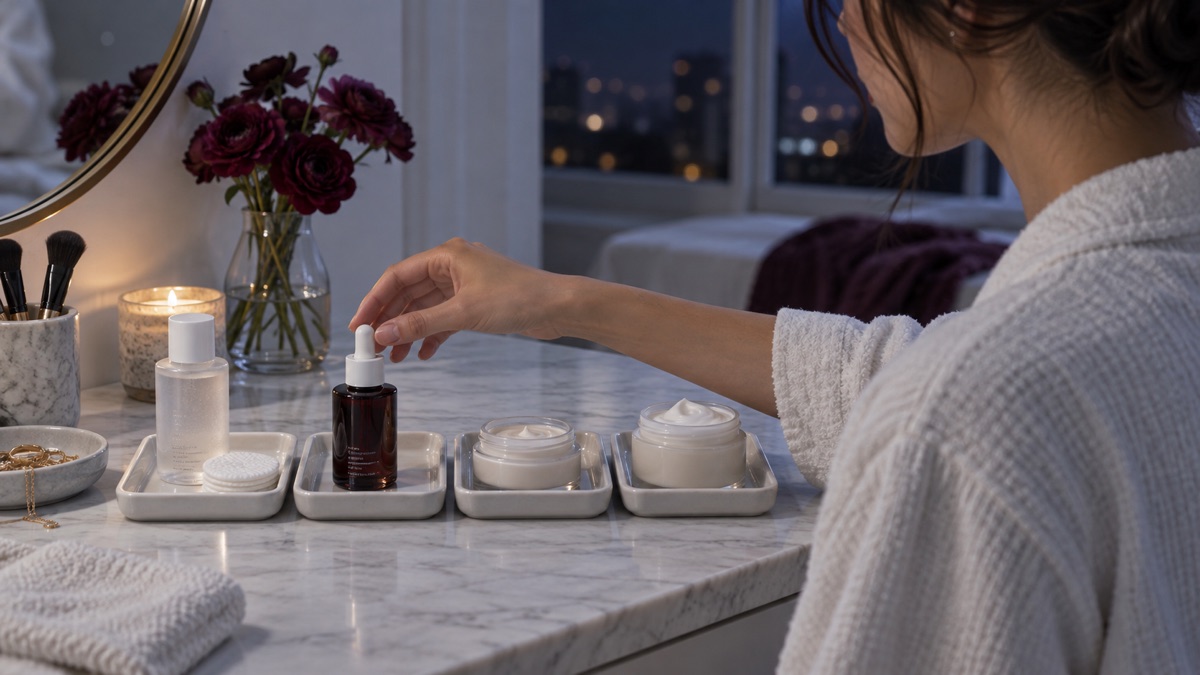
Skin cycling is a four-night rotation: exfoliate, retinoid, recover, recover, repeat. It was named and popularized by New York dermatologist Whitney Bowe in 2022 and became one of the largest skincare trends ever to come out of TikTok.
Here is the honest framing, which most coverage skips: skin cycling did not invent anything. Rotational dosing — spacing irritating actives apart and building in recovery — has been standard dermatology practice for decades. What Bowe did was give it a name, a number, and a schedule, which turns out to matter enormously, because the step people actually skip is the rest night.
The cycle, night by night
| Night | Do this | Skip this | What is happening |
|---|---|---|---|
| 1 — Exfoliation | Cleanse, one chemical exfoliant (AHA or BHA), moisturizer | Retinoid, scrubs, anything else with an acid in it | Clearing the dead-cell layer so the next night's retinoid meets less resistance. |
| 2 — Retinoid | Cleanse, dry the skin fully, pea-size retinoid, moisturizer | Acids, vitamin C, benzoyl peroxide | The night that does the long-term work. It lands on freshly exfoliated skin, which is why it also stings more. |
| 3 — Recovery | Cleanse gently, hydrating serum, richer moisturizer | Every active. No exceptions. | Barrier lipids rebuild. This is not a rest day from your routine — it is the routine. |
| 4 — Recovery | Same as night 3 | Every active | Skin returns to baseline so the next cycle starts from zero rather than from deficit. |
Every morning of the cycle is the same: gentle cleanse or water rinse, moisturizer, sunscreen. Cycling is a night schedule only. If you use vitamin C, it stays in the morning on all four days.
Does it actually work?
Two things are true at once, and both are worth saying plainly.
No published trial has tested this specific four-night sequence as a unit against alternative schedules. When someone tells you skin cycling is "clinically proven," they are describing the underlying principle, not the protocol.
The underlying principle is well established. Rotational, lower-frequency dosing of retinoids and acids is the standard way dermatologists reduce irritation without giving up results — and irritation is not a cosmetic side issue. It is the thing that makes people quit, and in darker skin tones it is also what drives post-inflammatory hyperpigmentation, so the "gentler" route is often the faster route to the result you wanted.
Skin cycling does not do anything to your skin that using the same products on your own schedule would not. What it does is make the recovery nights structural. Told to "use a retinoid a few times a week," most people quietly drift toward nightly. Told to follow a four-night cycle, they don't. That behavioral difference is the whole product.
Who this is for — and who should not bother
- You are new to retinoids or acidsIdeal starting structureYou get both actives at a frequency that rarely overwhelms a beginner
- Your skin is red, tight, or flaking from "doing everything"Start here, but extend itTry a six-night cycle first — see below
- You keep buying actives and using them all at onceThis is the fixThe schedule's only real job is to stop you stacking
- You already tolerate a nightly retinoidDon't downgradeCutting from seven retinoid nights to two is a real loss of dose for no gain
- You are on a prescription acne regimenFollow the prescriptionAdapalene and benzoyl peroxide schedules are set for a reason
- You have active eczema, or rosacea in flareNeither active night is appropriateBarrier repair only until it settles, then talk to a dermatologist
Adapt the length to your skin, not to the hashtag
Four nights is a starting shape, not a rule. The variable to change is the number of recovery nights.
Signs you should lengthen the cycle: stinging on night 2 that lasts past a minute, flaking that shows up after moisturizer, or skin that looks better on recovery nights than at any other point. Signs you can shorten it: two full cycles with no redness, no tightness, and no reaction to either active night.
What a recovery night is actually made of
"Recovery" gets treated as a rest day where you do nothing. It works better as a specific, boring routine you repeat exactly.
- Step 1A cleanser that does not strip. No acids, no scrubs, no clay. If your skin feels tight after washing, that cleanser is undoing the point of the night.
- Step 2Humectants, while the skin is slightly damp. Glycerin, hyaluronic acid, panthenol, beta-glucan. These pull water into the surface layer.
- Step 3Lipids and occlusives on top. Ceramides, cholesterol, fatty acids, squalane, and — if your skin is genuinely damaged — petrolatum on the dry patches. This is what actually rebuilds the barrier.
- NeverNo actives, and that includes the ones you forget are actives. Vitamin C, exfoliating toners, "brightening" pads, acne spot treatments, and strongly fragranced products all break a recovery night.
Do
- Keep sunscreen every single morning — exfoliation and retinoids both raise sun sensitivity
- Use one exfoliant on night 1, not a cleanser plus a toner plus a serum that all contain acids
- Apply the retinoid to completely dry skin
- Restart the cycle where you left off if you miss a night — no doubling up
- Give it two full months before deciding whether it suits you
Don't
- Treat recovery nights as optional when your skin looks fine — that is the night doing the work
- Add a "gentle" acid toner on recovery nights; it is still an acid
- Use a scrub on night 1 as well as a chemical exfoliant
- Start cycling and a brand-new active in the same week
- Shorten the cycle because progress feels slow at week three
The five mistakes that make it fail
| Mistake | What it looks like | Fix |
|---|---|---|
| Hidden actives | A "hydrating" toner with glycolic acid used on recovery nights | Read the ingredient list of every product you use on nights 3 and 4 |
| Too much on night 1 | Acid cleanser, acid toner, and an acid serum stacked | One exfoliant, one time, then moisturizer |
| Skipping sunscreen | Cycling faithfully, burning daily | SPF every morning, all four days — this is non-negotiable |
| Judging too early | Quitting at three weeks because nothing changed | Retinoid results run on a three-to-six-month clock, not a four-night one |
| Cycling something that should be daily | Moving a working nightly adapalene into a two-nights-a-week slot | If a nightly routine is already comfortable, keep it |
The bottom line
Skin cycling is a good default for anyone who owns more actives than their skin can absorb, and a genuinely excellent on-ramp for beginners. It is not a treatment, it has no evidence of its own, and it will not beat a routine you already tolerate and use consistently. Judge it as what it is: a scheduling tool that makes restraint automatic — which, for most people's skin, is worth more than another serum.
Frequently Asked Questions
-
Yes — in the morning, on all four days. Skin cycling is a night-time schedule, and vitamin C belongs in the morning anyway, where its antioxidant activity complements sunscreen. What you should not do is add it to a recovery night. A recovery night with an active in it is just a normal night with extra steps.
-
Spot-treat the spot, not the face. A dab of benzoyl peroxide or a pimple patch on one lesion will not undo a recovery night. Applying an acid toner across the whole face because of one spot will. If breakouts are frequent enough that this comes up often, the issue is that your routine is not addressing acne — consider adapalene as your retinoid, which is prescription-grade and sold over the counter.
-
No, and the branded four-product sets are the least necessary purchase in the trend. You need one chemical exfoliant, one retinoid, one good moisturizer and a sunscreen. If you already own those, you can start tonight for free — that is a point in the method's favor, not against it.
-
Comfort improves first, often within one or two cycles — less tightness, less flaking, skin that stops feeling angry. That is the barrier recovering, and it is real. The retinoid results people actually want, on texture and fine lines, run on a three-to-six-month clock regardless of schedule. Do not judge the method by week three.
-
It can help mild congestion, since it combines a BHA night with a retinoid night without over-drying. For moderate or inflammatory acne it is not a treatment plan — twice-weekly dosing is well below what acne regimens are built around, and the recovery nights delay things further. See a dermatologist rather than scheduling your way out of it.
-
Pick up where you left off. Do not double up, and do not restart the cycle from night one — both just compress your actives into a shorter window, which is the exact thing the schedule exists to prevent. A missed night costs you almost nothing over a three-month horizon.