Skincare for Rosacea: A Routine Built by Subtraction
41% of rosacea patients name their own skincare products as a trigger — the same share as indoor heat. Which means the fastest improvement available to you is usually deleting things, not buying them.
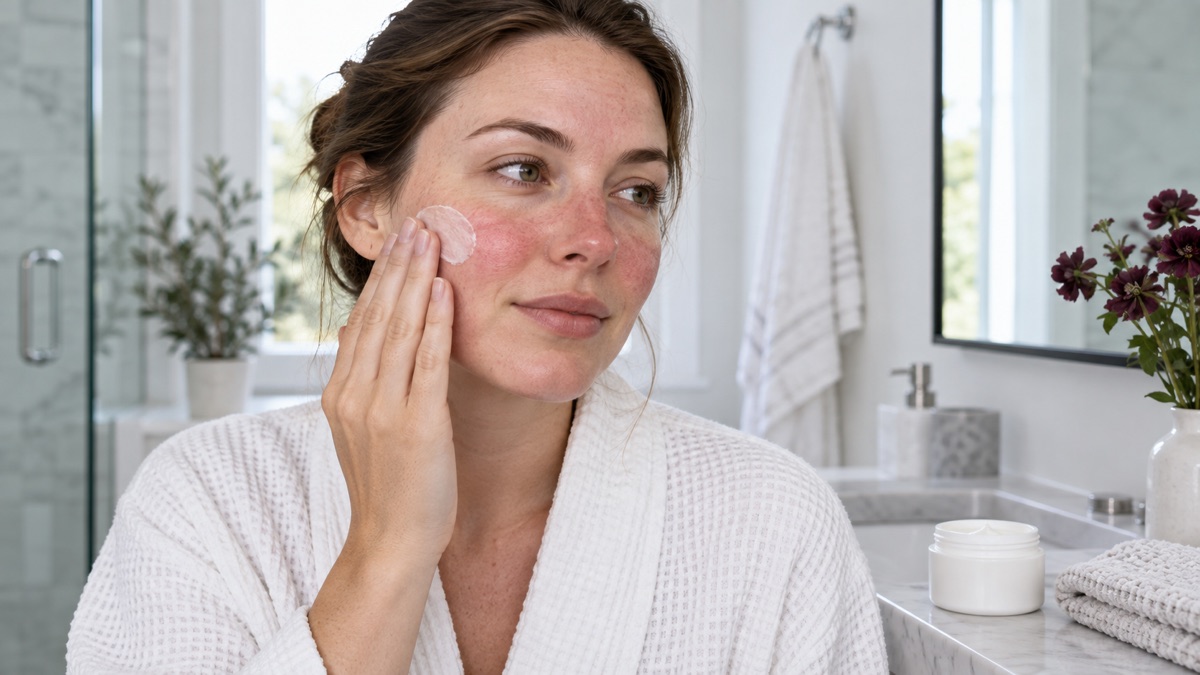
Most skincare advice is additive: here is a thing to buy, add it to your routine. Rosacea is the condition where that instinct does the most damage. The routine that works is almost entirely subtractive — and the fastest improvement most people get comes from deleting products, not adding them.
There is a number that makes this concrete. In a National Rosacea Society survey of 1,066 patients, 41% named their own skin-care products as a trigger — the same share as indoor heat, and more than heated beverages or spicy food.
What actually sets it off, ranked
Read the top of that list carefully. Sun exposure is number one at 81%, ahead of every food, drink and product. If you do one thing after reading this page, it is not swapping a moisturizer — it is wearing sunscreen daily and seeking shade.
The survey shows what is common, not what is true for you. Red wine sends one person flushing and does nothing to the next. The list is a place to start a two-week diary, not a set of rules to adopt wholesale.
The eight ingredients dermatologists name
The American Academy of Dermatology publishes a specific avoid-list for rosacea-prone skin. It is short, and it is worth memorizing because these ingredients hide in products that market themselves as gentle.
| Avoid | Where it hides |
|---|---|
| Alcohol | Toners, "oil-control" liquids, setting sprays, many gel moisturizers (look for alcohol denat. high in the list) |
| Camphor | Spot treatments, "cooling" gels, lip products |
| Fragrance | Almost everything, including products sold for sensitive skin |
| Glycolic acid | Exfoliating toners, pads, "resurfacing" serums, body lotions |
| Lactic acid | Gentle-branded exfoliants, hydrating toners, some cleansers |
| Menthol | Anything described as cooling, tingling or refreshing |
| Sodium lauryl sulfate | Foaming cleansers — and, easy to miss, shampoo and toothpaste that run over your face |
| Urea | Rich body and foot creams, some barrier repair creams |
The AAD says to choose "fragrance-free" rather than "unscented." They are not synonyms. "Unscented" often means a masking fragrance was added to cover the raw smell of the base — so an unscented product can contain more fragrance chemistry than a scented one. Only "fragrance-free" means what you think it means.
The routine, in full
- Twice dailyCleanse very gently. A mild rosacea-friendly cleanser, not soap. Apply with fingertips in a circular motion, rinse with warm water using only your fingertips — no washcloth, no sponge, no brush.
- After cleansingMoisturize with a cream, not a lotion or gel. The AAD is specific about the format: creams are recommended over lotions and gels for rosacea-prone skin, and gels in particular often carry the alcohol you are trying to avoid.
- Every morningBroad-spectrum SPF 30 or higher, water resistant — even on cloudy days. Sun is the single most-reported trigger, across all skin tones.
- NeverNo astringents, no toners. The AAD's wording is "never use an astringent or toner." This is the step people are most reluctant to give up and the one that most reliably helps.
- NeverStop exfoliating. Also verbatim: "If you exfoliate your skin, stop." No scrubs, no acids, no cleansing brushes, no facial massage, no rubbing.
That is the entire routine. Three products, two of which you already own. Anything beyond it is a variable you will have to eliminate later when your face flares and you cannot work out why.
Sunscreen, when sunscreen is the thing that stings
This is the most common practical problem in rosacea skincare: the one product that matters most is often the one that burns. The AAD's guidance is specific about what to look for instead.
Look for
What tends to be tolerated
- Filters
- Zinc oxide, titanium dioxide, or both — a mineral sunscreen
- Base
- Silicone, listed as dimethicone or cyclomethicone — it buffers the skin surface
- Fragrance
- "Fragrance-free" on the label, not "unscented"
- If it leaves a white cast
- Choose a micronized or tinted mineral sunscreen — the AAD's fix for deeper skin tones
Skip
What tends to provoke
- Format
- Alcohol-heavy gels and sprays
- Extras
- Fragrance, essential oils, menthol or "cooling" claims
- Marketing
- "Refreshing," "tingling," "purifying" — all usually mean something volatile
- Application
- Rubbing it in hard; press and pat instead
Test before you commit
If it feels like everything stings, stop guessing and test. The AAD recommends testing products before applying them to your face. A workable protocol:
- Pick one product. One at a time, always — two at once tells you nothing.
- Apply a small amount to the same patch twice a day for seven to 10 days — the AAD's recommended testing window. Use a quarter-sized spot somewhere it will not be rubbed or washed off, such as the underside of the arm or the bend of the elbow.
- Watch for delayed reactions. Irritant stinging shows up in minutes; an allergic reaction can take two to four days. Stopping the test at 24 hours is why people get surprised later.
- If it is clear, introduce it alone for two more weeks before adding anything else. Yes, this is slow. It is faster than an unexplained three-month flare.
Makeup is allowed, and it helps
Nothing about rosacea requires giving up makeup, and for many people camouflage does more for daily life than any topical. The AAD's color guidance is practical: a green-tinted concealer camouflages redness, and a yellow-tinted concealer masks discoloration across skin tones from light to dark. Water-based formulas are the ones dermatologists tend to recommend.
Do
- Press products on with fingertips rather than rubbing or buffing
- Keep a two-week trigger diary before blaming any one thing
- Use a wide-brim hat and UV sunglasses — clothing is the sunscreen that never stings
- Wash with lukewarm water; hot water is a trigger in its own right (hot baths: 51%)
- See a dermatologist — rosacea has genuinely effective prescription treatments
Don't
- Use a cleansing brush, sponge, washcloth or scrub, ever
- Treat the bumps as acne and attack them with acids and benzoyl peroxide
- Apply a topical steroid to a red face without medical advice — it can worsen rosacea
- Chase "soothing" products with long botanical ingredient lists; more ingredients means more suspects
- Assume a product is fine because it is expensive or labeled for sensitive skin
Rosacea is treatable, and the treatments that work best are prescriptions — your dermatologist may discuss topical options such as azelaic acid, ivermectin, metronidazole or brimonidine, oral medication for inflammatory forms, or laser and light treatment for persistent visible vessels. Skincare's job is to stop making things worse and to support whatever treatment you are given. It is not a substitute for one. Persistent redness, visible vessels, eye irritation or thickening skin all warrant a proper diagnosis — several conditions look like rosacea and are treated differently.
What to expect
Stripping the routine back usually improves comfort within one to two weeks — less stinging, less tightness, fewer random flares. The persistent background redness is slower and often needs medical treatment. Visible blood vessels do not fade with skincare at all; they respond to laser or light treatment, and no cream will change that. Knowing which of your symptoms is a skincare problem and which is a medical one is most of the battle, and it is the main thing worth taking to a first appointment.
Frequently Asked Questions
-
The AAD's instruction is unambiguous: if you exfoliate, stop. They also name glycolic and lactic acid on the avoid list specifically. Polyhydroxy acids are the gentler class sometimes used on rosacea-prone skin in a clinical setting, but that is a decision to make with a dermatologist who has seen your face — not an exception to grant yourself. Attempting to exfoliate your way out of rosacea bumps is the single most common way people make this condition worse.
-
No, though the papules and pustules look similar enough that people treat it as acne and get worse. Rosacea involves flushing, persistent central-face redness, and often visible vessels and eye symptoms, and it responds to a different set of treatments. Blackheads point toward acne; flushing that comes on with heat, sun or alcohol points toward rosacea. Getting an actual diagnosis is worth the appointment because the two treatment paths diverge immediately.
-
Rosacea-prone skin has a compromised barrier, so ingredients that would be unremarkable on other faces register as stinging. Work through the AAD checklist: fragrance-free rather than unscented, made for sensitive skin, non-comedogenic, cream rather than lotion or gel, and no alcohol, menthol, camphor or urea. Then test on a patch for four to five days before putting it on your whole face. Shorter ingredient lists genuinely help — every additional ingredient is another suspect.
-
Diet does not cause it, but specific foods trigger flares in some people: spicy foods were reported by 45% of patients and alcohol by 52%. Note both sit well below sun exposure at 81%. Keep a two-week diary rather than eliminating foods preemptively — restricting your diet based on someone else's trigger list is a lot of effort for a factor that may not be yours at all.
-
Partly. The reactive, stinging, flaring component usually improves noticeably within a couple of weeks of stripping the routine back. Persistent background redness typically needs medical treatment, and visible broken vessels do not respond to skincare at all — those are a laser or light-treatment question. Products can stop you provoking your skin; they cannot reverse vascular changes that are already there.
-
Not inherently, and the AAD explicitly includes makeup in their guidance rather than discouraging it: green-tinted concealer for redness, yellow-tinted for discoloration on light through dark skin tones, with water-based formulas usually recommended. The risk is in the ingredients and the application, not the concept — so patch-test the formula and press it on with your fingertips rather than buffing it in with a brush.