The Best Skincare for Travel: What to Pack and How to Adjust for Every Trip
The best skincare for travel is a shorter routine built around your trip — flights, beaches, snow, humidity or jet lag — with the products to pack, and why sunscreen on the plane matters more than most people think.
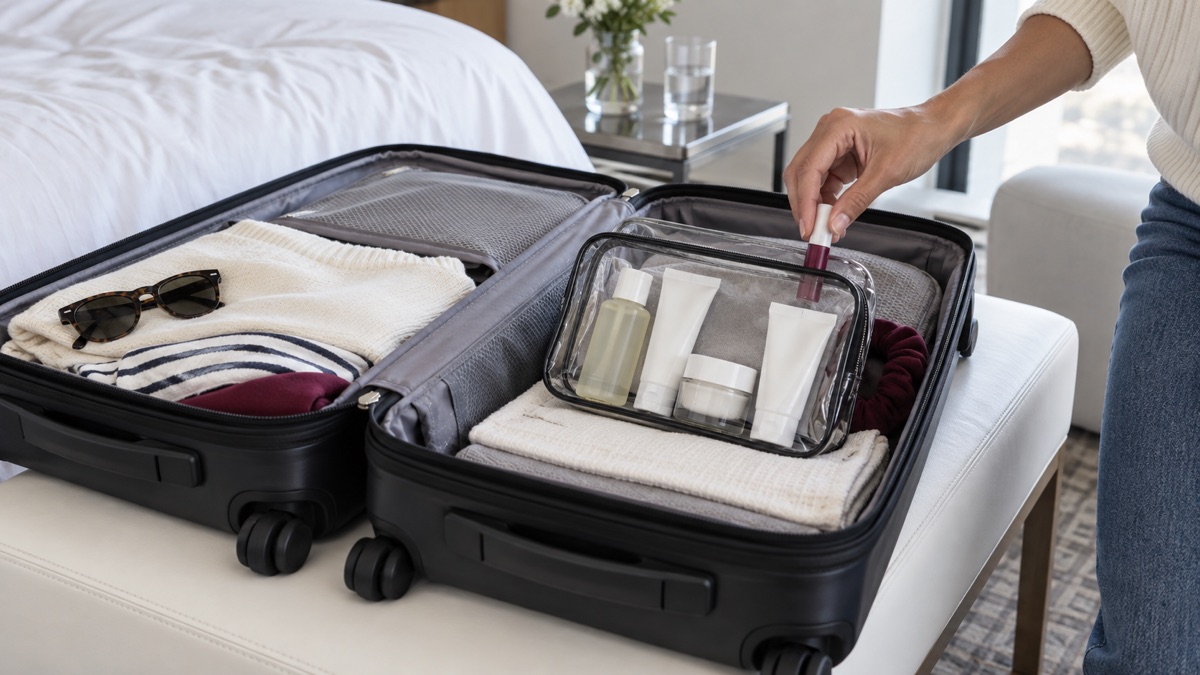
Travel is hard on skin in ways that have nothing to do with your routine at home: bone-dry cabin air, more sun than you're used to, a new climate, a disrupted sleep schedule and hotel water. The best skincare for travel isn't a longer routine — it's a shorter one, built around the specific trip you're taking.
What your skin needs depends on the trip
| Trip | What goes wrong | Change this | Pack |
|---|---|---|---|
| Any flight | Tight, dehydrated skin; unexpected UV through the window | Moisturize before and during; sunscreen on in the air | CeraVe Moisturizing Cream (travel size), Supergoop Unseen Sunscreen, SPF lip balm |
| Beach or hot, sunny | Burn, sweat, clogged pores | Water-resistant SPF 30+, reapplied; lighter moisturizer | La Roche-Posay Anthelios Melt-in Milk SPF 60, Neutrogena Hydro Boost Water Gel |
| Ski, snow or high altitude | Windburn, cracked lips, UV reflected off snow | Richer moisturizer; sunscreen even when it's cold | First Aid Beauty Ultra Repair Cream, Aquaphor Healing Ointment, Supergoop Glow Stick |
| Humid city | Shine, congestion, makeup sliding off | Gel textures; cleanse properly at night | Neutrogena Hydro Boost Water Gel, Bioderma Sensibio H2O |
| Long-haul and jet lag | Dull, puffy, dehydrated skin on arrival | Skip makeup in flight; hydrating mask on arrival night | Summer Fridays Jet Lag Mask, Laneige Water Sleeping Mask |
Why the flight itself is a skincare problem
Most people think of airplanes as a dryness issue. They're also a sun issue, and that part is easy to miss.
At 30,000 to 40,000 feet the atmosphere is thinner, so fewer UV rays are blocked, and clouds or snowfields below can bounce UV back up at you. Passengers get far less exposure than pilots, who sit behind a large forward-facing window on long routes — but even a single long flight adds to cumulative skin damage.
The in-flight routine
- Board with clean skin and little or no makeup, so you can reapply moisturizer during the flight.
- Apply a broad-spectrum SPF 30+ before takeoff and reapply every two hours on daytime flights — and if you're in a window seat, close the shade.
- Use a lip balm with SPF. Lips are thin skin and dry out first.
- Reapply moisturizer halfway through long flights. A rich cream such as CeraVe Moisturizing Cream, or Aquaphor Healing Ointment on dry patches, does more than a mist alone.
- Drink water. The dry air in airplane cabins can make the effects of sun exposure worse, and alcohol and caffeine won't help.
The travel skincare packing list
You need fewer products than you think. This covers almost any trip:
| Pack | Best pick | Why |
|---|---|---|
| Gentle cleanser | CeraVe Hydrating Facial Cleanser (travel size) | Won't strip skin that's already dehydrated from flying |
| Makeup remover | Bioderma Sensibio H2O (travel size) | Micellar water works even without a good sink |
| Moisturizer | CeraVe Moisturizing Cream (travel size) | A barrier cream for dry cabins and cold climates |
| Face sunscreen | Supergoop Unseen Sunscreen (travel size) | Easy to reapply, including over makeup |
| Body sunscreen | La Roche-Posay Anthelios Melt-in Milk SPF 60 (travel size) | High SPF for beach and outdoor days |
| Sunscreen stick | Supergoop Glow Stick | A no-spill way to top up in a bag |
| Rescue balm | Aquaphor Healing Ointment (travel size) | Lips, cuticles, windburn, chafing |
| Soothing balm | La Roche-Posay Cicaplast Baume B5 (travel size) | For irritated or sunburned patches |
| Hydrating mask | Summer Fridays Jet Lag Mask | For the first night after a long flight |
| Face mist | Mario Badescu Facial Spray | A refresh on the go — follow with moisturizer to lock it in |
If your usual products do not come in minis, decant them into clearly labeled, leak-resistant containers of 3.4 ounces (100 mL) or less rather than changing your whole routine for the trip.
Sunscreen is the step that matters most
Travel usually means more time outdoors, often somewhere sunnier than home. The American Academy of Dermatology recommends a broad-spectrum, water-resistant sunscreen with SPF 30 or higher, at least a teaspoon for the face, applied 15 minutes before going out and reapplied about every two hours outdoors or after swimming or sweating. Ohio State's guidance adds that creams and lotions give more even coverage than sprays, and mineral sunscreens with zinc oxide or titanium dioxide are a good choice for sensitive skin. For topping up over makeup mid-trip, see how to reapply sunscreen over makeup.
Travel rules that save your skin
- Don't try new products on a trip. A reaction is worse away from home. If you want something new, patch test it before you leave.
- Pause strong actives around sun-heavy trips. Retinoids and exfoliating acids increase sun sensitivity, so a beach week is a good time to take a break.
- Pack your carry-on liquids right. Liquids, gels, creams and pastes must be in containers of 3.4 ounces (100 mL) or less, in one quart-sized bag.
- Keep your routine short. Cleanser, moisturizer and sunscreen do most of the work — see our three-product routine.
Frequently Asked Questions
-
On daytime flights, yes — especially in a window seat. Airplane windows may block some UVB but often let UVA through, and the atmosphere is thinner at cruising altitude. Apply a broad-spectrum SPF 30+ before takeoff, reapply every two hours, and close the window shade when you can.
-
Board with clean skin and minimal makeup, apply a rich moisturizer before the flight, and reapply it halfway through long flights. Put an ointment such as Aquaphor on lips and dry patches, and drink water. A face mist feels refreshing, but follow it with moisturizer or the water simply evaporates.
-
A water-resistant, broad-spectrum SPF 30+ sunscreen for body and face — such as La Roche-Posay Anthelios Melt-in Milk SPF 60 — plus a lighter gel moisturizer, SPF lip balm and a soothing balm like La Roche-Posay Cicaplast Baume B5 for any irritated patches. Reapply sunscreen about every two hours and after swimming.
-
Many people pause retinoids and exfoliating acids around a sun-heavy trip, since both increase sun sensitivity. If you keep using them, be extra consistent with sunscreen and shade. Don't introduce either one for the first time right before or during a trip.
-
Yes, in containers of 3.4 ounces (100 milliliters) or less, all packed in one quart-sized bag. That rule covers creams, gels, serums and pastes, not just liquids. Put full-size bottles in checked baggage, or decant into refillable travel bottles.