Skincare for Teens: The Short Routine Dermatologists Actually Recommend
Gentle cleanser, fragrance-free moisturizer, daily sunscreen — plus one acne treatment only if there is acne. The retinol, vitamin C and acid serums trending with teens treat problems young skin doesn't have.
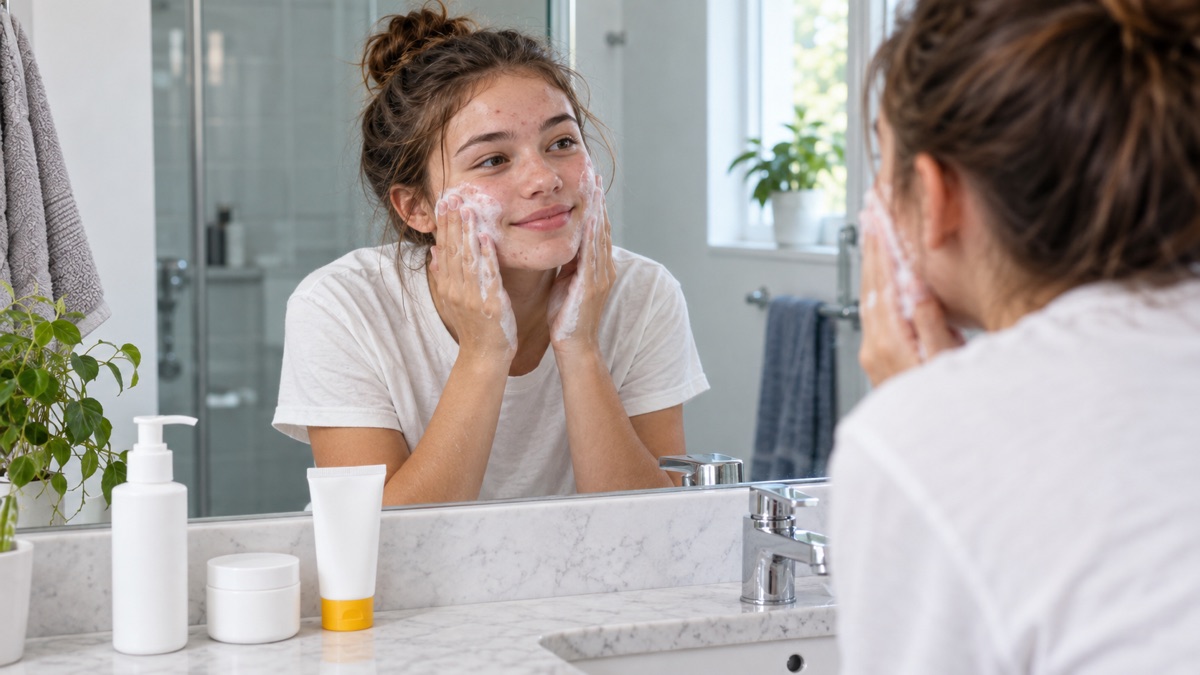
Skincare has become one of the most-watched topics on teen social media, and the routines on screen increasingly belong to adults with adult concerns — retinoids, vitamin C, multi-acid serums, ten steps. The American Academy of Dermatology addressed this directly in October 2025, and its guidance to families is refreshingly short: simple, age-appropriate products are the safest and most effective.
This guide is for teens building a first routine and for the parents fielding the wish list. The answer is the same for both, and it is cheaper than either expects.
Tweens: learn the basics, nothing more
The AAD dermatologist behind that guidance, Marisa Garshick, MD — a board-certified dermatologist and a parent of tweens — recommends a three-step routine for tweens:
- Step 1Wash with a gentle, non-abrasive cleanser. Harsh cleansing or scrubbing irritates skin. For dry or sensitive skin, washing once a day in the evening may be enough.
- Step 2Apply a fragrance-free moisturizer. Moisturizing relieves dryness and itching, and fragrance-free matters because added scents can trigger irritation or allergic reactions.
- Step 3Wear broad-spectrum, water-resistant sunscreen, SPF 30 or higher, every day. This is the habit that pays off for decades.
"If kids learn to wash their face, moisturize, and wear sunscreen every day, they're already ahead of the curve." — Marisa Garshick, MD, FAAD
Teens: add acne care only if there is acne
As tweens become teenagers, hormonal changes often increase oil production, which can bring blackheads, breakouts and an oily complexion. This is the point where one active ingredient earns a place — but only if the problem is actually there.
Option 1
Salicylic acid
- Found in
- Acne cleansers, toners, spot treatments and medicated pads
- Best for
- Blackheads and whiteheads — it unclogs pores
- Easiest start
- A cleanser; short contact, low risk
- Watch for
- Dryness and irritation
Option 2
Benzoyl peroxide
- Found in
- Prescription and non-prescription acne products — one of the most effective, commonly used treatments
- Best for
- Pimples
- Easiest start
- A 2.5% product, which avoids much of the dryness and burning of stronger ones
- Watch for
- Dryness, and bleached towels and pillowcases
Both are drying, which is why the AAD's guidance pairs them with a gentle daily moisturizer and continued sun protection. Pick one, not both, and give it time: for acne treatments generally, the AAD's dermatologists describe fewer breakouts at four to eight weeks. For how the two families of acid differ, see AHA vs BHA.
For parents: handling the wish list
Social media can make every product look essential. The AAD's advice is to steer toward age-appropriate products — gentle cleansers, lightweight moisturizers and broad-spectrum sunscreen — and away from actives designed for adult skin.
| On the wish list | Verdict | Why |
|---|---|---|
| Retinol serum | Skip | Treats wrinkles and sun damage that children don't have; can cause redness, burning and peeling |
| Vitamin C serum | Skip | Targets sun damage and uneven tone; no benefit to young skin |
| Exfoliating acid toner or peel pads | Skip | Young skin is thinner and more prone to irritation |
| Anything labelled anti-aging | Skip | By definition built for a problem a teenager does not have |
| A gentle cleanser they like using | Yes | The first habit that matters |
| A fragrance-free moisturizer with ceramides or hyaluronic acid | Yes | Ceramides keep skin hydrated; the AAD names both as science-backed ingredients |
| A sunscreen with a texture they will actually wear | Yes — worth paying for | The best sunscreen is the one used every day |
| An acne cleanser (salicylic acid or benzoyl peroxide) | Only if there is acne | Useful, but drying; pair with a moisturizer |
Dr. Garshick's point to her own children: skincare doesn't have to be complicated to work, and something that looks fun or costs more isn't automatically better. "More is not more," and consistency beats a 10-step routine. The goal is not to forbid the interest — it is to point it at the three products that actually do something.
Introducing anything new
- One new product at a time. The AAD recommends introducing products individually so it is clear whether skin tolerates each one.
- Test a small amount first if skin is sensitive, before putting it on the whole face. How to patch test explains the version that actually catches allergies.
- Watch for stinging, redness or flaking — signs to stop, not push through.
- If skin keeps reacting to over-the-counter products, that is a reason to see a board-certified dermatologist, who can diagnose the problem and suggest products suited to that skin.
When to see a dermatologist
- Breakouts are leaving dark marks or scarsBook an appointmentThe AAD names this specifically — scarring is permanent
- A few months of over-the-counter acne treatment, no improvementBook an appointmentPrescription options work where store-bought products stall
- Deep, painful lumps rather than small pimplesBook an appointmentOver-the-counter products are unlikely to treat this type
- Skin reacts to everythingBook an appointmentA dermatologist can work out what is going on
- A few small pimples, otherwise fineBasics plus one acne cleanserGive it at least four to eight weeks
The short version
Gentle cleanser, fragrance-free moisturizer, daily SPF 30+. Add salicylic acid or benzoyl peroxide only if there is acne, and pair it with moisturizer. Leave retinol, vitamin C and exfoliating acids on the shelf — they treat adult problems on skin that is thinner and more reactive than an adult's. And see a dermatologist if acne leaves marks or scars, or hasn't improved after a few months.
Related reading
- A beginner's skincare routine — the same three-product foundation, for any age
- Skincare for hormonal acne — when breakouts continue into adulthood
- AHA vs BHA — why salicylic acid is the one that reaches inside pores
Frequently Asked Questions
-
The basics can start in the tween years, and the AAD frames it as learning habits rather than treating problems: a gentle cleanser, a fragrance-free moisturizer and daily sunscreen. Sunscreen, in fact, matters from well before then. What should not start early is active ingredients — retinol, vitamin C and exfoliating acids offer no benefit to young skin.
-
For routine use, the AAD advises tweens and teens to avoid it: it targets wrinkles and sun damage, and young skin is thinner and more prone to irritation, so it can cause redness, burning and peeling without benefit. The exception is acne — a dermatologist may recommend a retinoid for a teen's acne after assessing their skin. That is a medical decision, not a trend to follow.
-
Many teens do well washing twice a day, particularly with oily or acne-prone skin. For dry or sensitive skin, the AAD's guidance is that washing once a day in the evening may be sufficient. Whatever the frequency, the cleanser should be gentle and non-abrasive — scrubbing irritates skin and does not clear acne faster.
-
For mild acne, over-the-counter salicylic acid or benzoyl peroxide. Salicylic acid works best on blackheads and whiteheads; benzoyl peroxide is especially effective on pimples, and a 2.5% product is the gentler place to start. Use one consistently for at least four to eight weeks with a daily moisturizer. If acne leaves marks or scars, or hasn't improved after a few months, see a dermatologist.
-
The AAD's advice to parents is to choose age-appropriate products: a gentle cleanser, a lightweight fragrance-free moisturizer and broad-spectrum sunscreen. If the interest is genuine, lean into it with a nice version of those — a sunscreen with a texture they love is money well spent. Skip retinol, vitamin C, exfoliating acids and anything labelled anti-aging.
-
Yes — broad-spectrum, water-resistant, SPF 30 or higher is part of the AAD's basic routine for tweens and teens. It is also the single most valuable long-term habit in skincare. Teens who start it early are, in the words of the AAD's dermatologist, already ahead of the curve.