The Right Order to Apply Skincare — And the Three Times It Doesn't Matter
Thinnest to thickest, then sunscreen last. That single rule replaces every ten-step list — once you understand why a moisturizer seals your serum out as effectively as it seals water in.
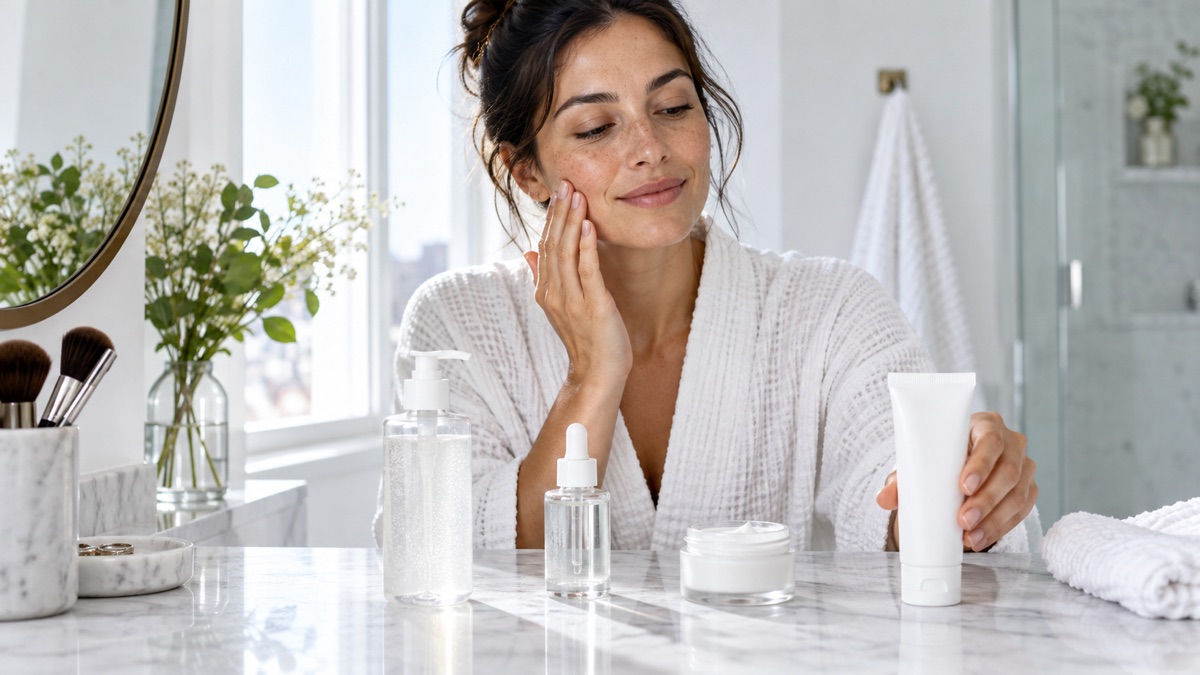
Most "correct order" articles hand you a list of ten steps and leave you to memorise it. That is backwards, because the list changes every time you buy something new. What does not change is the rule underneath it — and it is one sentence:
Thinnest to thickest, then sunscreen last. Every other instruction on this page is either a consequence of that, or one of the three exceptions to it.
The reason is physical, not mystical. A moisturizer's entire job is to lay down a film that slows water leaving your skin. That film does not check which direction something is travelling.
The order, with the reason for each step
The American Academy of Dermatology's version of this is deliberately short — cleanse, apply medication or treatment right after cleansing, then moisturizer and/or sunscreen, then makeup — and they note that "the sequence in which you apply your skin care products affects how well the products work." The table below is that skeleton with the optional layers slotted in where they belong.
| Order | Step | AM | PM | Why it sits here |
|---|---|---|---|---|
| 1 | Cleanser | Optional | Yes | Everything after this assumes a clean surface. Many people do fine rinsing with water only in the morning. |
| 2 | Toner / essence | Optional | Optional | Watery, so it goes first. Genuinely optional — skipping it costs you nothing. |
| 3 | Treatment (the active) | Vitamin C | Retinoid or acid | The step that does the work. Nothing should be between it and your skin. |
| 4 | Eye cream | Optional | Optional | Before heavier creams, so it is not blocked. Ring finger, lightest pressure. |
| 5 | Moisturizer | Yes | Yes | Seals the surface — which is why it cannot come earlier. |
| 6 | Face oil / balm | Rarely | Optional | Heaviest of the skincare layers. Only ever above moisturizer, never below. |
| 7 | Sunscreen | Always | — | The last skincare step, every morning. It only protects what it covers, in an unbroken film. |
| 8 | Makeup | Optional | — | After sunscreen has set, so you are not wiping the film around. |
Cleanser, moisturizer, sunscreen is a complete routine. It is not a beginner's compromise — it is the part that is actually load-bearing. Steps 2, 4 and 6 are refinements you can add over years, or never.
The three real exceptions
- Exception 1Sunscreen ignores the texture rule. A rich SPF cream still goes on last, after a lighter moisturizer. Sunscreen is tested as a film sitting on top of everything, so anything applied over it disturbs the layer that is doing the protecting.
- Exception 2pH-dependent actives go first, even if something thinner is waiting. Pure L-ascorbic acid has to be formulated below pH 3.5 to get into skin at all — Pinnell's absorption work put the effective ceiling at 20% concentration and the pH requirement at under 3.5. Put it under a thin toner and you have changed the surface it lands on.
- Exception 3Prescription medication goes where your doctor put it. If a dermatologist told you to apply something to dry skin, or to buffer it with moisturizer first, that instruction outranks any routine you read online — including this one.
What actually needs a wait, and what does not
"Wait 20 to 30 minutes between layers" is repeated everywhere and is mostly folklore. It comes from an old instruction to apply tretinoin to fully dry skin, which then got generalised into a universal rule that costs people half an hour every evening for no benefit. The waits that have a real reason behind them are short and specific:
| Situation | Wait | Reason |
|---|---|---|
| After washing, before a retinoid | Until skin is dry | Damp skin increases penetration and, with retinoids, irritation. This is the wait the 20-minute myth came from — and "dry" usually takes a couple of minutes, not thirty. |
| Moisturizer, then sunscreen | ~1 minute | So the SPF spreads as an even film rather than sliding on a wet surface. |
| Sunscreen, then makeup | 2–3 minutes | Let the film set so foundation does not drag it into streaks. |
| Between two watery serums | None | Absorption is not a queue. Apply, let it stop feeling wet, move on. |
| Between serum and moisturizer | None | Slightly damp skin actually helps a moisturizer work. |
What can share a routine, and what cannot
This is where most routines break — not in the order, but in the combination. The matrix below is the short version.
| Vitamin C | Retinoid | AHA / BHA | Niacinamide | Benzoyl peroxide | |
|---|---|---|---|---|---|
| Vitamin C | — | ◐ | ◐ | ✓ | ✕ |
| Retinoid | ◐ | — | ◐ | ✓ | ✕ tretinoin · ✓ adapalene |
| AHA / BHA | ◐ | ◐ | — | ✓ | ◐ |
| Niacinamide | ✓ | ✓ | ✓ | — | ✓ |
| Sunscreen | ✓ | ✓ | ✓ | ✓ | ✓ |
The one with hard numbers behind it
Benzoyl peroxide and tretinoin is the combination that is not a matter of taste. When Martin and colleagues mixed benzoyl peroxide 10% with tretinoin 0.025% and exposed it to light, more than 50% of the tretinoin degraded in about two hours, and 95% within 24 hours. Adapalene, tested the same way, was essentially unaffected.
So: benzoyl peroxide in the morning, tretinoin at night. If you want both in one step, adapalene is the retinoid that tolerates it — which is exactly why prescription adapalene-plus-benzoyl-peroxide gels exist and tretinoin-plus-benzoyl-peroxide ones do not.
The one that is a myth
Niacinamide and vitamin C are fine together. The fear traces to old laboratory work in which niacinamide converted to nicotinic acid — a flushing agent — under high heat and specific conditions that a serum on a bathroom shelf does not reproduce. Modern formulations combine them deliberately. If a particular pairing stings on your face, that is that formula, not the chemistry.
Sunscreen: the step where the technique matters more than the product
Every SPF number on every bottle is measured at a standard dose of 2 mg per square centimetre of skin. That is a lot more product than it feels like it should be, and applying less does not cost you protection proportionally — it costs you more.
Two ways to hit the dose without measuring anything:
Do
- Use the two-finger rule — a strip along the index and middle fingers, palm crease to fingertip, for face and neck
- Or follow the AAD's figure directly: at least a teaspoon for the face, which they describe as the amount that covers the length of your index and middle fingers
- Apply as the last skincare step, before makeup
- Include the ears, the hairline, the sides of the neck and the back of the hands
- Reapply through the day if you are outdoors — a powder or stick over makeup is far better than nothing
Don't
- Mix sunscreen into your moisturizer — you are diluting the filter film that the SPF number was measured on
- Rely on the SPF in your foundation alone; nobody applies foundation at 2 mg/cm²
- Apply moisturizer over sunscreen and disturb the layer
- Treat sunscreen as the step to skip on cloudy days or indoors near windows
- Assume "one pump" is enough because the bottle is small
Three routines that actually work
- Minimum — you want skin that behaves, with no projectAM: cleanse → moisturizer → SPFPM: cleanse → moisturizer. That is a complete routine, permanently.
- One goal — texture, dark marks, or breakoutsAdd one active, at nightAM: cleanse → moisturizer → SPF. PM: cleanse → the active → moisturizer. Give it eight weeks before adding anything else.
- Full — you enjoy this and your skin is stableSplit your actives across AM and PMAM: cleanse → vitamin C → moisturizer → SPF. PM: cleanse → retinoid (or acid, alternating nights) → moisturizer.
The AAD's caution is about quantity, not order: using too many products can irritate skin, "especially if you are using more than one anti-aging product," which tends to make the signs of aging more noticeable rather than less. A four-step routine done consistently beats a ten-step routine you abandon in March — and beats a ten-step routine you keep, if the tenth product is why your face is red.
How to change a routine without losing the thread
- Add one product at a time. If three things change at once and your skin reacts, you have no way to know which one did it, and you will usually eliminate the wrong one.
- Give it two weeks minimum, eight for an active. Hydration shows up in days. Texture takes weeks. Pigment takes months.
- Change frequency before you change strength. If a retinoid is irritating, go from nightly to twice a week before you go to a lower percentage — most people quit at the wrong variable.
- Write down what you started and when. Two months later you will not remember, and the note is the difference between knowing what works and starting over.
Frequently Asked Questions
-
It changes the result, and the AAD says so plainly: the sequence affects how well products work. The size of the effect depends on the products. Putting a watery serum over a rich cream can waste most of it. Putting eye cream before or after a lightweight lotion barely matters. Order matters most for the thin, active, expensive things — which is precisely where people tend to get it wrong.
-
The names are marketing categories, not chemical ones — all three are watery and go in the same part of the routine. What matters is what is dissolved in them. A hydrating toner and a hydrating essence do a nearly identical job; using both is fine but redundant. If you are choosing one thing to spend on in that slot, make it the one with an active you actually want.
-
You can, and the split works. Vitamin C is usually placed in the morning because its antioxidant activity complements sunscreen during the day, and retinoids at night because they are degraded by light and increase sun sensitivity. If your schedule makes the reverse easier, the loss is small — far smaller than the loss from skipping either one because the routine was inconvenient.
-
Where your prescriber told you. The AAD's general guidance is to apply medication right after cleansing, before moisturizer, so nothing sits between the drug and your skin. But some dermatologists deliberately have patients buffer a retinoid with moisturizer underneath to reduce irritation. That is a considered choice about your skin, and it beats a general rule.
-
No, and it is often worse. Each additional product adds a chance of irritation, a chance of an interaction, and a cost that makes you less likely to keep going. The AAD specifically warns that using too many products — especially several anti-aging products at once — can irritate skin and make aging more visible. A short routine done every day outperforms a long one done sporadically.
-
The AAD's own figure is at least a teaspoon for the face — which they describe as the amount needed to cover the length of your index and middle fingers. That is the same quantity the two-finger rule describes, and it approximates the 2 mg/cm² density used when the SPF number is measured. Measure it once against an actual teaspoon so you know what it looks like in your hand; after that you can eyeball it. Reapply approximately every two hours when you are outdoors.