How to Use a Gua Sha — Technique, Evidence, and When to Skip It
The traditional body technique is scraped hard enough to raise deliberate bruising. The facial version is not supposed to, and understanding that difference is most of what separates using it well from marking your own face.
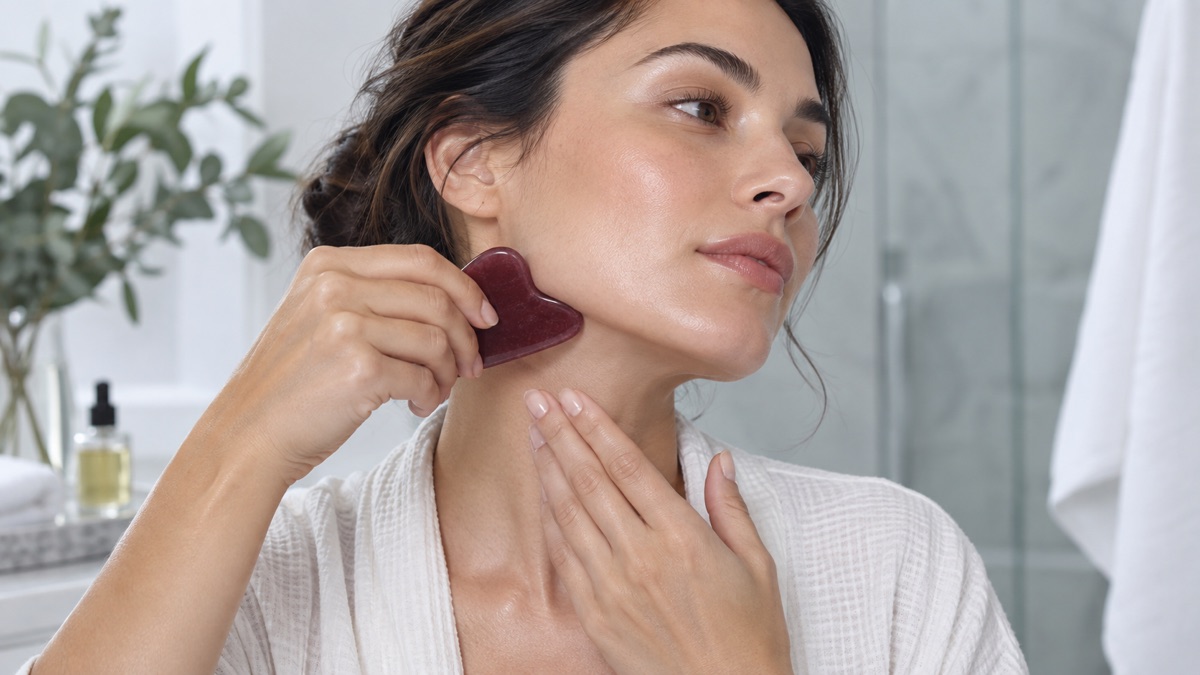
Gua sha is a flat stone tool drawn across the skin. The facial version is a soft adaptation of a traditional practice in which the tool is scraped hard enough on the body to raise sha — deliberate petechiae, the small red spots that gave the technique its name. The facial version is not supposed to do that, and knowing why is most of what separates using it well from bruising yourself.
What it actually does, and what it doesn't
Supported
Reasonable to expect
- Blood flow
- Facial massage measurably increases local circulation — this is the best-supported effect
- Puffiness
- Directional massage moves interstitial fluid; morning puffiness genuinely responds
- Short-term look
- Skin appears less swollen and more defined for a few hours
- Tension
- It feels good on a clenched jaw, and that is a real benefit
- Product absorption
- You are applying oil and spending five minutes on it; that alone helps
Not supported
Claims that outrun the evidence
- "Sculpting" bone structure
- No mechanism. Facial contour is bone, fat pads and muscle.
- Permanent lifting
- Fluid reduction is temporary and returns
- Collagen stimulation
- Not demonstrated at the pressures facial gua sha uses
- "Detoxing"
- Not a physiological process your face performs
- Replacing treatment
- It does nothing for pigment, acne or fine lines
A 2023 review in the Journal of Cosmetic Dermatology examined gua sha, jade rollers and facial massage for dermatologic benefit and found measurable effects on blood and lymphatic flow — alongside a literature dominated by small samples, short durations and missing controls. Much of what is cited for facial gua sha is extrapolated from traditional body gua sha, which is a different technique performed at a different pressure. Treat it as a pleasant, low-risk practice with a modest short-term payoff, and you will not be disappointed.
The technique
- Non-negotiableAlways use slip. Facial oil, or a rich serum. Never on dry skin — the tool has to glide. Dragging is what causes irritation, broken capillaries and the bruises people blame on the tool itself.
- AngleHold it nearly flat — roughly 15 degrees to the skin. Upright, the edge digs in. Flat, it glides and moves fluid, which is the entire point.
- PressureLight. Lighter than you think. The lymphatic vessels you are trying to influence sit just under the skin. Heavy pressure pushes past them and bruises instead.
- OrderNeck first. Downward strokes along the sides of the neck before you touch the face, so the fluid you move has somewhere to go. Finish the same way.
- DirectionCenter outward, and slightly upward. Chin to ear, nose to ear, brow to temple. Follow the numbered strokes above.
- RepetitionsThree to five passes per section, then move on. The whole routine should take five minutes, not twenty.
- Around the eyesLightest pressure of all, inner corner outward. This skin is the thinnest on the face and marks easily. Many people are better off skipping it.
- AfterwardWash the tool with soap and water and dry it. It picks up oil and skin every session. An unwashed stone rubbed across your face is a genuinely bad idea if you are acne-prone.
When not to use one
You have active inflammatory acne or pustules — you will spread bacteria and inflame lesions. Rosacea, especially in flare: the AAD's rosacea guidance explicitly advises against rubbing or massaging the skin. Sunburn, eczema, broken skin, or an active rash. Recent injectables or facial procedures — ask the person who performed them when it is safe. And if you take anticoagulants or bruise very easily, raise it with your doctor first; bruising is the main documented risk of the technique.
The mistakes that turn it into a problem
| Mistake | What happens | Fix |
|---|---|---|
| Not enough slip | Drag, redness, broken capillaries | More oil than feels necessary; reapply mid-session if it starts to grip |
| Too much pressure | Bruising, petechiae — the body technique on a face | Light enough that you could do it on your eyelid |
| Holding the tool upright | The edge digs a line into the skin | Lay it almost flat, about 15° |
| Skipping the neck | Fluid has nowhere to drain to | Neck first, neck last, every time |
| Using it over actives | Retinoid or acid worked mechanically into irritated skin | Gua sha on oil, on a night with no actives |
| Never cleaning the tool | Oil, bacteria and dead skin reapplied nightly | Soap and water after each use |
| Doing it for twenty minutes | Cumulative irritation, no extra benefit | Five minutes, three to five passes per area |
Stone, roller, or neither
- Morning puffiness is your main complaintGua sha, five minutesThis is the use with the clearest short-term payoff
- You want something faster and lower-riskA rollerLess pressure control needed, harder to bruise yourself with
- You clench your jaw or hold tensionGua sha, on the masseterThe relaxation is real even if the "sculpting" is not
- Your goals are lines, pigment or acneThis is the wrong toolA retinoid, sunscreen and — for acne — a proper treatment plan
- You have rosacea or active acneNeitherMechanical friction is specifically what to avoid
The short version
Use plenty of oil, hold the stone almost flat, press lightly, start and finish at the neck, work center-outward, and stop at five minutes. Expect a less puffy, more defined-looking face for a few hours and a genuinely relaxing five minutes — which is a fair return for a stone and a bit of oil. Expect sculpting or collagen and you are buying a story the evidence does not support.
Frequently Asked Questions
-
No. Facial contour is determined by bone, fat pads and muscle, and a stone drawn across the surface does not change any of them. What it does change is fluid distribution, which can make a face look less puffy and more defined for a few hours. That effect is real and photographs well — it is simply not structural, and it returns.
-
Much lighter than most tutorials suggest. If the skin blanches white or you see red lines forming, you are using body-gua-sha pressure on facial skin. A useful calibration: the pressure should be gentle enough that you would be comfortable using it near your eye. Bruising is the main documented risk, and it comes almost entirely from pressure plus insufficient slip.
-
Daily is fine if you are gentle and always using oil — it is closer to a massage than a treatment. Most people get what they want from it three or four mornings a week, particularly on the days they wake up puffy. There is no cumulative benefit to doing it longer within a session; five minutes is the whole routine.
-
Not for the effect. What matters is a smooth edge with no chips, a shape that fits your jaw and cheekbone, and that it stays cool. Stainless steel is the most hygienic and hardest to break; stone is more pleasant to hold. A chipped stone is the one genuine problem — inspect the edge, and replace it if it has nicks.
-
Only if the serum gives real slip and contains no actives. A thin watery serum absorbs too fast and the tool starts dragging halfway through. A retinoid or acid serum is worse — you would be mechanically working an irritant into the skin. An oil or a rich balm is the right medium, and it is the reason gua sha belongs on a night with no actives.
-
Many people find light work over the masseter genuinely relieving, and that is one of the more defensible reasons to own one. It is not a treatment for a temporomandibular joint disorder, though — persistent jaw pain, clicking or locking warrants a dentist or doctor rather than a stone, and vigorous massage over an inflamed joint can make things worse.