Niacinamide vs Vitamin C: Different Steps, Very Different Demands
One interferes with pigment being made; the other blocks it being delivered. One needs a pH below 3.5 and opaque packaging to work at all; the other works in almost anything. That is the real comparison.
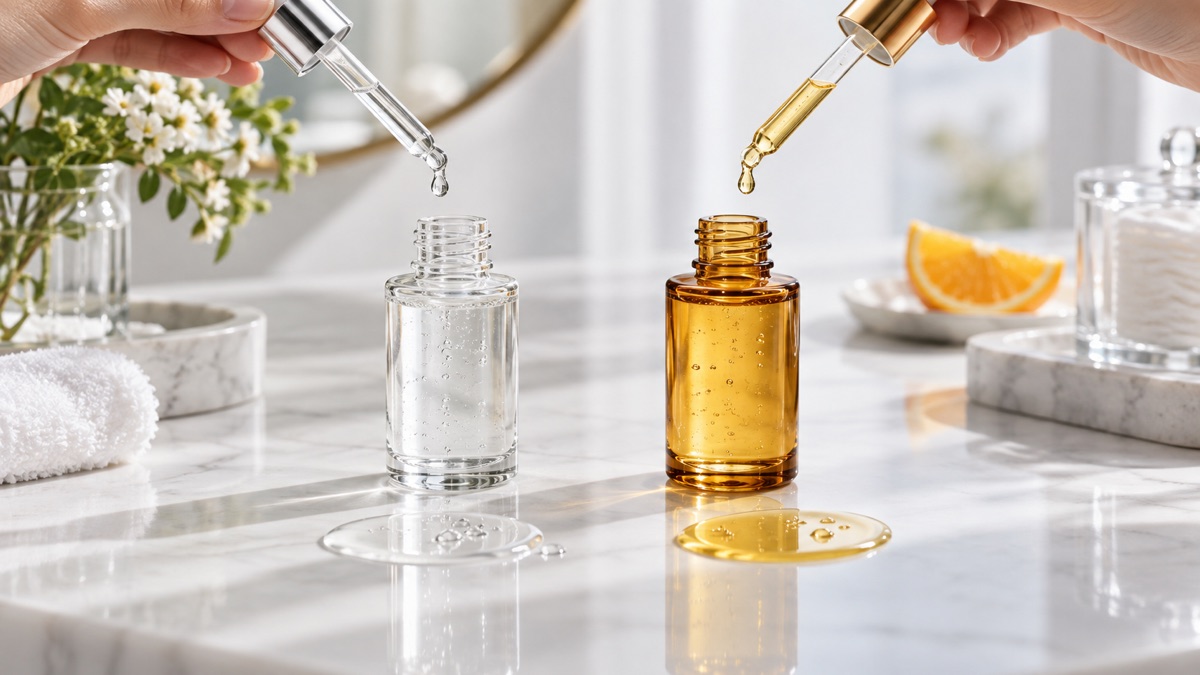
Search this comparison and you will mostly find the same two paragraphs: vitamin C brightens, niacinamide soothes, pick whichever suits you. That framing is not wrong, but it hides the thing that actually decides which one belongs in your routine — they interrupt different steps of the same process, and they have very different demands about how they are formulated.
The comparison that matters
The high-maintenance one
Vitamin C
- Best-evidenced job
- Antioxidant photoprotection, alongside sunscreen
- Effective form
- L-ascorbic acid, up to 20%
- Formulation demand
- Must be below pH 3.5 to penetrate at all
- Stability
- Poor — oxidizes in light, heat and air
- Tolerance
- Can sting; the low pH is the reason
- When to use
- Morning, before sunscreen
The easy one
Niacinamide
- Best-evidenced job
- Pigment and barrier support, with a mild side-effect profile
- Effective form
- Niacinamide, typically 2–5%
- Formulation demand
- Works across a normal skincare pH range
- Stability
- Excellent — it does not need special packaging
- Tolerance
- High; irritation usually means the percentage is too high
- When to use
- Morning or night, in almost anything
What each one is actually proven to do
Vitamin C's strongest evidence is not brightening
This surprises people. The most solid clinical result for topical vitamin C is photoprotection — reducing UV damage as an adjunct to sunscreen, not replacing it. In the study that defined the category, adding ferulic acid to a solution of 15% L-ascorbic acid and 1% alpha-tocopherol stabilized the vitamins and doubled photoprotection from roughly 4-fold to 8-fold, measured by both erythema and sunburn-cell formation.
Three consequences follow from those numbers, and they are the practical core of buying vitamin C:
- A vitamin C serum above pH 3.5 is decorative. This is why some products sting and others feel like nothing — and why the ones that feel like nothing often do nothing.
- Above 20% you are buying irritation, not benefit. Absorption peaked at 20% in Pinnell's work; the 30% serums are a marketing number.
- It is an adjunct to sunscreen, not an alternative. An 8-fold protective effect sounds enormous until you compare it with a correctly applied SPF 30. Use both; they work by different mechanisms.
Niacinamide's evidence is quieter and broader
Niacinamide reduces pigment by a different route: it interferes with the transfer of melanosomes from the melanocyte to the keratinocyte — the handoff, rather than the production.
The comparison worth knowing is a double-blind split-face trial in melasma, where 4% niacinamide was applied to one side of the face and 4% hydroquinone — long the reference treatment — to the other, for eight weeks. Colorimetric measurement found no statistically significant difference between the two sides, and side effects were reported less often on the niacinamide side.
It is a small, eight-week trial in one pigment condition, not proof that niacinamide equals hydroquinone in general. But it does establish something useful: on the strongest measure available, an over-the-counter ingredient with a mild side-effect profile held its own against the prescription-strength reference — which is not a claim most cosmetic actives can make.
Formulation is the real difference
If you only take one practical thing from this page, take this: niacinamide is nearly impossible to buy badly, and vitamin C is easy to buy badly.
| Vitamin C (L-ascorbic acid) | Niacinamide | |
|---|---|---|
| pH requirement | Below 3.5, or it does not penetrate | None in practice |
| Useful concentration | 10–20%; peaks at 20% | 2–5%; above 10% often irritates |
| Packaging | Opaque, airless, essential | Irrelevant |
| How it fails | Oxidizes — turns yellow, then brown, then orange | It mostly doesn't |
| Cost of getting it right | High — good formulation is expensive | Low — cheap versions work |
| If it stings | Expected at working pH | The percentage is too high; drop to 5% or less |
A fresh L-ascorbic acid serum is clear to pale straw. As it oxidizes it goes yellow, then amber, then orange-brown. Once it is properly orange it has lost most of its activity — it is not dangerous, just spent. This is the only skincare product where you can assess potency by looking at it, which is a genuinely useful thing to know.
Which one should you buy?
- You want one active and you want it to be easyNiacinamide 4–5%Stable, cheap, forgiving, and it layers with everything
- Your main concern is sun-related damage and preventionVitamin C, in the morningIts best-evidenced role is as an antioxidant partner to sunscreen
- Dark marks left behind after spots or melasmaBoth, plus rigorous sunscreenThey hit different steps, and neither works without sun protection
- Sensitive or reactive skinNiacinamideLow-pH vitamin C is a common source of stinging
- Oily skin, visible pores, uneven textureNiacinamideThis is the territory where it has the broadest reported benefits
- You have a budget of one product and it is smallNiacinamideCheap niacinamide works; cheap vitamin C frequently does not
Using both — and the myth that says you can't
You can use them together. The idea that niacinamide and vitamin C cancel each other out traces to old laboratory work where niacinamide converted to nicotinic acid — a flushing agent — under high heat and conditions a serum on a shelf does not reproduce. Modern formulas deliberately combine them. We covered this in more detail in the guide to skincare layering order.
If you want to keep them apart for your own reasons, the tidiest split is vitamin C in the morning — where its antioxidant effect pairs with sunscreen — and niacinamide at night, or simply in your moisturizer where it usually already is.
Do
- Buy vitamin C in opaque, airless packaging and finish it within a few months
- Treat niacinamide as an ingredient to have in a moisturizer, not a separate step
- Wear sunscreen — neither ingredient does much for pigment without it
- Give either one eight to twelve weeks before judging pigment results
- Check the ingredient list of what you already own; you may have both already
Don't
- Pay a premium for above 20% L-ascorbic acid, or above 10% niacinamide
- Keep using a vitamin C serum that has gone orange
- Expect either to fade pigment that is still being created by daily sun exposure
- Layer a low-pH vitamin C directly under an exfoliating acid — that is a lot of acid at once
- Assume a stinging product is a working product
Realistic timelines
The short version
Niacinamide is the sensible default: stable, inexpensive, well tolerated, and it works on the step where pigment gets delivered. Vitamin C is worth the extra care if you buy it properly — correct form, correct pH, opaque packaging, used in the morning as a partner to sunscreen, which is where its strongest evidence actually sits. Using both is rational rather than redundant. And neither of them can outrun a face that is not wearing sunscreen.
Frequently Asked Questions
-
Yes. The incompatibility story comes from old lab work in which niacinamide converted to nicotinic acid under high heat and specific conditions — not conditions a serum on your shelf reproduces. Plenty of modern formulas contain both deliberately. If a particular pairing stings on your face, that is that formula or the low pH of the vitamin C, not a chemical conflict.
-
No. Percutaneous absorption of L-ascorbic acid peaked at 20% in Pinnell's work, so anything above that adds irritation rather than benefit. A well-formulated 15% at the correct pH, in opaque airless packaging, will outperform a 30% serum in a clear dropper bottle that has been open for six months.
-
They solve the two problems L-ascorbic acid has — instability and the need for a low pH — which makes them far gentler and much easier to formulate. The trade-off is that the human evidence base behind them is thinner, and they must convert to ascorbic acid in skin to work. They are a reasonable choice if pure L-ascorbic acid stings or keeps oxidizing on you; they are not the version the landmark studies were run on.
-
Two to five percent covers the commonly cited benefits. Ten percent products exist and are popular, but higher is where reports of flushing and irritation cluster, and there is little evidence that it buys more. If a niacinamide product stings, the percentage is the first thing to reduce — that is unusual among actives, where people normally assume they need more.
-
Partly, slowly, and only with sunscreen. Both act on pigment, but neither can outpace fresh pigment being generated by daily UV exposure — which is why sun protection does more for hyperpigmentation than either ingredient. Expect three to six months for post-spot marks and longer for melasma, and treat anything promising faster than that as marketing.
-
It is not harmful, but it has largely lost its activity — oxidation is exactly what the color change indicates. Fresh L-ascorbic acid is clear to pale straw; yellow means it is on its way; orange-brown means it is finished. Buy smaller bottles, keep them closed, cool and dark, and use them within a few months of opening.