What Is Slugging? The Mechanism, the Myth, and Who Should Skip It
Sealing your face with petrolatum overnight cuts water loss by about 98% — roughly four times what other oil-based moisturizers manage. The risk was never that it suffocates your skin. It is what you trap underneath.
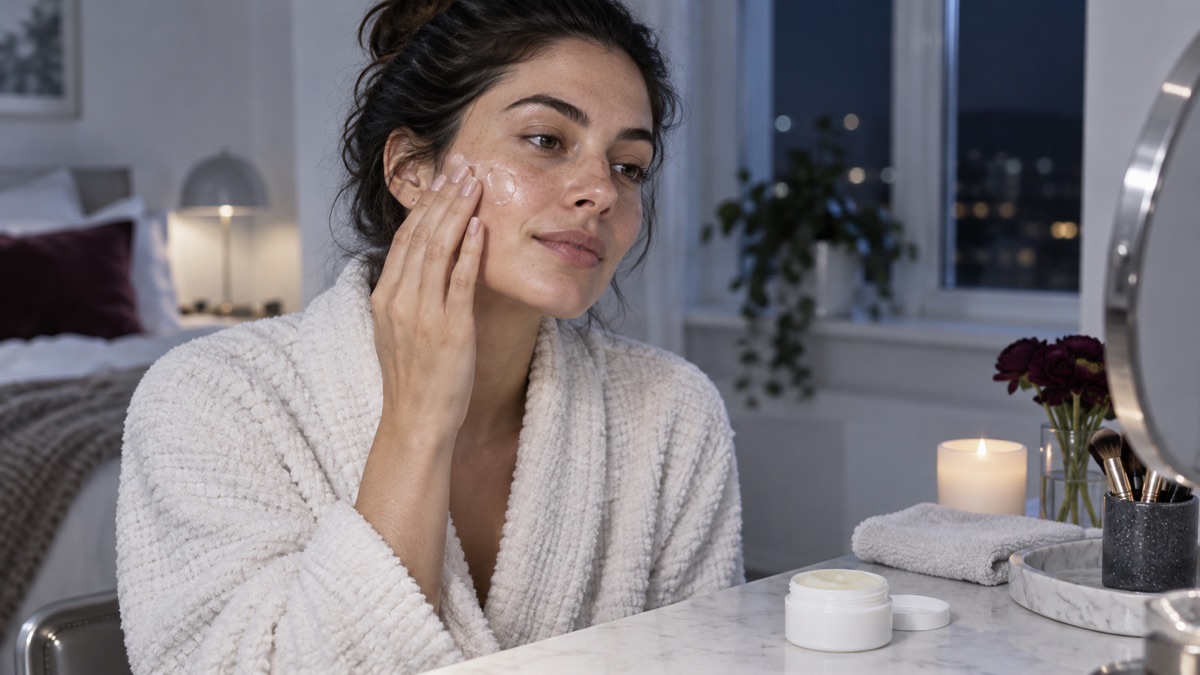
Slugging is applying a thin layer of an occlusive — usually plain petrolatum — as the last step of a night routine, so the skin is sealed while you sleep. The name is recent and came off social media; the practice is not, and the ingredient at the center of it is one of the most studied moisturizing agents there is.
It is also the skincare trend most often described with a wrong mental model, which is a shame, because the correct one explains exactly who it helps and who it wrecks.
The number that explains why it works
Occlusives are ranked by how much they reduce transepidermal water loss — water escaping through the skin surface. Petrolatum is not marginally better than the alternatives; it is in a different category.
That is the entire mechanism. Slugging does not add anything to your skin. It stops water leaving, which gives the barrier a humid environment to repair itself in — and a repairing barrier is what makes skin look plump and calm the next morning.
Skin does not respire through the surface in any meaningful way, and the foundational research is specific: petrolatum permeates the interstices of the stratum corneum rather than forming an impermeable membrane, and normal barrier recovery proceeds underneath it. The real risk of slugging is not suffocation. It is what you trap underneath.
Who this helps, and who it will punish
- Dry, tight, flaky skin — especially in winterIdeal candidateThis is the situation petrolatum was made for
- A barrier wrecked by over-exfoliating or a retinoid rampYes, as a repair toolPair it with the reset in how often to exfoliate
- Eczema-prone or very reactive skinYes — the short ingredient list is the pointPlain petrolatum has almost nothing in it to react to
- Oily or congestion-prone skinOccasionally, on dry patches onlyWhole-face slugging on oily skin frequently ends in closed comedones
- Active acneNot over the breakoutsYou will trap sebum and bacteria against inflamed skin all night
- Fungal acne / malassezia folliculitisNoOcclusion plus warmth is what that organism wants
- You use a prescription retinoidNot on top of itSee the warning below — this is the one that causes real damage
Never slug over an active. Occlusion drives whatever is underneath deeper and holds it against the skin for eight hours. Over a retinoid, an acid, or benzoyl peroxide, that turns a tolerable dose into a chemical burn. If you want both on the same night, the order is: active, wait until absorbed, moisturizer, and then decide whether petrolatum is still a good idea. On most nights it will not be.
How to do it
- Step 1Cleanse, and leave the skin slightly damp. Petrolatum seals in whatever is there; sealing in a little water is the point.
- Step 2Apply your humectants and moisturizer. Glycerin, hyaluronic acid, ceramides — the things that actually hydrate. Petrolatum on bare dry skin traps dryness.
- Step 3A thin layer of petrolatum on top. Thin. A pea-sized amount warmed between fingertips covers a face. If it looks glossy rather than greasy, that is enough.
- Step 4Skip the areas that do not need it. Nose, chin and anywhere that congests. Most people should be slugging cheeks and around the mouth, not the whole face.
- Step 5Protect your pillow, and wash in the morning. An old pillowcase, and a proper cleanse — not just water — in the morning.
- FrequencyTwo or three nights a week is plenty for most people; nightly only for genuinely dry or eczema-prone skin.
What to actually use
| Option | Best for | Notes |
|---|---|---|
| Plain petrolatum | The reference — dry skin, barrier repair | Cheapest and most studied. Nothing in it to react to. |
| Petrolatum-based ointment with ceramides | Anyone who wants one product instead of two | Slightly more elegant; more ingredients, so more suspects if you react |
| Squalane oil | Oily or congestion-prone skin | Far less occlusive — closer to the 20–30% group — but much lighter |
| Shea butter / heavy balm | Body, hands, feet | Fine below the neck; frequently too rich for a face |
| Coconut oil | Not the face | Comedogenic for many people; a common cause of "slugging broke me out" |
| Anything fragranced | No | Eight hours of sealed contact is the worst possible exposure for a fragrance allergy |
Slugging beyond the face
The least discussed and most reliable use. Hands after washing, heels, elbows, cuticles, and lips all respond to an occlusive far more predictably than a face does — no pores to congest, and the skin is thicker and drier to begin with. An overnight occlusive on cracked heels under cotton socks does more than most dedicated foot products.
Do
- Apply over a moisturizer, never onto bare dry skin
- Use a thin layer and skip the oily zones
- Start with two nights a week and judge after a month
- Use it on hands, lips and heels without hesitation
- Stop if you see small closed bumps appearing — that is congestion, and it compounds
Don't
- Slug over a retinoid, acid or benzoyl peroxide
- Slug over active breakouts or a fungal-acne flare
- Use a fragranced balm
- Apply a thick layer thinking more is better — it isn't, it just transfers to your pillow
- Expect it to do anything about wrinkles, pigment or pores; it hydrates and seals, nothing else
The short version
Slugging is a humidity tool, not a treatment. Petrolatum's ~98% reduction in water loss is real and unmatched, and the research says it does that by permeating the surface layer rather than smothering it. Applied over a moisturizer, on the right skin, a few nights a week, it is one of the cheapest genuinely effective things in skincare. Applied over an active, or on oily congested skin, it is one of the fastest ways to make your face worse.
Frequently Asked Questions
-
Petrolatum itself is generally considered non-comedogenic, but occlusion changes the local environment — it traps sebum, sweat and whatever you applied earlier against the skin for eight hours. On oily or congestion-prone skin that is frequently enough to produce closed bumps. The practical answer is to slug the areas that are dry and skip the ones that congest, rather than treating it as an all-or-nothing routine.
-
No — this is the single most important rule. Sealing an occlusive over a retinoid dramatically increases its effect and holds it against the skin all night, which turns a dose you tolerate into one you do not. If you want both, use the retinoid on its own nights and slug on your recovery nights. That is essentially what skin cycling already builds in.
-
An oil works, but it is doing a much weaker version of the same job — other oil-based moisturizers reduce water loss by 20–30% against petrolatum's ~98%. That is not automatically worse: on oily or acne-prone skin, something lighter like squalane is the sensible trade. But if your goal is repairing a genuinely damaged barrier, the heavy occlusive is the one with the evidence behind it.
-
Two or three nights a week suits most people, and it pairs naturally with recovery nights if you follow a cycle. Nightly makes sense for very dry or eczema-prone skin, or during a barrier reset. If you find yourself needing it every night to feel comfortable, the question worth asking is what is stripping your skin the rest of the time.
-
Not over active breakouts, and not at all if you have malassezia folliculitis — occlusion plus warmth favors exactly that organism. Where it can help acne-prone skin is indirectly: many people on drying acne treatments have a wrecked barrier, and a light occlusive on the dry areas, away from the lesions, makes the treatment tolerable. That is a targeted use, not a full-face routine.
-
Only in the sense that well-hydrated skin looks temporarily smoother — fine lines are more visible on dehydrated skin, and that improves overnight. There is no mechanism by which an occlusive changes collagen or pigment. If those are the goals, the ingredient with the evidence is a retinoid, and the point of slugging in that context is making the retinoid survivable rather than replacing it.