Skincare for Hormonal Acne: Read the Pattern Before You Treat It
Hormonal acne is a pattern, not a guess: breakouts along the jaw and lower face that track your cycle. 44% of women in one study reported premenstrual flares — and the pattern decides what works at home and when a prescription is faster.
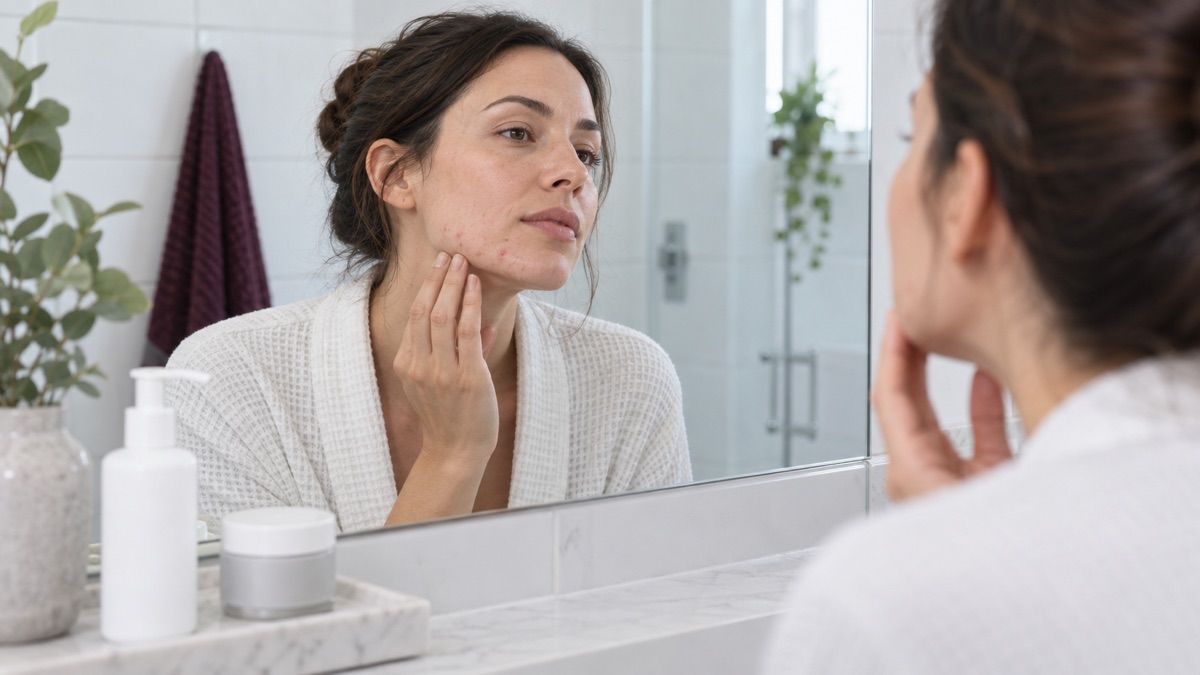
"Hormonal acne" is used online to mean almost any breakout in an adult, which makes it close to useless as a label. Dermatologists use it more narrowly, and the narrow version is the helpful one: it describes a pattern — where the breakouts sit and when they arrive — and that pattern changes both what will work at home and when a prescription is the faster route.
It is also far more common than people assume. The American Academy of Dermatology notes that adults can keep getting acne into their 30s, 40s and 50s, that women get adult acne more often than men, and that acne appearing for the first time in adulthood is most common among women going through menopause.
What drives it
The AAD lists the usual causes of adult acne, and hormones sit at the top — but not alone. Working through all of them matters, because treating a product problem as a hormone problem wastes months.
| Cause | What it looks like | What to check |
|---|---|---|
| Fluctuating hormones | Flares around your period, during pregnancy, perimenopause or menopause, or after starting or stopping birth control pills | Does it track your cycle or a life change? |
| Stress | Breakouts during sustained stressful stretches — stress raises androgens, which stimulate oil glands | Did it start with a hard few months? |
| Family history | A parent or sibling had adult acne | Useful context for how persistent it may be |
| Hair and skin products | Breakouts along the hairline, or wherever a heavy product sits | Every product should say non-comedogenic, non-acnegenic, oil-free, or won't clog pores |
| Medication side effect | Acne that began after a new prescription | Keep taking it; ask the prescriber whether acne is a known side effect |
| An underlying condition | Acne alongside irregular periods, excess hair growth or other symptoms | Worth a doctor's visit — treating the condition often clears the acne |
In the study behind the 44% figure, women older than 33 reported premenstrual flares at a higher rate than women aged 20 to 33 — and oral contraceptive use did not change the flare rate. So a cycle-linked pattern can strengthen with age rather than fade, and being on the pill does not by itself rule the pattern out.
What works at home
Mild acne — blackheads, whiteheads and small pimples — can often be treated effectively with over-the-counter products. The AAD's dermatologists name four active ingredients.
| Active | What it does best | How to start |
|---|---|---|
| Adapalene | A retinoid that clears blackheads, whiteheads and pimples — and helps prevent the next ones | Thin layer at night; expect dryness early. See retinol vs retinal for where it sits among retinoids. |
| Azelaic acid | Fights acne and fades the dark marks acne leaves behind | A good fit when post-acne marks bother you as much as the spots |
| Benzoyl peroxide | Especially effective on mild pimples | Start at 2.5%, not 10% — it avoids dryness, irritation and burning |
| Salicylic acid | Unclogs pores and exfoliates; best on whiteheads and blackheads | A cleanser is the gentlest entry point. See AHA vs BHA. |
Pick one product with one active, and use it for six to eight weeks before judging it. Don't add a second product during that window, and don't stop the first. Most people who conclude "nothing works" have tried six things for ten days each.
Apply it where the acne will be, not where it is
The AAD's advice is to apply a thin layer to the whole acne-prone area rather than dotting it on the spots you can see. Treating only visible spots treats what is already there; treating the whole area prevents the next breakout. For a hormonal pattern that means the entire lower face and jawline, even on a clear week.
The realistic timeline
Do
- Track breakouts against your cycle for two or three months — the pattern is your best evidence
- Check every product label for non-comedogenic or oil-free, including hair products and sunscreen
- Moisturize daily; acne actives are drying and irritated skin tolerates less
- Keep using the treatment through clear weeks
- Wear sunscreen — marks left by acne darken with sun
Don't
- Put toothpaste on a spot — the AAD is blunt that it contains nothing that fights acne and can irritate skin
- Start at 10% benzoyl peroxide
- Stack a retinoid, an acid and benzoyl peroxide in one routine
- Pick or squeeze deep, tender lesions — those are the ones that scar
- Treat acne yourself while pregnant or trying to conceive without checking with a dermatologist first
When it is a prescription problem
Deep, tender breakouts along the jaw and neck are frequently the kind over-the-counter products cannot reach. The AAD's position is that large, painful pimples sitting deep in the skin, or acne that scars, need a dermatologist — store-bought products are unlikely to treat them effectively. This is also where hormonal therapy comes in.
Hormonal therapy 1
Birth control pills
- Evidence
- Effective for blackheads, whiteheads, pimples, nodules and cysts — the FDA has approved some oral contraceptives specifically for acne
- Safety
- Generally considered safe, but not suitable for everyone
- Age note
- At 35 or older the pill may not be an option
Hormonal therapy 2
Spironolactone
- Evidence
- Treats deep-seated, tender acne on the lower face, jawline or neck when other treatments have not worked
- Who
- Women only — it is not prescribed for acne in men because of side effects
- Critical
- Birth control is essential while taking it: pregnancy on spironolactone risks serious birth defects
On outcomes, the AAD cites a review of the medical records of 85 women who took spironolactone alone:
- Deep, painful lumps along the jaw or neckSee a dermatologistThis type rarely responds to over-the-counter products
- Dark marks remain after spots clearSee a dermatologistPost-inflammatory hyperpigmentation signals significant inflammation, and is more common on darker skin tones
- Acne that leaves scarsSee a dermatologist nowScarring is permanent; waiting costs more than the appointment
- Weeks of one product used properly, no changeSee a dermatologistDermatologists often combine two or more treatments
- Irregular periods or new excess hair growth alongside acneSee a doctorAcne can be a sign of an underlying condition worth diagnosing
- Mild, cycle-linked breakouts and nothing elseOne OTC active, 6–8 weeksAdapalene or azelaic acid across the whole lower face
The AAD's closing line on adult acne is worth holding onto: with a dermatologist's help and some patience, virtually every case of acne can be controlled. Adult hormonal acne is persistent, not untreatable.
Related reading
- Skincare for menopausal skin — adult-onset acne is most common during menopause, and teenage acne treatments are often too harsh for it
- Skincare for teens — the same hormones, at the other end of life
- Pregnancy-safe skincare — which acne actives are off the table
Frequently Asked Questions
-
Look at two things together for two or three months: location and timing. Breakouts concentrated on the jawline, chin, lower face and neck, that reliably worsen in the week or so before your period, are the pattern dermatologists treat as hormonal. Location alone is not proof, and neither is timing alone. If you also have irregular periods or new excess hair growth, see a doctor — acne can be a sign of an underlying condition.
-
Often, yes — especially when it is mild. Adapalene, azelaic acid, benzoyl peroxide and salicylic acid are all effective over-the-counter options for blackheads, whiteheads and small pimples. Hormonal therapy is the tool for the deep, tender, persistent kind that topical products cannot reach. The two approaches are not either/or; dermatologists often combine topical and hormonal treatments.
-
It can be. In the menstrual-cycle study behind the 44% figure, women over 33 reported premenstrual flares at a higher rate than women aged 20 to 33. And the AAD notes that adult-onset acne is most common in women going through menopause, when shifting hormone levels can bring back teenage-like breakouts on skin that is now thinner and drier.
-
The AAD's list of adult acne causes centers on hormone fluctuations, stress, family history, products, medications and underlying conditions. Diet is a debated contributor for some people, but it is not the lever to pull first. Establishing one effective topical treatment and tracking your cycle will tell you far more, far sooner, than an elimination diet.
-
The AAD describes it as generally considered safe for healthy women, and it has been prescribed for acne for many years. The critical caveat: you must use birth control while taking it, because pregnancy on spironolactone can cause serious birth defects. It is not prescribed for acne in men. Whether it suits you is a conversation with a dermatologist who knows your medical history.
-
Treat the whole acne-prone area. The AAD's dermatologists explain that applying medication only to visible spots treats the acne that is already there, while a thin layer across the area also prevents the next breakout. For a hormonal pattern, that means the entire jawline and lower face — including on the weeks you are clear.